
7 Exact finite and countable packet coordinates
On this page · Permalink · Source line 1
Reader roadmap
Packets give exact coordinates through idempotent maps. For finitely many packets, the reconstruction is algebraic. For countably many packets, we must also specify how the series converges and bound the coordinate maps. We begin with finite reconstruction, then consider packet support, tensor products, duality, and the universal mapping property before turning to convergence.
7.1 Finite exact packets
On this page · Permalink · Source line 8
Definition 7.1: Finite packet system
A finite packet system on a vector space \(X\) over \({\Bbbk}\) is a family
satisfying
Set \(X_\alpha=P_\alpha X\). Zero packet spaces may be removed without changing any identity. No orthogonality is assumed unless stated.
Visual guide: An atlas of the objects · Permalink · Source line 10 · Claim record · Lean coverage · Code · Worked examples
Definition 7.2: Packet support and packet pure vectors
For a finite packet system \({\mathcal P}=(P_\alpha)_{\alpha\in I}\) and \(x\in X\), define
The vector \(x\) is packet pure if \(|{\operatorname{Supp}}_{{\mathcal P}}(x)|\leq1\). A finite family is packet pure if each of its members is packet pure, although different members may lie in different packets.
Permalink · Source line 28 · Claim record · Lean coverage · Code · Worked examples
How to read the result
Packet support records which packet coordinates are present. A seed may lie in one packet, have coordinates in several packets, or be zero. Later, when we count the seeds needed for generation, this distinction matters because a seed with several nonzero coordinates can meet several graph sources at once.
Lemma 7.3: Finite packet aggregation
Let \(\sigma:I\twoheadrightarrow J\) be a surjection and define
Then \((Q_j)_{j\in J}\) is a finite packet system and
Read proof · Read statement and proof side by side · Permalink · Source line 45 · Claim record · Lean coverage · Code · Worked examples
Proof of Lemma 7.3
Pairwise annihilation of the \(P_\alpha\) gives
Summing over \(j\) recovers \(\sum_\alpha P_\alpha=I\). The range statement follows from the directness forced by pairwise annihilation.
Back to statement · Read statement and proof side by side · Permalink · Source line 59 · Claim record · Lean coverage · Code · Worked examples
Definition 7.4: Packet analysis and synthesis
For a finite packet system, define
and
Permalink · Source line 69 · Claim record · Lean coverage · Code · Worked examples
Theorem 7.5: Exact packet coordinate isomorphism
For every finite packet system,
Hence
Read proof · Visual guide: What can one seed actually do? · Visual guide: Exact does not mean orthogonal · Read statement and proof side by side · Permalink · Source line 86 · Claim record · Lean coverage · Code · Worked examples
Proof of Theorem 7.5
For \(x\in X\),
If \(x_\alpha\in X_\alpha\), then \(P_\beta x_\alpha=\delta_{\alpha\beta}x_\alpha\), so
Thus analysis and synthesis are inverse linear maps.
Back to statement · Read statement and proof side by side · Permalink · Source line 105 · Claim record · Lean coverage · Code · Worked examples
The central idea
Analysis records every packet coordinate and synthesis adds them back. The theorem gives an exact change of coordinates. Its proof uses the idempotent identities and does not require orthogonality. Questions about norms, energy, and conditioning require further structure.
Corollary 7.6: Packetwise equality
For \(x,y\in X\),
Read proof · Read statement and proof side by side · Permalink · Source line 128 · Claim record · Lean coverage · Code · Worked examples
Proof of Corollary 7.6
The forward implication is immediate. For the reverse implication, sum the packet equalities and use \(\sum_\alpha P_\alpha=I\).
Back to statement · Read statement and proof side by side · Permalink · Source line 140 · Claim record · Lean coverage · Code · Worked examples
Corollary 7.7: Universal mapping property of finite packet coordinates
Let \({\mathcal P}=(P_\alpha)_{\alpha\in I}\) be a finite packet system on \(X\), and let \(Y\) be a vector space over \({\Bbbk}\).
Every family of linear maps \(f_\alpha:X_\alpha\to Y\) determines a unique linear map \(f:X\to Y\) with \(f|_{X_\alpha}=f_\alpha\), namely
\[ f=\sum_\alpha f_\alpha P_\alpha. \]Every family of linear maps \(g_\alpha:Y\to X_\alpha\) determines a unique linear map \(g:Y\to X\) with \(P_\alpha g=g_\alpha\), namely
\[ g=\sum_\alpha g_\alpha. \]
Equivalently,
where the products are finite.
Read proof · Read statement and proof side by side · Permalink · Source line 146 · Claim record · Lean coverage · Code · Worked examples
Proof of Corollary 7.7
For \(x=\sum_\alpha P_\alpha x\), any extension of the \(f_\alpha\) must satisfy
which proves both existence and uniqueness of the first formula. For the second, the sum \(g=\sum_\alpha g_\alpha\) satisfies
because \(g_\alpha(Y)\subseteq X_\alpha\). Uniqueness follows from \(\sum_\alpha P_\alpha=I\).
Back to statement · Read statement and proof side by side · Permalink · Source line 171 · Claim record · Lean coverage · Code · Worked examples
7.2 Tensor products and dual packets
On this page · Permalink · Source line 186
Theorem 7.8: Tensor product packet systems
Let \({\mathcal P}=(P_\alpha)_{\alpha\in I}\) be a finite packet system on \(X\), and let \({\mathcal Q}=(Q_\gamma)_{\gamma\in J}\) be a finite packet system on \(Y\). Then
is a finite packet system on the algebraic tensor product \(X\otimes_{{\Bbbk}}Y\), with packet spaces
Hence
Read proof · Read statement and proof side by side · Permalink · Source line 188 · Claim record · Lean coverage · Code · Worked examples
Proof of Theorem 7.8
For every pair of packet indices,
If \((\alpha,\gamma)\neq(\beta,\delta)\), then either \(P_\alpha P_\beta=0\) or \(Q_\gamma Q_\delta=0\), so the corresponding tensor idempotents annihilate each other. Finally,
The range is generated by pure tensors \(P_\alpha x\otimes Q_\gamma y\), hence equals \(X_\alpha\otimes Y_\gamma\). Exact reconstruction follows from Theorem 7.5.
Back to statement · Read statement and proof side by side · Permalink · Source line 215 · Claim record · Lean coverage · Code · Worked examples
Proposition 7.9: Dual packet systems
Let \(X\) be finite dimensional and let \({\mathcal P}=(P_\alpha)\) be a finite packet system. The algebraic dual maps
form a finite packet system on \(X^*\). Its packet with index \(\alpha\) is canonically isomorphic to \(X_\alpha^*\), and
Read proof · Read statement and proof side by side · Permalink · Source line 234 · Claim record · Lean coverage · Code · Worked examples
Proof of Proposition 7.9
Because dualization reverses products,
Also \(\sum_\alpha P_\alpha^*=I_{X^*}\). Thus the dual maps form a packet system. Restriction gives a map from \(P_\alpha^*X^*\) to \(X_\alpha^*\). It is injective because a covector in the range of \(P_\alpha^*\) vanishes on every other packet, and it is surjective because any covector on \(X_\alpha\) extends to \(X\) through the direct sum decomposition.
Back to statement · Read statement and proof side by side · Permalink · Source line 251 · Claim record · Lean coverage · Code · Worked examples
Tensoring the oblique packet split
Tensor the two oblique packets in Running Example R3 with the coordinate packets of \({\Bbbk}^3\). The result has six exact packets. No orthogonality is created by tensoring, but the analysis and synthesis identities remain exact because they are idempotent identities.
7.3 Banach stability and coordinate conditioning
On this page · Permalink · Source line 264
Exact reconstruction answers whether the coordinates retain the whole vector. Stability asks how errors in those coordinates affect the reconstructed vector. A finite packet system answers the first question through its idempotent identities. On a Banach space, boundedness of analysis and synthesis answers the second. The chosen norm on the coordinate space matters, so we fix it before comparing operator sizes.
Theorem 7.10: Finite Banach packet isomorphism
Let \(X\) be Banach and let \((P_\alpha)_{\alpha\in I}\) be a finite family of bounded pairwise annihilating idempotents with sum \(I_X\). Then every range \(X_\alpha=P_\alpha X\) is closed. For any finite product norm equivalent to the maximum norm on \(\bigoplus_\alpha X_\alpha\), packet analysis and synthesis are bounded inverse operators.
Read proof · Visual guide: Residue packets retain an address carry · Read statement and proof side by side · Permalink · Source line 267 · Claim record · Lean coverage · Code · Worked examples
Proof of Theorem 7.10
The range of a bounded idempotent is its space of fixed points,
which is closed. Because \(I\) is finite, analysis and synthesis are bounded for the maximum and sum norms, respectively, and therefore for every equivalent finite product norm. Their inverse identities are algebraic and were proved in Theorem 7.5.
Back to statement · Read statement and proof side by side · Permalink · Source line 274 · Claim record · Lean coverage · Code · Worked examples
Definition 7.11: Packet coordinate condition number
Fix a finite product norm on \(\bigoplus_\alpha X_\alpha\) equivalent to the maximum norm, as in Theorem 7.10. Define
Permalink · Source line 282 · Claim record · Lean coverage · Code · Worked examples
Proposition 7.12: Conditioned coordinate transport
For a finite Banach packet system with \(X\ne0\),
If \(T\in\mathcal B(X)\) and
then
Read proof · Read statement and proof side by side · Permalink · Source line 293 · Claim record · Lean coverage · Code · Worked examples
Proof of Proposition 7.12
Since \(I=\mathcal S_{{\mathcal P}}\mathcal A_{{\mathcal P}}\),
The first displayed estimate follows from submultiplicativity. The inverse identity
gives the second estimate.
Back to statement · Read statement and proof side by side · Permalink · Source line 317 · Claim record · Lean coverage · Code · Worked examples
How to read the result
The quantity \(\kappa({\mathcal P})\) measures how strongly the chosen packet coordinates can amplify perturbations. An orthogonal Hilbert decomposition has the best possible behavior in the natural \(\ell^2\) sum norm. An oblique packet system can reconstruct every vector exactly and still have a large condition number.
Corollary 7.13: Completion preserves a finite packet split
Let \(M\) be a dense normed subspace of a Banach space \(X\). Suppose every bounded \(P_\alpha\) leaves \(M\) invariant and the restricted projectors form a packet system on \(M\). Then
and the packet decomposition of \(M\) extends uniquely to the completion \(X\).
Read proof · Read statement and proof side by side · Permalink · Source line 334 · Claim record · Lean coverage · Code · Worked examples
Proof of Corollary 7.13
For \(x\in X\), choose \(m_n\in M\) with \(m_n\to x\). Continuity gives \(P_\alpha m_n\to P_\alpha x\), so \(P_\alpha X\subseteq{\overline{P_\alpha M}}\). The reverse inclusion follows because \(P_\alpha X\) is closed and contains \(P_\alpha M\). The bounded extensions remain pairwise annihilating idempotents whose finite sum is the identity.
Back to statement · Read statement and proof side by side · Permalink · Source line 345 · Claim record · Lean coverage · Code · Worked examples
7.4 Countable packets and unconditional convergence
On this page · Permalink · Source line 349
For a finite family, synthesis adds a fixed number of coordinates. For a countable family, it must also take a limit. The algebraic idempotent identities still separate the coordinates, but they do not by themselves guarantee that the sum converges. The next definition includes unconditional convergence in the coordinate space itself, so synthesis is defined on precisely the sequences whose packet sums can be assembled in this way.
Definition 7.14: Unconditional packet sum space
Let \((X_n)_{n\geq1}\) be closed subspaces of a real or complex Banach space \(X\). Define
to be the space of sequences \(x=(x_n)\) with \(x_n\in X_n\) for which \(\sum_nx_n\) converges unconditionally in \(X\). Equip it with
Permalink · Source line 352 · Claim record · Lean coverage · Code · Worked examples
Lemma 7.15: Completeness of the unconditional packet sum
The normed space \(\bigoplus_{n\geq1}^{u}X_n\) in Definition 7.14 is Banach.
Read proof · Read statement and proof side by side · Permalink · Source line 369 · Claim record · Lean coverage · Code · Worked examples
Proof of Lemma 7.15
Let \(x^{(k)}=(x_n^{(k)})\) be Cauchy in \(\|\cdot\|_u\). For every fixed \(n\),
so \(x_n^{(k)}\) converges to some \(x_n\in X_n\) because \(X_n\) is closed. Given \(\varepsilon>0\), choose \(k_0\) such that
For finite \(F\) and \(|a_n|\leq1\), pass \(\ell\to\infty\) in the finite sum to obtain
Hence \(\|x^{(k)}-x\|_u\leq\varepsilon\) once \(x\) is known to be unconditionally summable.
Choose such a \(k\geq k_0\). Since \(x^{(k)}\) is unconditionally summable, there is a finite \(F_0\) such that every finite \(F\subseteq\mathbb N\setminus F_0\) and every \(|a_n|\leq1\) satisfy
The preceding uniform estimate then gives
Thus the tails of \(\sum_nx_n\) are uniformly small under bounded scalar changes, which is the unconditional Cauchy criterion. Therefore \(x\in\bigoplus^uX_n\), and the earlier estimate proves \(x^{(k)}\to x\) in \(\|\cdot\|_u\).
Back to statement · Read statement and proof side by side · Permalink · Source line 376 · Claim record · Lean coverage · Code · Worked examples
Theorem 7.16: Countable unconditional packet isomorphism
Let \(X\) be a real or complex Banach space and let \((P_n)_{n\geq1}\subseteq\mathcal B(X)\) satisfy
and
unconditionally for every \(x\in X\). Assume
Then analysis and synthesis define inverse Banach space isomorphisms
More precisely,
Read proof · Read statement and proof side by side · Permalink · Source line 407 · Claim record · Lean coverage · Code · Worked examples
Proof of Theorem 7.16
Each \(P_nX={\operatorname{Ker}}(I-P_n)\) is closed. For \(x\in X\),
For \(y=(y_n)\in\bigoplus^uP_nX\), define
Since the finite partial sums with every coefficient equal to one are among those used in \(\|y\|_u\),
The assumed expansion gives \(\mathcal S_{{\mathcal P}}\mathcal A_{{\mathcal P}}x=x\). Conversely, boundedness of \(P_m\) permits termwise application to the unconditionally convergent series:
Thus \(\mathcal A_{{\mathcal P}}\mathcal S_{{\mathcal P}}=I\). Completeness of the coordinate space is Lemma 7.15.
Back to statement · Read statement and proof side by side · Permalink · Source line 441 · Claim record · Lean coverage · Code · Worked examples
Remark 7.17: Uniform boundedness
If every expansion \(\sum_nP_nx\) is unconditional, the operators obtained from finite partial sums with signs form a pointwise bounded family. The uniform boundedness principle therefore yields a finite constant \(K\). We retain this constant explicitly in Theorem 7.16 because later estimates use it to bound the coordinate map.
Permalink · Source line 469 · Claim record · Lean coverage · Code · Worked examples
Boundary 7.18: Infinite packet sums
For an infinite family, an identity such as \(\sum_\alpha P_\alpha=I\) requires a declared convergence mode and the corresponding uniform boundedness statement. Pointwise, strong, norm, weak, and unconditional convergence are not interchangeable.
Permalink · Source line 475 · Claim record · Lean coverage · Code · Worked examples
Section recap
Finite packet systems give exact coordinates in a direct sum, with no orthogonality requirement. Their universal property assembles arbitrary packetwise linear maps uniquely. Tensor products and duals preserve packet structure. In Banach spaces, the analysis and synthesis norms control conditioning. The countable theory developed here uses unconditional convergence and a uniform bound on finite partial sums with signs.
8 Transfer block algebra and support patterns
On this page · Permalink · Source line 486
Reader roadmap
Once vectors are resolved into packets, every operator becomes a matrix of maps between packet spaces. To multiply operators, we sum over the possible intermediate packets. The blocks permitted to be nonzero define a relation on the packet indices. When that relation is a preorder, the resulting algebra has a triangular structure and a nilpotent ideal of strict transfers.
8.1 Exact operator coordinates
On this page · Permalink · Source line 490
Definition 8.1: Transfer block
For \(T\in{\operatorname{End}}_{{\Bbbk}}(X)\) and a finite packet system \({\mathcal P}\), define
Visual guide: An atlas of the objects · Permalink · Source line 492 · Claim record · Lean coverage · Code · Worked examples
Theorem 8.2: Exact operator reconstruction
Every \(T\in{\operatorname{End}}_{{\Bbbk}}(X)\) satisfies
Read proof · Visual guide: A transfer block has an input and an output · Read statement and proof side by side · Permalink · Source line 502 · Claim record · Lean coverage · Code · Worked examples
Proof of Theorem 8.2
Insert the finite packet identity on both sides:
Back to statement · Read statement and proof side by side · Permalink · Source line 512 · Claim record · Lean coverage · Code · Worked examples
How to read the result
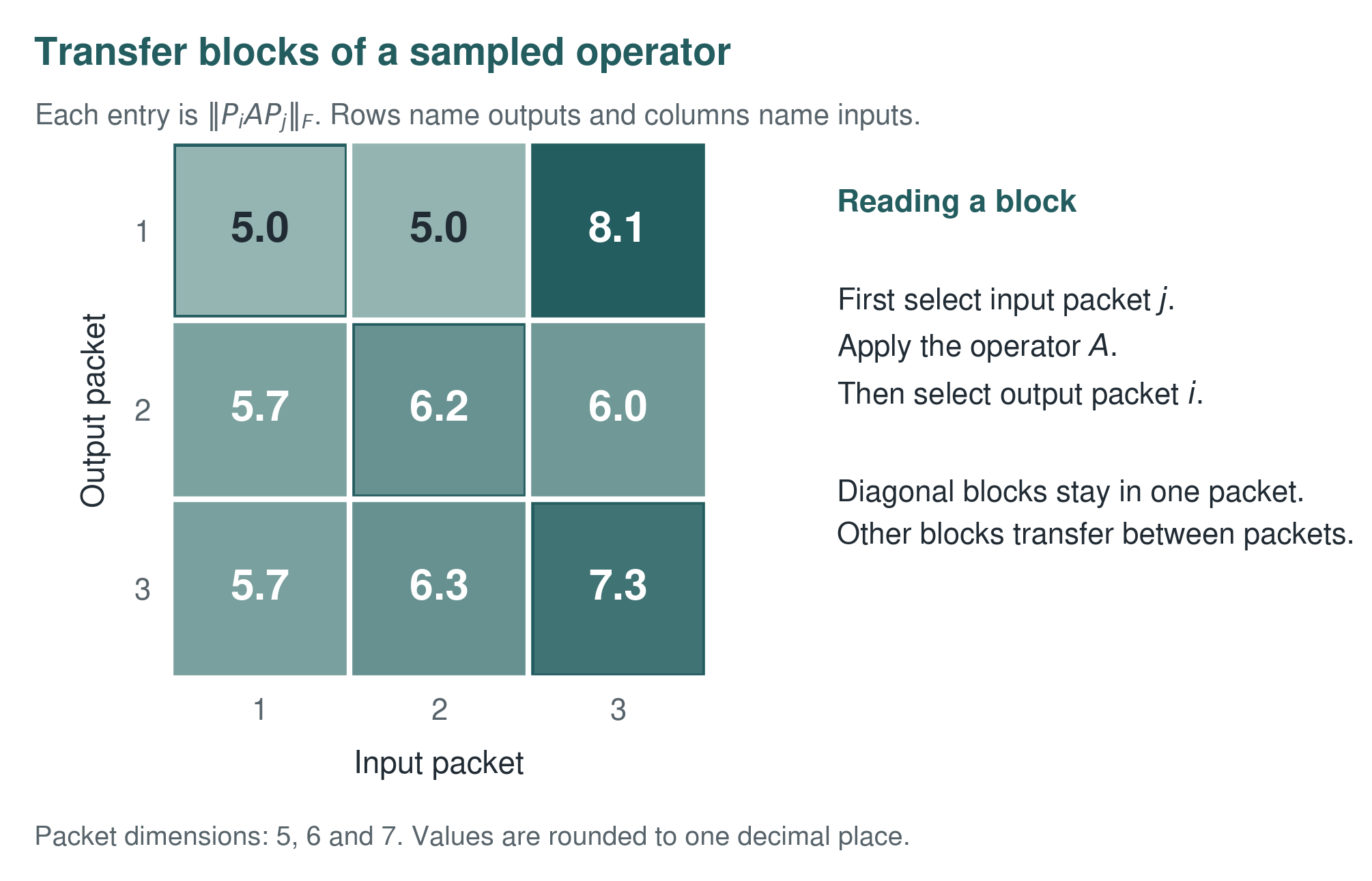
Operator reconstruction inserts the identity on both sides of \(T\). The source index \(\alpha\) records where a vector begins, and the target index \(\beta\) records where its image lands. The resulting matrix is exact, and each entry is itself a linear map.
Theorem 8.3: Packet matrix multiplication
For \(S,T\in{\operatorname{End}}_{{\Bbbk}}(X)\),
Read proof · Visual guide: A transfer block has an input and an output · Read statement and proof side by side · Permalink · Source line 529 · Claim record · Lean coverage · Code · Worked examples
Proof of Theorem 8.3
Insert \(I=\sum_\beta P_\beta\) between \(S\) and \(T\):
Back to statement · Read statement and proof side by side · Permalink · Source line 544 · Claim record · Lean coverage · Code · Worked examples
The central idea
The intermediate packet index in block multiplication plays the role of a summed matrix index. Repeated multiplication therefore becomes a sum over packet paths. Paper II adds weights and filtrations to this path expansion. Paper III adds nonlinear trees.
Corollary 8.4: Packet powers and paths
For \(m\geq1\),
The same formula holds for a product of nonidentical operators with the corresponding blocks in temporal order.
Read proof · Visual guide: A transfer block has an input and an output · Visual guide: Two visible routes can cancel exactly · Read statement and proof side by side · Permalink · Source line 559 · Claim record · Lean coverage · Code · Worked examples
Proof of Corollary 8.4
Induct on \(m\) using Theorem 8.3. For a product of different operators, use the same induction with the specified operator at each step.
Back to statement · Read statement and proof side by side · Permalink · Source line 575 · Claim record · Lean coverage · Code · Worked examples
Corollary 8.5: Adjoint reversal
If \(X\) is Hilbert, every \(P_\alpha\) is orthogonal, and \(T\in\mathcal B(X)\), then
Read proof · Visual guide: Exact does not mean orthogonal · Read statement and proof side by side · Permalink · Source line 579 · Claim record · Lean coverage · Code · Worked examples
Proof of Corollary 8.5
Because \(P_\alpha^*=P_\alpha\),
Back to statement · Read statement and proof side by side · Permalink · Source line 589 · Claim record · Lean coverage · Code · Worked examples
8.2 The full block algebra and intertwining equations
On this page · Permalink · Source line 596
Corollary 8.6: Tensor product transfer blocks
Let \(S\in{\operatorname{End}}(X)\) and \(T\in{\operatorname{End}}(Y)\), with packet systems \({\mathcal P}\) and \({\mathcal Q}\). Relative to the tensor product packet system of Theorem 7.8,
Read proof · Read statement and proof side by side · Permalink · Source line 598 · Claim record · Lean coverage · Code · Worked examples
Proof of Corollary 8.6
By definition,
Back to statement · Read statement and proof side by side · Permalink · Source line 613 · Claim record · Lean coverage · Code · Worked examples
Theorem 8.7: Blockwise intertwining equations
Let \(T\in{\operatorname{End}}(X)\), \(S\in{\operatorname{End}}(Y)\), let \({\mathcal P}=(P_\alpha)_{\alpha\in I}\) and \({\mathcal Q}=(Q_\gamma)_{\gamma\in J}\) be finite packet systems, and let \(U:X\to Y\) be linear. Define
Then
if and only if, for every \(\gamma\in J\) and \(\alpha\in I\),
Read proof · Read statement and proof side by side · Permalink · Source line 623 · Claim record · Lean coverage · Code · Worked examples
Proof of Theorem 8.7
Apply \(Q_\gamma\) on the left and \(P_\alpha\) on the right. Inserting \(I_X=\sum_\beta P_\beta\) gives
Inserting \(I_Y=\sum_\delta Q_\delta\) gives
Thus \(UT=SU\) implies every block equation. Conversely, if every block equation holds, then all blocks of \(UT-SU\) vanish. Exact operator reconstruction yields \(UT-SU=0\).
Back to statement · Read statement and proof side by side · Permalink · Source line 650 · Claim record · Lean coverage · Code · Worked examples
How to read the result
A global intertwiner is equivalent to a coupled finite system of packet equations. Later arguments about holonomy and representations use this theorem after the local blocks have been constructed. The equations state the exact compatibility those blocks must satisfy.
Theorem 8.8: Full block algebra representation
The map
is an algebra isomorphism when the codomain is equipped with matrix multiplication whose entries are operators.
Read proof · Read statement and proof side by side · Permalink · Source line 675 · Claim record · Lean coverage · Code · Worked examples
Proof of Theorem 8.8
Injectivity follows from exact reconstruction. Given arbitrary linear maps \(B_{\beta\alpha}:X_\alpha\to X_\beta\), define
The packet decomposition is unique and the index set is finite, so this defines a linear operator whose blocks are the prescribed maps. Thus \(\Theta_{{\mathcal P}}\) is surjective. Compatibility with multiplication is Theorem 8.3.
Back to statement · Read statement and proof side by side · Permalink · Source line 691 · Claim record · Lean coverage · Code · Worked examples
Corollary 8.9: Propagation of packet support
Let \(T\in{\operatorname{End}}(X)\) and \(x\in X\). Then
Equality holds whenever, for every target \(\beta\) in the set on the right, the active contributions
have nonzero sum. In particular, equality holds if at most one active source packet feeds each such \(\beta\) and that source coordinate does not lie in the kernel of the corresponding block.
Read proof · Read statement and proof side by side · Permalink · Source line 703 · Claim record · Lean coverage · Code · Worked examples
Proof of Corollary 8.9
For every target packet \(\beta\),
If every block in this sum is zero, then the coordinate with index \(\beta\) vanishes. This proves the inclusion. Equality is exactly the assertion that the displayed active sum is nonzero for every target in the set on the right. The final sufficient condition leaves at most one nonzero summand at each target, and kernel avoidance makes that summand nonzero.
Back to statement · Read statement and proof side by side · Permalink · Source line 725 · Claim record · Lean coverage · Code · Worked examples
Corollary 8.10: Dimension count
If \(X\) is finite dimensional and \(d_\alpha=\dim X_\alpha\), then
Read proof · Read statement and proof side by side · Permalink · Source line 736 · Claim record · Lean coverage · Code · Worked examples
Proof of Corollary 8.10
Take dimensions in the block algebra isomorphism and use \(\dim{\operatorname{Hom}}(X_\alpha,X_\beta)=d_\alpha d_\beta\).
Back to statement · Read statement and proof side by side · Permalink · Source line 750 · Claim record · Lean coverage · Code · Worked examples
Proposition 8.11: Block diagonal projection and packet commutant
Define
Then \(\Delta_{{\mathcal P}}\) is a linear idempotent on \({\operatorname{End}}(X)\) whose range is the block diagonal subalgebra. For \(T\in{\operatorname{End}}(X)\), the following are equivalent:
\(TP_\alpha=P_\alpha T\) for every \(\alpha\).
\(T_{\beta\alpha}=0\) whenever \(\beta\neq\alpha\).
\(\Delta_{{\mathcal P}}(T)=T\).
Read proof · Read statement and proof side by side · Permalink · Source line 754 · Claim record · Lean coverage · Code · Worked examples
Proof of Proposition 8.11
Pairwise annihilation gives \(\Delta_{{\mathcal P}}^2=\Delta_{{\mathcal P}}\) and identifies its range with diagonal block families. If \(T\) commutes with all \(P_\alpha\), then for \(\beta\neq\alpha\),
Thus (i) implies (ii). Exact reconstruction shows (ii) implies (iii). If \(T=\sum_\alpha P_\alpha TP_\alpha\), then
so (iii) implies (i).
Back to statement · Read statement and proof side by side · Permalink · Source line 771 · Claim record · Lean coverage · Code · Worked examples
Lower triangular support
Take three packets of dimension one. Permit the diagonal blocks and transfers from a source with a lower index to a target with a higher index. The support relation is a total preorder. The blocks outside the diagonal form a nilpotent ideal, and every product of three strict transfers vanishes. This finite algebraic example anticipates the weighted triangular inverses developed in Paper II.
8.3 Support patterns, preorders, and triangular structure
On this page · Permalink · Source line 788
Definition 8.12: Support relation and support space
For a relation \(R\subseteq I\times I\), with \((\beta,\alpha)\) interpreted as an allowed transfer \(\alpha\to\beta\), define
Permalink · Source line 789 · Claim record · Lean coverage · Code · Worked examples
Theorem 8.13: Support pattern algebra criterion
Assume \(X_\alpha\neq0\) for every \(\alpha\in I\). Then:
\(I_X\in\mathfrak M_R\) if and only if \(R\) is reflexive.
\(\mathfrak M_R\mathfrak M_R\subseteq\mathfrak M_R\) if and only if \(R\) is transitive.
\(\mathfrak M_R\) is a unital subalgebra if and only if \(R\) is a preorder.
Read proof · Visual guide: Which zero patterns survive multiplication? · Read statement and proof side by side · Permalink · Source line 800 · Claim record · Lean coverage · Code · Worked examples
Proof of Theorem 8.13
The identity has diagonal blocks \(I_{X_\alpha}\) and no blocks outside the diagonal, so it belongs to \(\mathfrak M_R\) exactly when \((\alpha,\alpha)\in R\) for every \(\alpha\).
Assume \(R\) is transitive. If a summand
in the \((\gamma,\alpha)\) block of \(ST\) is nonzero, then \((\gamma,\beta)\) and \((\beta,\alpha)\) lie in \(R\). Transitivity gives \((\gamma,\alpha)\in R\), so every forbidden block of \(ST\) vanishes.
Conversely, suppose transitivity fails. Choose \(\alpha,\beta,\gamma\) with
Choose nonzero vectors \(u\in X_\alpha\), \(v\in X_\beta\), and \(w\in X_\gamma\). Choose linear functionals \(f\in X_\alpha^*\) and \(g\in X_\beta^*\) with \(f(u)=g(v)=1\). Let \(T\) have the sole block \(x\mapsto f(x)v\) from \(X_\alpha\) to \(X_\beta\), and let \(S\) have the sole block \(y\mapsto g(y)w\) from \(X_\beta\) to \(X_\gamma\). Then \(S,T\in\mathfrak M_R\), but \(ST\) has a nonzero forbidden \((\gamma,\alpha)\) block. This proves necessity. Combining reflexivity and transitivity gives (iii).
Back to statement · Read statement and proof side by side · Permalink · Source line 812 · Claim record · Lean coverage · Code · Worked examples
Corollary 8.14: Bounded support patterns closed under \(*\)
Let \(X\) be Hilbert, let the packet projectors be orthogonal, assume \(X_\alpha\neq0\) for every \(\alpha\in I\), and put
Then \(\mathfrak M_R^{\mathrm b}\) is closed under adjoints if and only if \(R\) is symmetric. Hence \(\mathfrak M_R^{\mathrm b}\) is a unital \(*\) subalgebra of \(\mathcal B(X)\) if and only if \(R\) is an equivalence relation.
Read proof · Read statement and proof side by side · Permalink · Source line 832 · Claim record · Lean coverage · Code · Worked examples
Proof of Corollary 8.14
Adjoint reversal sends an allowed \((\beta,\alpha)\) block to an \((\alpha,\beta)\) block. Symmetry is therefore sufficient. If symmetry fails, choose a nonzero map of rank one in an allowed nonsymmetric block. Its adjoint occupies the forbidden reverse block, proving necessity. A reflexive, transitive, symmetric relation is an equivalence relation.
Back to statement · Read statement and proof side by side · Permalink · Source line 843 · Claim record · Lean coverage · Code · Worked examples
Theorem 8.15: Preorder support algebra decomposition
Let \(R\) be a preorder on the finite set \(I\). Define
Let \(\overline I=I/{\sim}\), which carries the induced partial order, and put
Let \(\mathfrak N_R\subseteq\mathfrak M_R\) consist of operators whose blocks vanish whenever source and target belong to the same equivalence class. Then:
\(\mathfrak N_R\) is a nilpotent ideal on both sides.
If \(h\) is the maximal number of strict steps in a chain of \(\overline I\), then
\[ \mathfrak N_R^{\,h+1}=0. \]The map to the diagonal classes induces an algebra isomorphism
\[ \boxed{ \mathfrak M_R/\mathfrak N_R \cong \prod_{C\in\overline I}{\operatorname{End}}_{{\Bbbk}}(X_C). } \]
Read proof · Read statement and proof side by side · Permalink · Source line 847 · Claim record · Lean coverage · Code · Worked examples
Proof of Theorem 8.15
A nonzero block in \(\mathfrak N_R\) moves from one equivalence class to a strictly larger class in the quotient partial order. The block multiplication law shows that products concatenate such moves. Therefore left or right multiplication by an element of \(\mathfrak M_R\) preserves the property of having no blocks within a single class, so \(\mathfrak N_R\) is an ideal on both sides. A product of \(h+1\) elements of \(\mathfrak N_R\) would require a strict chain of \(h+1\) steps in \(\overline I\), which does not exist. This proves nilpotence.
Let \(P_C=\sum_{\alpha\in C}P_\alpha\). Define
If an intermediate class \(D\) contributes to \(P_CSTP_C\), then the preorder contains transfers \(C\to D\) and \(D\to C\), forcing \(C=D\) in the quotient poset. Hence
so \(\rho\) is an algebra homomorphism. Every collection of endomorphisms of the \(X_C\) defines an allowed operator that is block diagonal with respect to the classes, so \(\rho\) is surjective. Its kernel is exactly \(\mathfrak N_R\). The first isomorphism theorem gives the quotient formula.
Back to statement · Read statement and proof side by side · Permalink · Source line 880 · Claim record · Lean coverage · Code · Worked examples
Section recap
Every operator has an exact packet matrix. Products sum over intermediate packet indices, tensor products factor blockwise, and global intertwiners are equivalent to coupled block equations. A support pattern is closed under multiplication precisely when its relation is transitive. For a preorder pattern, the quotient is block diagonal and the ideal of strict transfers is nilpotent.
9 Transfer graphs and directed packet generation
On this page · Permalink · Source line 907
Reader roadmap
The transfer graph records which blocks between packets occur in a declared generating family. Reachability constrains every word in that family. To obtain an exact seed count from the graph, we also need hypotheses that let generation propagate along its edges.
9.1 Graphs generated by declared operators
On this page · Permalink · Source line 914
Definition 9.1: Transfer graph of a family generating the algebra
Let \({\mathcal P}=(P_\alpha)_{\alpha\in I}\) be a finite packet system on \(X\) with every \(P_\alpha\in{\mathcal A}\). Let \(\mathcal G\subseteq{\mathcal A}\) satisfy
where \({\operatorname{alg}}_{{\Bbbk}}(E)\) denotes the unital subalgebra over \({\Bbbk}\) generated by \(E\). The transfer graph \(\Gamma(\mathcal G,{\mathcal P})\) has vertex set \(I\) and an arrow
when
for at least one \(G\in\mathcal G\). Reachability includes paths of length zero.
Permalink · Source line 916 · Claim record · Lean coverage · Code · Worked examples
Theorem 9.2: Reachability support of the generated algebra
For every \(A\in{\mathcal A}\),
Equivalently,
Read proof · Read statement and proof side by side · Permalink · Source line 934 · Claim record · Lean coverage · Code · Worked examples
Proof of Theorem 9.2
It is enough to treat a word in the generators and packet projectors. Insert
between consecutive nonprojector generators. Every resulting \((\beta,\alpha)\) block is a finite sum of products
A nonzero product requires every consecutive block to be nonzero, hence gives a directed path
Packet projectors only insert stationary steps. Thus a word has no block from \(\alpha\) to an unreachable \(\beta\). Linear combinations preserve the same zero pattern.
Back to statement · Read statement and proof side by side · Permalink · Source line 951 · Claim record · Lean coverage · Code · Worked examples
How to read the result
The graph belongs to the declared generating family within \({\operatorname{End}}(X)\). Multiplying its generators concatenates paths, so a word in them cannot create a block outside graph reachability. Reachability alone gives less information in the other direction. A nonzero edge block may reach only a proper subspace of its target packet.
A path records a possible sequence of transfers. It does not guarantee that the composed transfer is nonzero. The image of one block may lie in the kernel of the next, and different path contributions may cancel when they are added. The reachability theorem therefore gives a restriction on support. To prove that a target packet is generated, we must also examine what the blocks do to vectors. Surjectivity along edges will provide that additional information below.
9.2 Reachability obstructions for seeds
On this page · Permalink · Source line 976
Proposition 9.3: Reachability obstruction for generated hulls
Let \(I_0\subseteq I\) and let
Then
In particular, no seed supported outside a source strongly connected component can generate a nonzero vector in that source component.
Read proof · Visual guide: Two visible routes can cancel exactly · Read statement and proof side by side · Permalink · Source line 977 · Claim record · Lean coverage · Code · Worked examples
Proof of Proposition 9.3
For \(s\in S\), write \(s=\sum_{\alpha\in I_0}P_\alpha s\). If \(\beta\) is unreachable from \(I_0\), then for every \(A\in{\mathcal A}\),
by Theorem 9.2. The same holds for every finite linear combination of orbit vectors.
Back to statement · Read statement and proof side by side · Permalink · Source line 996 · Claim record · Lean coverage · Code · Worked examples
9.3 Packet pure generation and source components
On this page · Permalink · Source line 1007
A strongly connected component groups packets that can reach one another. The condensation graph replaces each such group by a single vertex. It has no directed cycles between distinct components. A source component has no incoming edge from another component, so generation there must begin with seed coordinates already present in that component. The rank below records the effect of requiring each seed to lie in a single packet.
Definition 9.4: Packet pure seed rank
A vector is packet pure when it is zero or lies in one packet space \(X_\alpha\), equivalently when its packet support has cardinality at most one. Define
For \(C\subseteq I\), put
and define the local packet pure rank
Visual guide: A reached type can still hide a direction · Permalink · Source line 1011 · Claim record · Lean coverage · Code · Worked examples
Proposition 9.5: Basic packet pure rank bounds
For every \(A\) module resolved into packets with \(P_\alpha\in A\),
The corner algebra on the right is unital on \(X_\alpha\) with identity \(P_\alpha\).
Read proof · Read statement and proof side by side · Permalink · Source line 1034 · Claim record · Lean coverage · Code · Worked examples
Proof of Proposition 9.5
Every packet pure generating family is an unrestricted generating family, which gives the first inequality. For each \(\alpha\), choose a minimal generating family \(S_\alpha\subseteq X_\alpha\) for the corner action \(P_\alpha A P_\alpha\). The union \(S=\bigcup_\alpha S_\alpha\) is packet pure. Since every \(x\in X\) has the unique decomposition \(x=\sum_\alpha x_\alpha\) and every \(x_\alpha\) lies in \((P_\alpha A P_\alpha)S_\alpha\subseteq AS\), the union generates \(X\). Its cardinality is at most the displayed sum.
Back to statement · Read statement and proof side by side · Permalink · Source line 1052 · Claim record · Lean coverage · Code · Worked examples
Definition 9.6: Packet system surjective along edges
The module resolved into packets is surjective along edges relative to \(\Gamma(\mathcal G,{\mathcal P})\) when, for every graph edge \(\alpha\to\beta\), there exists \(B\in{\mathcal A}\) such that the pure block
is surjective.
Permalink · Source line 1056 · Claim record · Lean coverage · Code · Worked examples
Theorem 9.7: Source component formula for packet pure seed rank
Assume \(I\) is finite, every packet space is nonzero, and the module resolved into packets is surjective along edges. Let \(\mathfrak C_0\) be the set of source strongly connected components of the condensation graph of \(\Gamma(\mathcal G,{\mathcal P})\). Then
Read proof · Read statement and proof side by side · Permalink · Source line 1066 · Claim record · Lean coverage · Code · Worked examples
Proof of Theorem 9.7
Let \(S\) be a packet pure generating family for \(X\). Discard zero seeds, which do not change the generated hull, and fix a source component \(C\). Seeds outside \(C\) cannot reach \(C\) by Proposition 9.3. Moreover, for \(s\in X_C\) and \(A\in{\mathcal A}\),
Thus the seeds of \(S\) lying in \(X_C\) must generate \(X_C\) under \({\mathcal A}_C\), and there are at least \(r_C\) of them. Summing over disjoint source components gives
For the reverse inequality, choose for each source component \(C\) a packet pure family \(S_C\) of size \(r_C\) generating \(X_C\) under \({\mathcal A}_C\), and put \(S=\bigcup_CS_C\). Then every source component lies in \({\mathcal A} S\). Traverse the finite condensation graph in a topological order. Suppose all components preceding a component \(D\) that is not a source have already been shown to lie in \({\mathcal A} S\). Choose an incoming condensation edge from such a component to \(D\), represented by a graph edge \(\alpha\to\beta\) with \(\alpha\) already generated and \(\beta\in D\). Surjectivity along edges gives a pure block
Because \(X_\alpha\subseteq{\mathcal A} S\) and \({\mathcal A} S\) is invariant under \({\mathcal A}\), surjectivity implies \(X_\beta\subseteq{\mathcal A} S\). For any other vertex \(\gamma\in D\), choose a directed path inside the strongly connected component from \(\beta\) to \(\gamma\). Successive surjective edge blocks propagate the full packet space along the path, so \(X_\gamma\subseteq{\mathcal A} S\). Hence \(X_D\subseteq{\mathcal A} S\). Induction over the condensation graph gives \(X={\mathcal A} S\), proving the upper bound.
Back to statement · Read statement and proof side by side · Permalink · Source line 1081 · Claim record · Lean coverage · Code · Worked examples
Why the hypotheses matter
The formula for source components uses local generation inside those components and surjectivity along the edges. Local generation supplies the starting packet spaces. Surjectivity then propagates their full spaces through the condensation graph. Without it, a path may exist while its blocks reach only a proper subspace.
Definition 9.8: Packet propagating system
A packet system that is surjective along edges is called packet propagating when every packet space \(X_\alpha\) is cyclic under its diagonal corner algebra
Permalink · Source line 1105 · Claim record · Lean coverage · Code · Worked examples
Corollary 9.9: Unweighted source component count
Assume the module resolved into packets is packet propagating and \(X_\alpha\neq0\) for every \(\alpha\in I\). If \(c_0\) denotes the number of source strongly connected components, then
Read proof · Read statement and proof side by side · Permalink · Source line 1114 · Claim record · Lean coverage · Code · Worked examples
Proof of Corollary 9.9
Fix a source component \(C\) and a vertex \(\alpha\in C\). Choose a cyclic vector \(s\in X_\alpha\) for \(P_\alpha{\mathcal A} P_\alpha\). It generates all of \(X_\alpha\). Strong connectivity and surjectivity along edges then propagate the whole packet space to every vertex of \(C\). Thus \(r_C=1\) for every source component. Apply Theorem 9.7.
Back to statement · Read statement and proof side by side · Permalink · Source line 1126 · Claim record · Lean coverage · Code · Worked examples
Boundary 9.10: Mixed support seeds can merge source requirements
The source component formulas concern packet pure seeds. They do not give the unrestricted seed rank. For example, let
with the coordinate action and the two coordinate packet projectors. The transfer graph has two source components and
but the mixed vector \((1,1)\) is cyclic, so
Permalink · Source line 1130 · Claim record · Lean coverage · Code · Worked examples
Why mixed seeds change the answer
Let the acting algebra be diagonal on \(X=X_1\oplus X_2\), with no transfer between the packets. Generation by packet pure seeds requires one seed in each source component, so \({\operatorname{psrank}}=2\). A single mixed vector \(x_1+x_2\) may generate both packets of dimension one under the diagonal action, so unrestricted seed rank can be \(1\).
Section recap
Graph reachability restricts which blocks can be nonzero in the algebra generated by the declared operators. Source components give the exact rank for packet pure seeds under the stated local generation and edge propagation hypotheses. Seeds with several nonzero packet coordinates have a different minimum count and may meet several source requirements at once.