
5 Tensor refinement of tame atoms
On this page · Visual guide: Tensor refinement is a diagonal orbit problem · Visual guide: Exponent coordinates test inertia triviality · Visual guide: Local polynomials and fixed vectors · Permalink · Source line 552
Let
where \(K_n/K\) and \(K_m/K\) are unramified. Put
Theorem 5.1: Greatest common divisor and least common multiple packets
There is a decomposition
where \(\xi_{L,n}\) and \(\eta_{L,m}\) are the norm lifts to \(K_L\).
Read proof · Read statement and proof side by side · Permalink · Source line 567 · Claim record · Lean coverage · Code · Worked examples
Proof of Theorem 5.1
Apply Mackey decomposition [23]. The double cosets
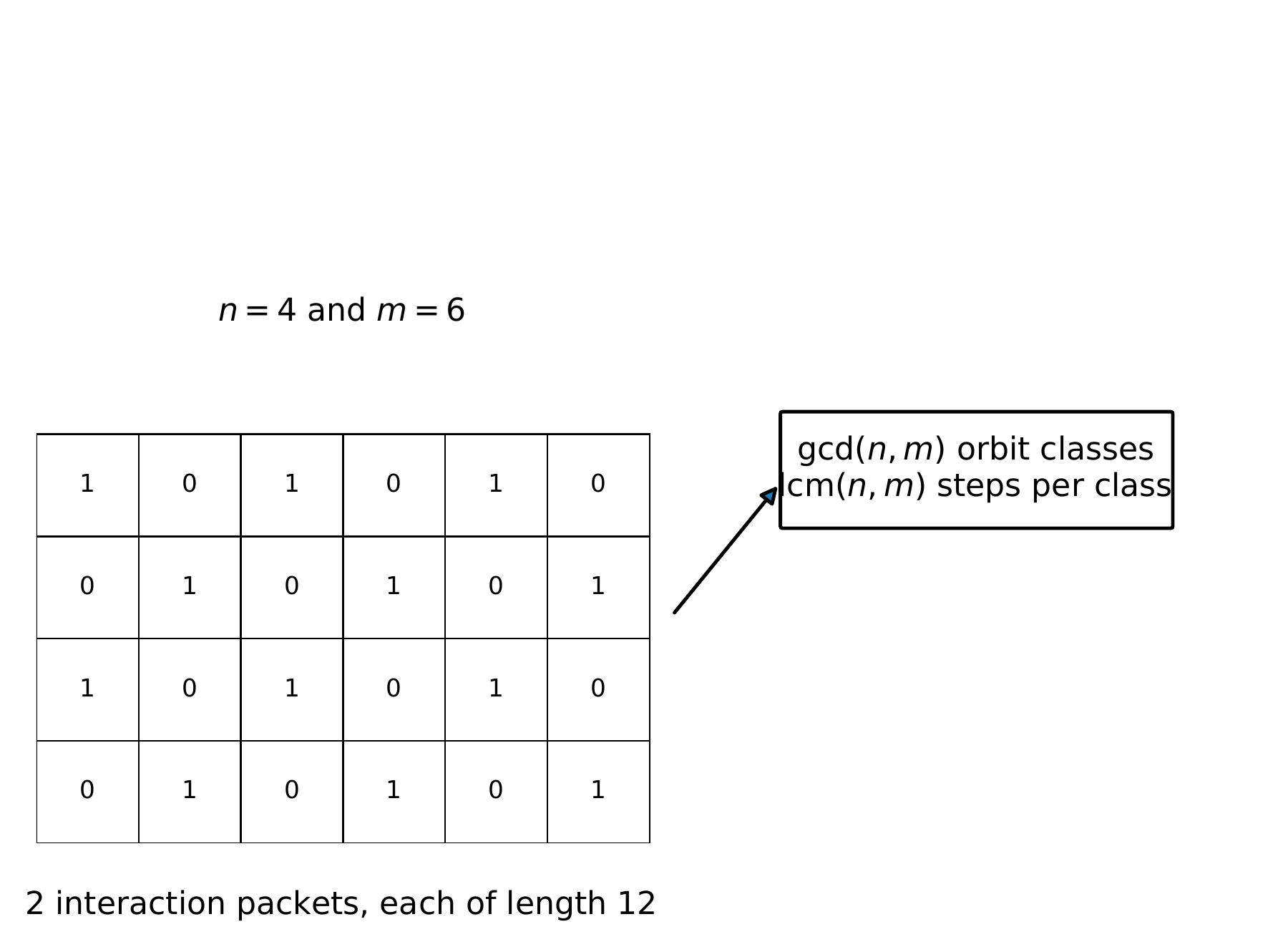
are the orbits of simultaneous translation on \({\mathbb Z}/n{\mathbb Z}\times{\mathbb Z}/m{\mathbb Z}\). There are \(d\) orbits, each of length \(L\). The stabilizer of a point in each orbit is \(W_{K_L}\). The second character is shifted by the chosen Frobenius representative. Summing the induced terms over the double cosets gives the decomposition.
Back to statement · Read statement and proof side by side · Permalink · Source line 583 · Claim record · Lean coverage · Code · Worked examples
Corollary 5.2: Packet count and dimension
The tensor product has \(d\) induced interaction packets, each with carrier dimension and Frobenius coset-cycle length \(L\). The interaction character may have a shorter inertia orbit, in which case a packet may split further into irreducible atoms. The total dimension is preserved because
Read proof · Read statement and proof side by side · Permalink · Source line 591 · Claim record · Lean coverage · Code · Worked examples
Proof of Corollary 5.2
The double coset calculation in Theorem 5.1 gives exactly \(d\) summands, and every stabilizer is \(W_{K_L}\), so every induced packet has dimension \(L\). The identity \(dL=nm\) follows from the definitions of greatest common divisor and least common multiple.
Back to statement · Read statement and proof side by side · Permalink · Source line 597 · Claim record · Lean coverage · Code · Worked examples
5.1 Exponent coordinates
On this page · Permalink · Source line 609
Represent the residue characters by exponents
Proposition 5.3: Refined exponent formula
The \(i\)th interaction packet on \({\mathbb F}_{q^L}^{\times}\) has exponent
It is trivial on tame inertia exactly when \(c_i=0\).
Read proof · Read statement and proof side by side · Permalink · Source line 618 · Claim record · Lean coverage · Code · Worked examples
Proof of Proposition 5.3
Norm lifting a character exponent from \({\mathbb F}_{q^n}^{\times}\) to \({\mathbb F}_{q^L}^{\times}\) multiplies the exponent by \((q^L-1)/(q^n-1)\). The Frobenius shift multiplies the second exponent by \(q^i\). Multiplication of characters adds exponents. Triviality is equivalent to the resulting exponent being zero modulo \(q^L-1\).
Back to statement · Read statement and proof side by side · Permalink · Source line 632 · Claim record · Lean coverage · Code · Worked examples
5.2 Tame local polynomials
On this page · Permalink · Source line 636
Let \(V\) be one interaction packet. If its inertia character is nontrivial, then \(V^{I_K}=0\). If the inertia character is trivial, Frobenius acts on the invariant packet by a companion cycle.
Proposition 5.4: Local polynomial of one tame packet
Suppose an interaction packet has orbit length \(r\) and closing scalar \(a\). Its local polynomial is
Read proof · Read statement and proof side by side · Permalink · Source line 640 · Claim record · Lean coverage · Code · Worked examples
Proof of Proposition 5.4
For nontrivial inertia, the invariant space is zero. In the trivial case, Frobenius on the invariant packet is the companion matrix of \(X^r-a\). Substituting \(X=u^{-1}\) and multiplying by \(u^r\) gives \(1-a u^r\).
Back to statement · Read statement and proof side by side · Permalink · Source line 652 · Claim record · Lean coverage · Code · Worked examples
Corollary 5.5: Tame tensor local factor
The local factor of the tame tensor product is the product of
over precisely those refined packets whose inertia exponent vanishes.
Read proof · Read statement and proof side by side · Permalink · Source line 656 · Claim record · Lean coverage · Code · Worked examples
Proof of Corollary 5.5
The invariant space is the direct sum of the invariant refined packets, and determinant is multiplicative on direct sums.
Back to statement · Read statement and proof side by side · Permalink · Source line 664 · Claim record · Lean coverage · Code · Worked examples
Proposition 5.6: Trivial tensor packet criterion
For every refined interaction packet, let \(r_i\) be its cycle length and \(a_i\) its closing scalar. The dimension of the \(W_K\) fixed space in \(\tau_\xi\otimes\tau_\eta\) equals the number of packets satisfying both
Read proof · Read statement and proof side by side · Permalink · Source line 668 · Claim record · Lean coverage · Code · Worked examples
Proof of Proposition 5.6
A nonzero fixed vector must lie in an inertia trivial packet, so \(c_i=0\). On that packet, Frobenius is a companion cycle with characteristic polynomial \(X^{r_i}-a_i\). Its fixed space is the eigenspace for eigenvalue one. This eigenspace is one dimensional exactly when \(a_i=1\), and it is zero otherwise. Summing over the refined packets proves the formula.
Back to statement · Read statement and proof side by side · Permalink · Source line 677 · Claim record · Lean coverage · Code · Worked examples
Corollary 5.7: Tame Hom test
For irreducible tame atoms,
is zero or one, and it is one exactly when the refined tensor packet test in Proposition 5.6 finds one trivial packet.
Read proof · Read statement and proof side by side · Permalink · Source line 681 · Claim record · Lean coverage · Code · Worked examples
Proof of Corollary 5.7
The Hom space is the fixed space of \(\tau_\xi\otimes\tau_\eta\). Schur's lemma gives dimension zero or one, and Proposition 5.6 gives the packet criterion.
Back to statement · Read statement and proof side by side · Permalink · Source line 689 · Claim record · Lean coverage · Code · Worked examples
5.3 Tame conductor
On this page · Permalink · Source line 693
Proposition 5.8: Conductor of a nontrivial tame atom
Let \(\tau\) be an irreducible tame Weil representation of dimension \(n>1\). Then
Read proof · Read statement and proof side by side · Permalink · Source line 695 · Claim record · Lean coverage · Code · Worked examples
Proof of Proposition 5.8
Wild inertia acts trivially, so the Swan conductor is zero. An inertia fixed vector would generate a nonzero Frobenius stable sum of trivial character packets. Irreducibility would then make inertia act trivially on all of \(\tau\). An irreducible representation of the quotient generated by Frobenius would be one dimensional, contrary to \(n>1\). The Artin conductor is therefore
Back to statement · Read statement and proof side by side · Permalink · Source line 706 · Claim record · Lean coverage · Code · Worked examples