
9 A restricted one break Galois envelope
On this page · Visual guide: Clifford multiplicity is the correct action space · Permalink · Source line 1010
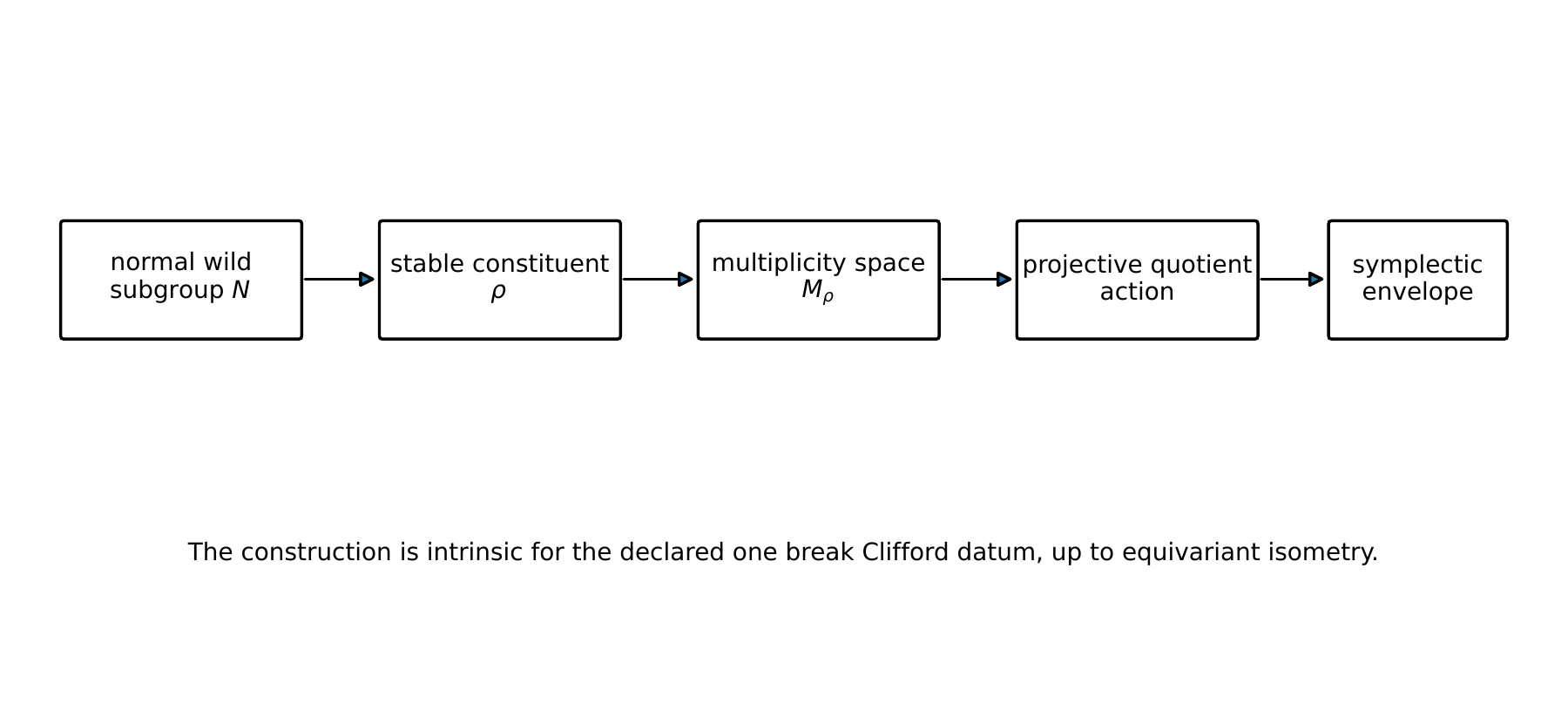
We now isolate a finite Clifford setting in which the quotient projective action is defined on a multiplicity space. This avoids assigning a quotient action directly to arbitrary representatives of \(G/N\).
Definition 9.1: One break Clifford datum
A one break Clifford datum consists of finite groups and representations
with the following properties.
The quotient \(A\) is a finite elementary abelian \(p\) group.
The representations \(\Pi\) and \(\rho\) are irreducible.
The isomorphism class of \(\rho\) is fixed by \(G\).
The restriction of \(\Pi\) to \(N\) is \(\rho\) isotypic.
The quotient records one declared ramification break.
The multiplicity space is
Permalink · Source line 1014 · Claim record · Lean coverage · Code · Worked examples
The isotypic condition gives an \(N\) equivariant evaluation isomorphism
Choose a section \(s:A\to G\). For every \(a\in A\), choose an intertwiner \(I_a\) from \(\rho\) to its conjugate by \(s(a)\). Under the evaluation isomorphism, there is a unique operator \(T_a\) on \(M_\rho\) such that
The operators \(T_a\) form a projective representation of \(A\).
Proposition 9.2: Clifford multiplicity action
The projective equivalence class of the action \((T_a)_{a\in A}\) is independent of the section, the intertwiners, and the chosen isotypic evaluation isomorphism. The projective action is irreducible.
Read proof · Read statement and proof side by side · Permalink · Source line 1053 · Claim record · Lean coverage · Code · Worked examples
Proof of Proposition 9.2
Changing an intertwiner \(I_a\) by a scalar changes \(T_a\) by the inverse scalar. Changing the isotypic evaluation isomorphism conjugates all \(T_a\) by one element of \({\operatorname{GL}}(M_\rho)\). Changing the section multiplies \(s(a)\) by an element of \(N\). That factor is absorbed by the \(\rho\) action on \(W\), leaving a scalar change on the multiplicity operator by Schur's lemma. Thus all choices give projectively equivalent actions.
If a nonzero proper subspace of \(M_\rho\) were stable under all projective operators \(T_a\), then its tensor product with \(W\) would give a nonzero proper \(G\) stable subspace of \({\mathcal X}\). This contradicts irreducibility of \(\Pi\).
Back to statement · Read statement and proof side by side · Permalink · Source line 1057 · Claim record · Lean coverage · Code · Worked examples
Definition 9.3: Clifford cocycle class
Choose scalars \(c(a,b)\) such that
The cohomology class
is the Clifford cocycle class of the datum.
Permalink · Source line 1063 · Claim record · Lean coverage · Code · Worked examples
Proposition 9.4: Intrinsic commutator pairing
The pairing
is independent of every choice in Definition 9.1. It is an alternating bicharacter
Read proof · Read statement and proof side by side · Permalink · Source line 1075 · Claim record · Lean coverage · Code · Worked examples
Proof of Proposition 9.4
The projective equivalence class is intrinsic by Proposition 9.2. Conjugation does not change scalar commutators, and scalar changes alter the cocycle by a coboundary. The commutator pairing is therefore unchanged by Proposition 8.1. Its alternating and bilinear properties follow from Proposition 8.2. Since every element of \(A\) has order \(p\), every value has order dividing \(p\).
Back to statement · Read statement and proof side by side · Permalink · Source line 1088 · Claim record · Lean coverage · Code · Worked examples
Definition 9.5: One break symplectic envelope
The one break symplectic envelope is
Permalink · Source line 1092 · Claim record · Lean coverage · Code · Worked examples
Theorem 9.6: Nondegenerate one break packet
If \(b_\rho\) is nondegenerate, then
Read proof · Read statement and proof side by side · Permalink · Source line 1101 · Claim record · Lean coverage · Code · Worked examples
Proof of Theorem 9.6
The projective action gives a nonzero representation of the twisted group algebra on \(M_\rho\). The algebra is a full matrix algebra by Theorem 8.3. Its unique irreducible module has dimension \(\sqrt{{\left\lvert A\right\rvert}}\). The projective multiplicity action is irreducible by Proposition 9.2, so it is that module.
Back to statement · Read statement and proof side by side · Permalink · Source line 1112 · Claim record · Lean coverage · Code · Worked examples
Proposition 9.7: Isomorphism invariance
The cocycle class and the equivariant isometry class of \(V_\rho\) depend only on the isomorphism class of the one break Clifford datum.
Read proof · Read statement and proof side by side · Permalink · Source line 1116 · Claim record · Lean coverage · Code · Worked examples
Proof of Proposition 9.7
An isomorphism of data transports the restriction, the multiplicity space, and its projective quotient action. It therefore transports the cocycle class, the commutator pairing, its radical, and the quotient.
Back to statement · Read statement and proof side by side · Permalink · Source line 1120 · Claim record · Lean coverage · Code · Worked examples
Proposition 9.8: Tame stabilizer action
Suppose a finite group \(C\) acts by automorphisms of the one break Clifford datum. Then \(C\) acts on \(V_\rho\) by symplectic automorphisms.
Read proof · Read statement and proof side by side · Permalink · Source line 1124 · Claim record · Lean coverage · Code · Worked examples
Proof of Proposition 9.8
The automorphism action transports the intrinsic projective multiplicity representation. It therefore preserves the scalar commutator pairing and its radical. The induced action on the quotient is symplectic.
Back to statement · Read statement and proof side by side · Permalink · Source line 1128 · Claim record · Lean coverage · Code · Worked examples
Corollary 9.9: Heisenberg representation attached to one break
Fix a nontrivial central character. The envelope \(V_\rho\) determines one irreducible finite Heisenberg representation up to isomorphism.
Read proof · Read statement and proof side by side · Permalink · Source line 1139 · Claim record · Lean coverage · Code · Worked examples
Proof of Corollary 9.9
Apply the finite Stone von Neumann theorem to the nondegenerate symplectic quotient.
Back to statement · Read statement and proof side by side · Permalink · Source line 1143 · Claim record · Lean coverage · Code · Worked examples
Remark 9.10
The group cohomology class records the extension obstruction for the multiplicity action. General background on projective representations and group cohomology can be found in [22], [3]. The theorem remains restricted because the finite quotient and the one break isotypic datum are assumed rather than constructed from arbitrary wild inertia.