
11 The restricted Galois to type bridge
On this page · Visual guide: Three mathematical objects · Visual guide: A supplied bridge reduces comparison to a scalar · Permalink · Source line 1192
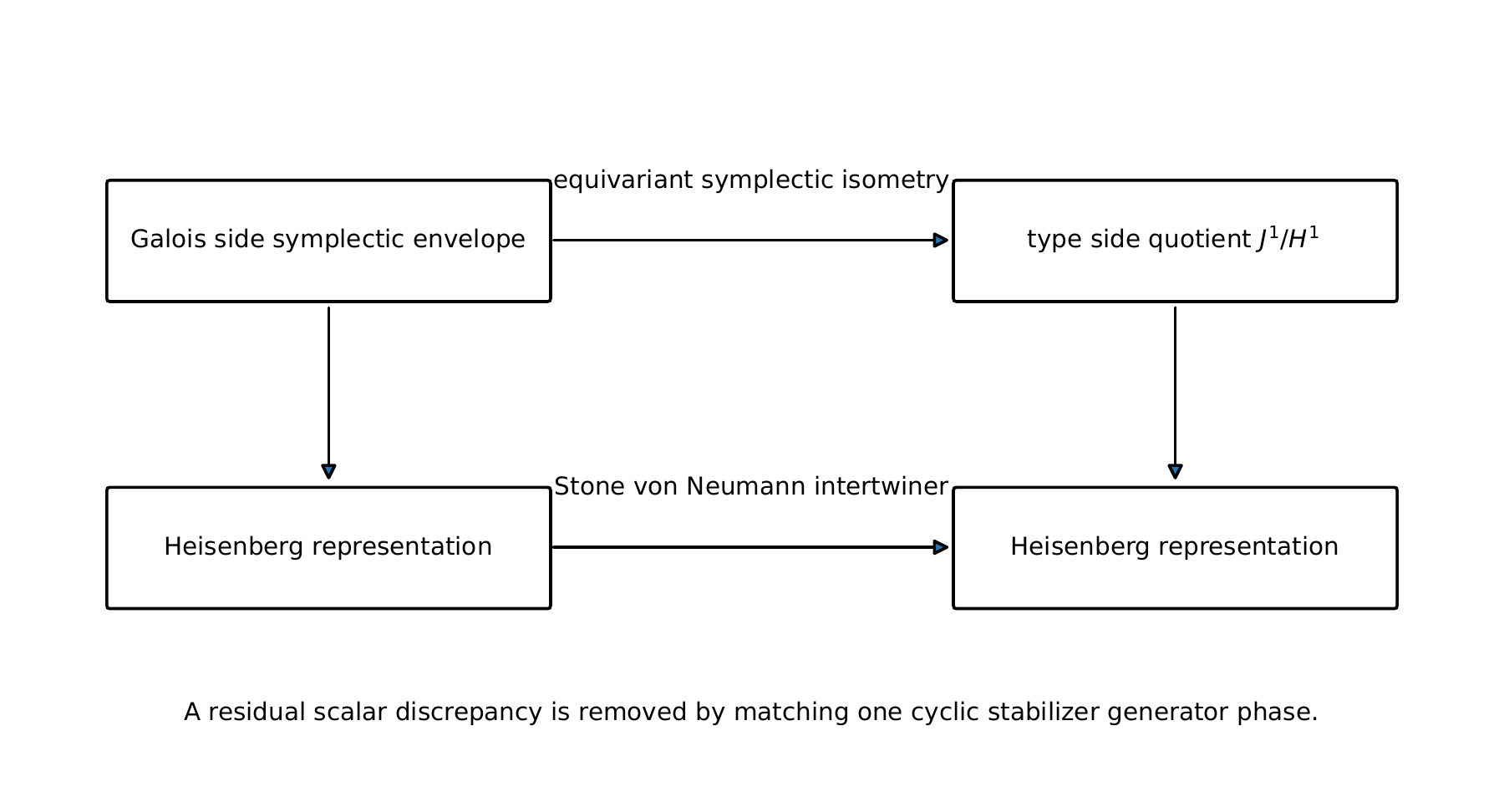
The full bridge would construct an intrinsic Galois envelope for every wild atom and identify it canonically with \(V_\theta\). We prove the comparison after the required symplectic identification has been supplied.
Definition 11.1: Bridge datum
A restricted bridge datum consists of
a one break Galois envelope \((V_\rho,b_\rho)\)
a type side quotient \((V_\theta,h_\theta)\)
an equivariant symplectic isometry
\[ \iota:V_\rho\longrightarrow V_\theta \]for a finite cyclic stabilizer \(C=\langle c\rangle\)
the same nontrivial central character on the two Heisenberg groups
when \(p=2\), compatible quadratic refinements and an isomorphism of the resulting Heisenberg central extensions lifting \(\iota\).
Permalink · Source line 1196 · Claim record · Lean coverage · Code · Worked examples
Theorem 11.2: Restricted Heisenberg bridge
A restricted bridge datum determines an isomorphism between the two Heisenberg representations, unique up to a nonzero scalar. More precisely, there is an invertible map
such that
for every Heisenberg element \(h\), and every other such map is a scalar multiple of \(U\).
Read proof · Read statement and proof side by side · Permalink · Source line 1212 · Claim record · Lean coverage · Code · Worked examples
Proof of Theorem 11.2
When \(p\) is odd, the symplectic isometry and the common central character induce the standard isomorphism \(\iota_H\) of the two Heisenberg groups. When \(p=2\), the required lift of \(\iota\) is part of the bridge datum because the alternating form alone does not determine the central extension. Pulling the type side representation back through \(\iota_H\) gives an irreducible Heisenberg representation with the same central character as the Galois side representation. The finite Stone von Neumann theorem gives an isomorphism. Schur's lemma gives uniqueness up to scalar.
Back to statement · Read statement and proof side by side · Permalink · Source line 1226 · Claim record · Lean coverage · Code · Worked examples
The stabilizer actions need not agree after choosing \(U\). Their discrepancy is scalar because both actions implement the same automorphisms of the irreducible Heisenberg representation.
Proposition 11.3: Cyclic discrepancy character
Assume that the two projective stabilizer actions have been linearized to honest representations of the cyclic group \(C\). Then there is a character
such that
for every \(g\in C\).
Read proof · Read statement and proof side by side · Permalink · Source line 1232 · Claim record · Lean coverage · Code · Worked examples
Proof of Proposition 11.3
For each \(g\), the operator
commutes with the type side Heisenberg representation. It is therefore scalar. Since both stabilizer actions are honest representations, multiplication of group elements shows that the scalars form a character.
Back to statement · Read statement and proof side by side · Permalink · Source line 1246 · Claim record · Lean coverage · Code · Worked examples
Lemma 11.4: Linearization over a cyclic stabilizer
Every finite dimensional projective representation of a finite cyclic group over \({\mathbb C}\) is projectively equivalent to an honest representation.
Read proof · Read statement and proof side by side · Permalink · Source line 1254 · Claim record · Lean coverage · Code · Worked examples
Proof of Lemma 11.4
Let \(C=\langle c\rangle\) have order \(m\), and let \(T\) be a lift of the projective generator. Since \(c^m=1\), the operator \(T^m\) is scalar. Choose \(\lambda\in{\mathbb C}^{\times}\) with \(\lambda^mT^m=I\). Replacing \(T\) by \(\lambda T\) gives an honest cyclic representation.
Back to statement · Read statement and proof side by side · Permalink · Source line 1258 · Claim record · Lean coverage · Code · Worked examples
Theorem 11.5: One phase closes the cyclic bridge
In a restricted bridge datum, choose linearizations of the cyclic stabilizer actions. If the two actions have the same scalar phase on the generator \(c\), then the Heisenberg intertwiner can be chosen to intertwine the full semidirect product action.
Read proof · Read statement and proof side by side · Permalink · Source line 1262 · Claim record · Lean coverage · Code · Worked examples
Proof of Theorem 11.5
By Proposition 11.3, the discrepancy is a character \(\delta\). Equality of the generator phase gives \(\delta(c)=1\). Since \(c\) generates \(C\), the character is trivial. The chosen map \(U\) then intertwines every stabilizer element as well as the Heisenberg group.
Back to statement · Read statement and proof side by side · Permalink · Source line 1266 · Claim record · Lean coverage · Code · Worked examples
Corollary 11.6: Bridge uniqueness
When the semidirect product representation is irreducible, the completed bridge is unique up to scalar.
Read proof · Read statement and proof side by side · Permalink · Source line 1277 · Claim record · Lean coverage · Code · Worked examples
Proof of Corollary 11.6
Any two completed bridges differ by an endomorphism commuting with the semidirect product representation. Schur's lemma applies.
Back to statement · Read statement and proof side by side · Permalink · Source line 1281 · Claim record · Lean coverage · Code · Worked examples
Remark 11.7
The theorem does not construct \(\iota\). It proves that, once an equivariant symplectic isometry exists, the remaining finite comparison is one dimensional for a cyclic stabilizer.