7 Finite Heisenberg packets
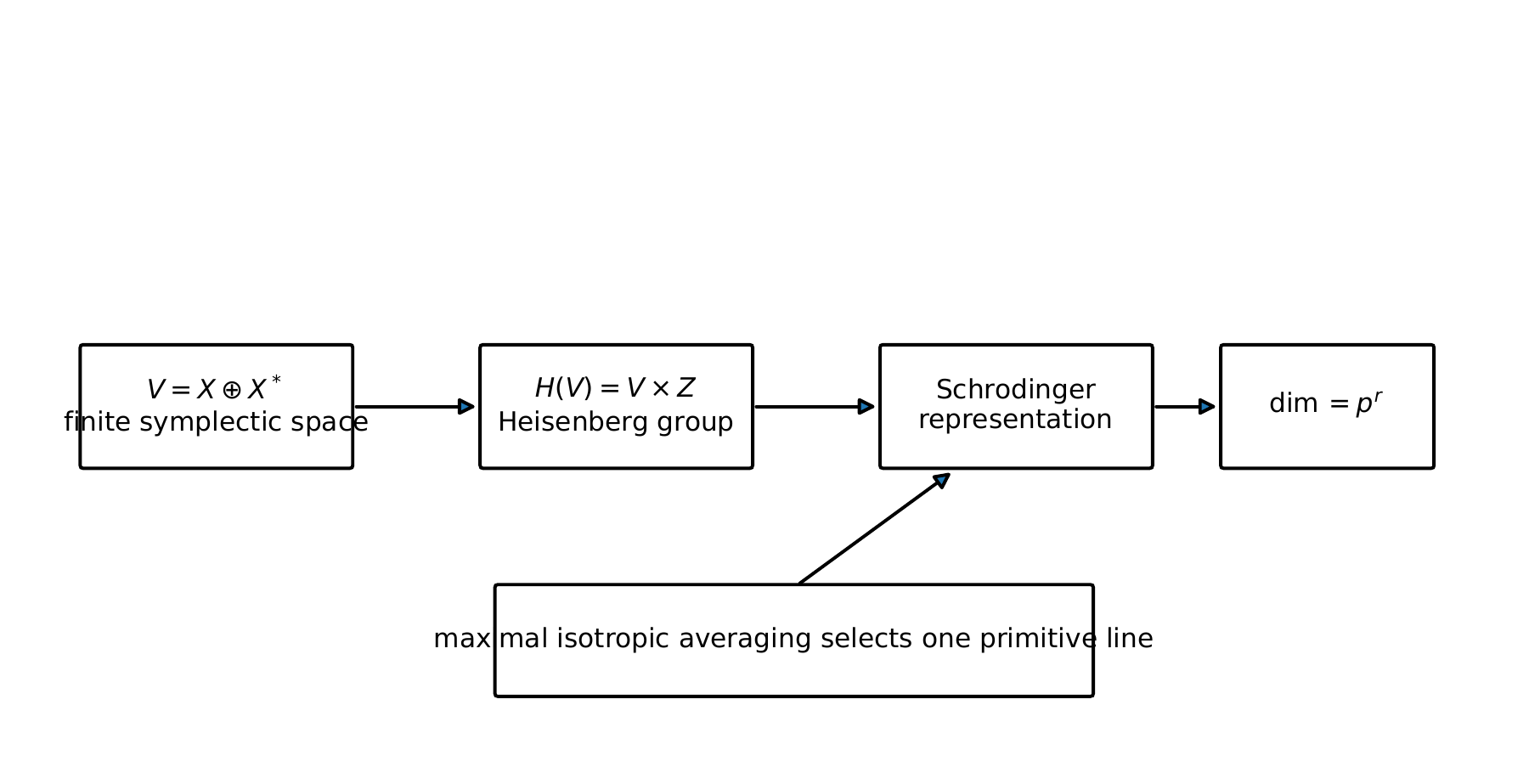
On this page · Visual guide: Translations and multipliers create Heisenberg packets · Visual guide: An isotropic average selects one line · Permalink · Source line 787
Let \(p\) be odd. Let \(X\) be an \(r\) dimensional vector space over \({\mathbb F}_p\), and put
Define the alternating form
Let \(Z={\mathbb F}_p\), and define the Heisenberg group
with multiplication
Fix the additive character
Definition 7.1: Schrödinger operators
On \({\mathcal H}={\mathbb C}^X\), define
Permalink · Source line 814 · Claim record · Lean coverage · Code · Worked examples
Theorem 7.2: Finite Schrödinger representation
The map \(\rho:{\mathfrak H}(V)\to{\operatorname{GL}}({\mathcal H})\) is a representation. It is irreducible, its center acts by \(\psi\), and
Read proof · Read statement and proof side by side · Permalink · Source line 823 · Claim record · Lean coverage · Code · Worked examples
Proof of Theorem 7.2
A direct calculation gives
Translations by \(X\) and multiplications by characters from \(X^*\) generate the full matrix algebra on \({\mathbb C}^X\). Indeed, the character multipliers give all diagonal projectors by finite Fourier inversion, and translations move each coordinate line to every other coordinate line. The commutant is therefore scalar, so the representation is irreducible. The dimension is \({\left\lvert X\right\rvert}=p^r\).
Back to statement · Read statement and proof side by side · Permalink · Source line 830 · Claim record · Lean coverage · Code · Worked examples
Proposition 7.3: Character support
The character of the Schrödinger representation satisfies
Read proof · Read statement and proof side by side · Permalink · Source line 840 · Claim record · Lean coverage · Code · Worked examples
Proof of Proposition 7.3
If the translation component \(x\) is nonzero, the operator permutes the standard basis without a fixed point, so its trace is zero. If \(x=0\) but \(\xi\ne0\), the trace is
When \(x=\xi=0\), the operator is the scalar \(\psi(z)\).
Back to statement · Read statement and proof side by side · Permalink · Source line 854 · Claim record · Lean coverage · Code · Worked examples
Standard fact 7.4: Finite Stone von Neumann theorem
For a finite Heisenberg group with nondegenerate commutator form and a fixed nontrivial central character, there is one irreducible representation up to isomorphism. Its dimension is the square root of the order of the symplectic quotient.
Permalink · Source line 862 · Claim record · Lean coverage · Code · Worked examples
The standard fact follows from the twisted group algebra argument in Section 8. It is also the finite form used in the classical Weil representation literature [15], [26].
7.1 Maximal isotropic selectors
On this page · Permalink · Source line 868
Let \(L\subseteq V\) be maximal isotropic. Choose a subgroup lift \(\widetilde L\subseteq{\mathfrak H}(V)\) on which the central coordinate is zero.
Proposition 7.5: Isotropic averaging projector
The operator
is an orthogonal projector. In the Schrödinger model with \(L=X\), it has rank one and selects the constant functions.
Read proof · Read statement and proof side by side · Permalink · Source line 872 · Claim record · Lean coverage · Code · Worked examples
Proof of Proposition 7.5
The lifted isotropic subgroup is abelian, so group averaging is an idempotent. Every operator in the average is unitary, and the subgroup is closed under inversion, so the average is self adjoint. For \(L=X\), the average is the translation average
which is the constant function with value equal to the mean of \(f\). Its range is one dimensional.
Back to statement · Read statement and proof side by side · Permalink · Source line 884 · Claim record · Lean coverage · Code · Worked examples
Corollary 7.6: Primitive line selector
Every maximal isotropic subgroup selects a one dimensional fixed line in the irreducible Heisenberg representation.
Read proof · Read statement and proof side by side · Permalink · Source line 895 · Claim record · Lean coverage · Code · Worked examples
Proof of Corollary 7.6
The projector rank equals its trace. The identity element contributes \(p^r\), while every nonidentity element of the lifted isotropic subgroup is noncentral and has trace zero by Proposition 7.3. Since \({\left\lvert L\right\rvert}=p^r\), we get
Thus the projector has rank one.
Back to statement · Read statement and proof side by side · Permalink · Source line 899 · Claim record · Lean coverage · Code · Worked examples