
1 Introduction
On this page · Permalink · Source line 188
The local Langlands correspondence for \({\operatorname{GL}}_n(K)\) is an established theorem. It matches irreducible smooth representations of \({\operatorname{GL}}_n(K)\) with Frobenius semisimple Weil Deligne representations of dimension \(n\). Its proof and normalization draw on global methods, harmonic analysis, types, local factors, and the geometry of Shimura varieties [19], [17], [8]. The present article asks a narrower structural question. Which parts of the local correspondence admit finite packet coordinates whose projectors, transfers, phases, and gluing laws can be proved directly?
The answer has a sharp division. The tame layers are explicit. A tame irreducible Weil representation is induced from a character of an unramified extension. Its inertia restriction is one Frobenius orbit. Regular characters of elliptic finite field tori give cuspidal blocks through the Deligne and Lusztig construction [13]. Their tensor products are controlled by a greatest common divisor and least common multiple decomposition. The corresponding cycle orientation and finite Gauss phases can be computed exactly. These features are closely related to the tame lifting and essentially tame correspondence of Bushnell and Henniart [4], [5], [6], [7], [9].
Wild data are different. The restriction to wild inertia need not split into cyclic characters. On the type side, simple character theory produces finite symplectic quotients and Heisenberg representations [11]. Canonical beta extensions fix a phase ambiguity in the extension to the normalizer [2], [14]. On the Galois side, higher ramification gives a canonical filtration and strong numerical constraints [10]. The missing construction is not another finite matrix calculation. It is a choice free passage from an arbitrary wild inertia atom to a finite symplectic envelope that agrees with the type side quotient.
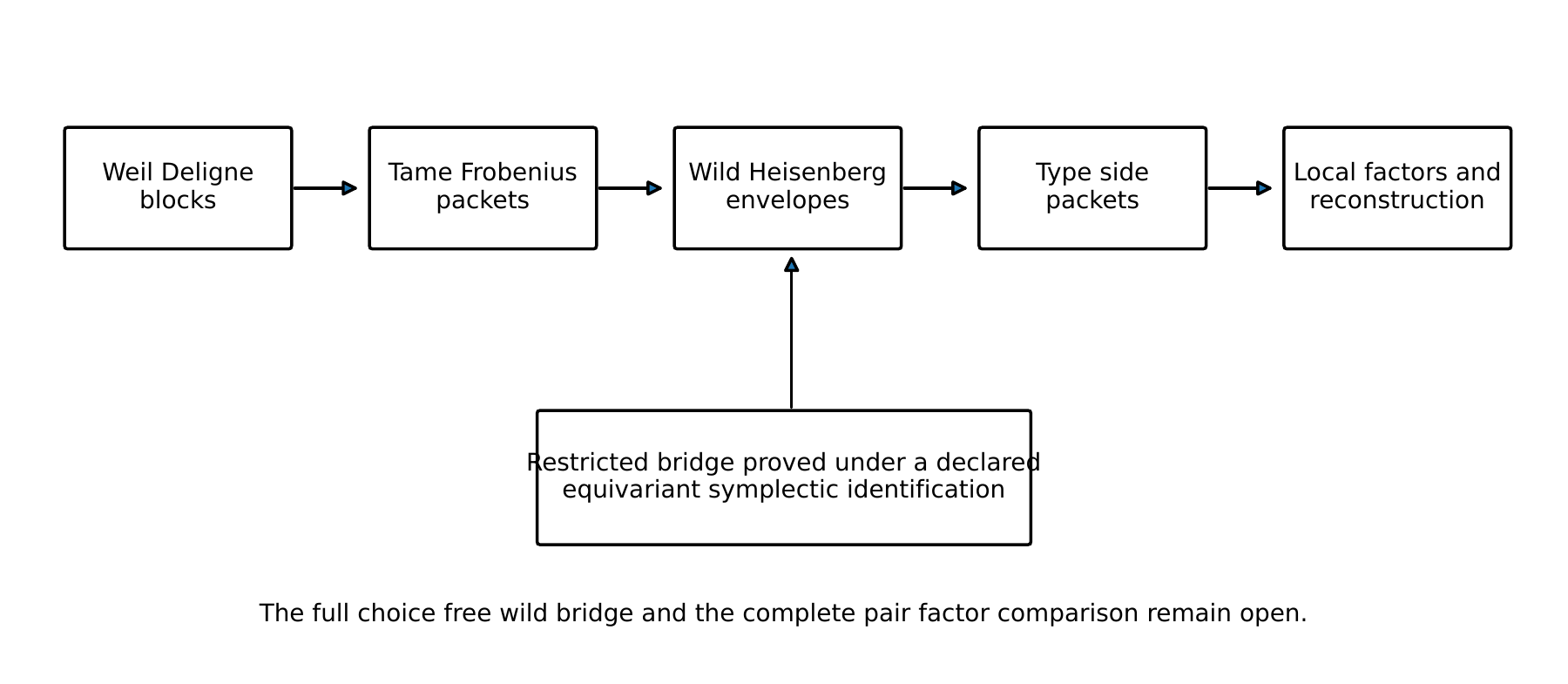
We therefore separate three levels of assertion. First, the article proves finite algebraic theorems about tame orbits, Heisenberg groups, twisted group algebras, finite Weil phases, and transport graphs. Second, it proves a restricted one break bridge once a normal wild datum and an equivariant symplectic identification are declared. Third, it records the exact additional input needed to pass from that restricted bridge to an independent construction of all wild atoms.
The finite Heisenberg theory used here is classical. We use the Stone von Neumann theorem, finite Weil representations, and standard projective representation theory [15], [25], [26], [22], [16]. The contribution is the way these results are arranged into one comparison diagram and the matrix holonomy theorem that controls finite gluing. In residue characteristic two, the alternating form does not determine the phase. A quadratic refinement and its Arf invariant are required. The underlying quadratic form theory is standard [24].
Local factors provide the final test. Henniart showed that pair epsilon factors characterize the local correspondence in the required range [18]. The tame packet calculations below recover exact local polynomials and finite Gauss phases for the declared tame atoms. They do not supply the complete pair factor comparison for arbitrary wild atoms. This boundary is retained throughout the paper.
This reading edition separates the missing arithmetic realization from the conditional identification of one actual candidate. The endpoint formerly listed as proof obligation 66 (historical Theorem 16.2, row 95 of the all-records register) is now Conjecture 66. The finite theorem statements and proofs include the geometric-Frobenius convention correction and the additional local corrections recorded in this edition's reading guide. The later restricted constructions are developed in Section 19 and the detailed construction appendices. Their evidence is ordinary proof with retained internal reviews, rather than new Lean certificates. These reviews are not external peer review.
The accompanying release includes Markdown (.md) files containing detailed proofs, construction notes, proof audits, and research records. These documents distinguish established results, conditional results, and the remaining obligations associated with Conjecture 66.
The article is organized as follows. Weil Deligne chains appear in Section 2. Tame Frobenius packets, finite field cuspidal projectors, tensor refinement, and Gauss phases are developed in Section 3, Section 4, Section 5, and Section 6. Finite Heisenberg groups and projective commutator envelopes appear in Section 7 and Section 8. The restricted one break Galois envelope and its comparison with the type side are treated in Section 9, Section 10, and Section 11. Odd and dyadic phase data are separated in Section 12 and Section 13. Matrix holonomy and breakwise reconstruction appear in Section 14 and Section 15. The local-factor boundary appears in Section 16. Examples and scope follow in Section 17 and Section 18. Section Section 19 and the appendices develop the restricted arithmetic constructions. The separate progress paper reconciles subsequent routes, corrections and remaining obligations without replacing these source records.