
6 Finite Gauss phases
On this page · Visual guide: Finite Gauss phases are unit scalars · Permalink · Source line 713
Let \(k={\mathbb F}_q\), let \(\psi:k\to{\mathbb C}^{\times}\) be a nontrivial additive character, and let \(\chi:k^{\times}\to{\mathbb C}^{\times}\) be a multiplicative character. Define
The standard theory of Gauss and Jacobi sums will be used in the form recorded in [12], [1].
Proposition 6.1: Gauss magnitude
If \(\chi\) is nontrivial, then
Read proof · Read statement and proof side by side · Permalink · Source line 723 · Claim record · Lean coverage · Code · Worked examples
Proof of Proposition 6.1
Compute
Write \(x=ty\). The inner sum over \(y\) equals \(q-1\) when \(t=1\) and equals \(-1\) otherwise. Since \(\sum_{t\in k^{\times}}\chi(t)=0\), the result is \(q\).
Back to statement · Read statement and proof side by side · Permalink · Source line 732 · Claim record · Lean coverage · Code · Worked examples
Definition 6.2: Normalized Gauss phase
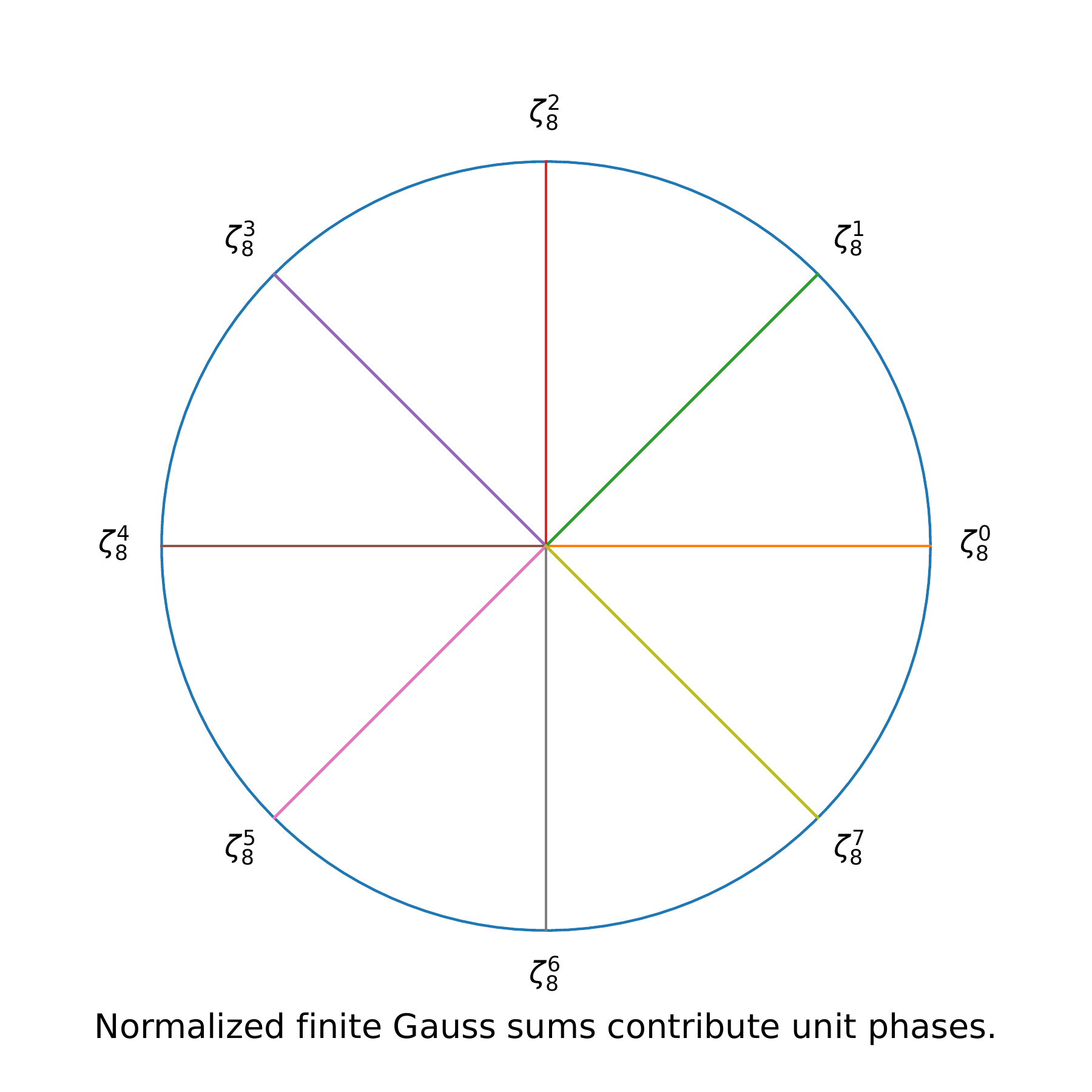
For nontrivial \(\chi\), define
Then \({\left\lvert\gamma(\chi,\psi)\right\rvert}=1\).
Permalink · Source line 743 · Claim record · Lean coverage · Code · Worked examples
Proposition 6.3: Duality of Gauss phases
For nontrivial \(\chi\),
Read proof · Read statement and proof side by side · Permalink · Source line 753 · Claim record · Lean coverage · Code · Worked examples
Proof of Proposition 6.3
The standard Gauss identity gives
Divide by \(q\).
Back to statement · Read statement and proof side by side · Permalink · Source line 764 · Claim record · Lean coverage · Code · Worked examples
Standard fact 6.4: Hasse and Davenport lifting
Let \(k_r/k\) be the extension of degree \(r\). Lift \(\chi\) by the norm and \(\psi\) by the trace. Then the lifted Gauss sum satisfies the Hasse and Davenport product relation, with a sign determined by the chosen additive character normalization.
Permalink · Source line 772 · Claim record · Lean coverage · Code · Worked examples
Remark 6.5
Finite Gauss phases reproduce the finite field part of tame and depth zero normalization. They do not by themselves give the full epsilon factor of a general wild pair.