15 Breakwise assembly
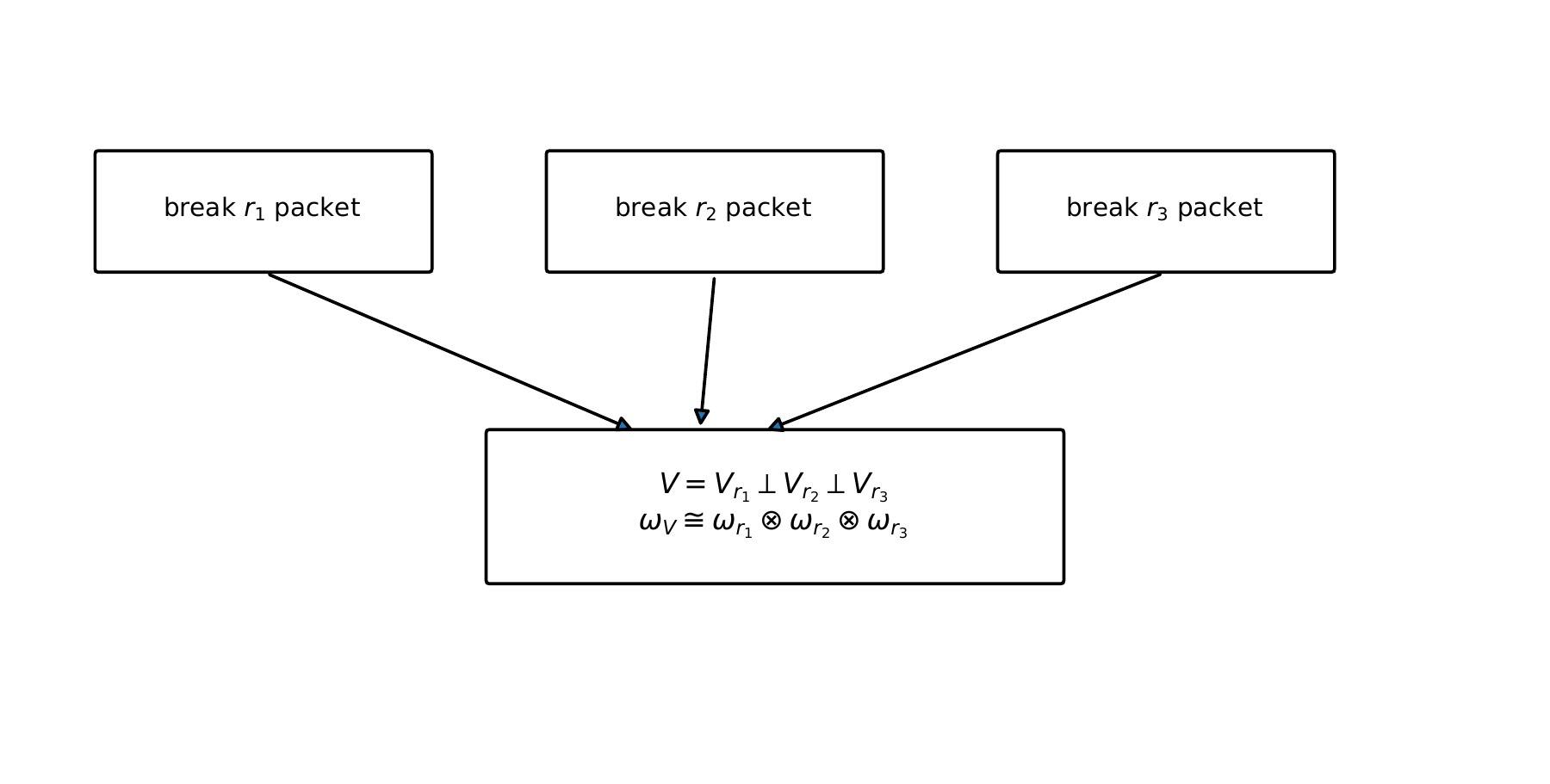
On this page · Visual guide: Orthogonal breaks become tensor factors · Permalink · Source line 1750
Wild inertia carries an upper ramification filtration. In favorable settings, a wild atom separates into finitely many break pieces. We state the finite algebra needed once such pieces are intrinsic.
Definition 15.1: Orthogonal break decomposition
An orthogonal break decomposition is a symplectic direct sum
that is preserved by the declared tame stabilizer. Each \(V_s\) is the finite symplectic packet assigned to one break.
Permalink · Source line 1754 · Claim record · Lean coverage · Code · Worked examples
Proposition 15.2: Heisenberg tensor factorization
Fix compatible central characters. The irreducible Heisenberg representation of an orthogonal sum is the tensor product of the irreducible Heisenberg representations of its summands:
Read proof · Read statement and proof side by side · Permalink · Source line 1762 · Claim record · Lean coverage · Code · Worked examples
Proof of Proposition 15.2
The Heisenberg group of an orthogonal sum is the central product of the Heisenberg groups of the summands. The tensor product representation has the declared central character and has dimension
It is irreducible by the finite Stone von Neumann theorem, so it is the required representation.
Back to statement · Read statement and proof side by side · Permalink · Source line 1773 · Claim record · Lean coverage · Code · Worked examples
Corollary 15.3: Breakwise phase product
In odd residue characteristic, let \(g\in{\operatorname{Sp}}(V)\) preserve every break packet and suppose its restriction to \(M={\operatorname{im}}(g-I)\) is fixed point free. Put \(g_s=g|_{V_s}\) and \(M_s={\operatorname{im}}(g_s-I)\). The moving restrictions are symplectic, and
In residue characteristic two, the analogous normalized Gauss sign is the product of the signs determined by the breakwise quadratic refinements.
Read proof · Read statement and proof side by side · Permalink · Source line 1783 · Claim record · Lean coverage · Code · Worked examples
Proof of Corollary 15.3
The invariant orthogonal decomposition gives \(M=\mathop{\perp}\limits_{s\in S}M_s\). Symplectic invariance gives \(M^\perp=\ker(g-I)\). Fixed point freeness on \(M\) therefore makes the restricted form nondegenerate on \(M\) and on each \(M_s\). Each restriction of \(g_s-I\) to \(M_s\) is invertible, so Proposition 12.4 applies to the moving spaces. A zero moving space contributes one. In characteristic two, apply Corollary 13.6.
Back to statement · Read statement and proof side by side · Permalink · Source line 1795 · Claim record · Lean coverage · Code · Worked examples
Theorem 15.4: Breakwise restricted bridge
Suppose every break has a restricted bridge datum, the symplectic isometries are compatible with the stabilizer action, and the scalar phases agree on a generating set of the stabilizer. Then the tensor product of the breakwise Heisenberg intertwiners gives a bridge for the full finite envelope. Any remaining gluing obstruction is exactly the matrix holonomy obstruction of Theorem 14.2.
Read proof · Read statement and proof side by side · Permalink · Source line 1799 · Claim record · Lean coverage · Code · Worked examples
Proof of Theorem 15.4
Tensor the breakwise Heisenberg intertwiners from Theorem 11.2. Phase agreement makes the tensor map equivariant on the chosen stabilizer generators. The breakwise direct sum and tensor factorization make the local comparisons compatible. If the packets are arranged over a transport graph, the only remaining condition is consistency of the local maps around cycles, which is exactly the holonomy criterion.
Back to statement · Read statement and proof side by side · Permalink · Source line 1803 · Claim record · Lean coverage · Code · Worked examples