
14 Matrix holonomy and finite gluing
On this page · Visual guide: A spanning tree fixes the vertex gauges · Visual guide: Cycle defects measure edge residuals exactly · Permalink · Source line 1609
Let \(\Gamma\) be a connected finite graph. At every vertex \(v\), place finite dimensional complex vector spaces \(V_v\) and \(W_v\) of the same dimension. For every oriented edge \(e:u\to v\), let
be invertible. The reversed edge carries the inverse map.
Definition 14.1: Path transport
For an oriented path
define
For a loop based at \(r\), these are the based holonomies.
Permalink · Source line 1619 · Claim record · Lean coverage · Code · Worked examples
Theorem 14.2: Matrix holonomy criterion
Fix a root \(r\) and an isomorphism
The following conditions are equivalent.
There are isomorphisms \(U_v:V_v\to W_v\), with the declared \(U_r\), such that
\[ U_vA_e=B_eU_u \]for every edge \(e:u\to v\).
For one fundamental cycle basis based at \(r\),
\[ U_rA_\gamma=B_\gamma U_r. \]The same identity holds for every based loop \(\gamma\).
Read proof · Read statement and proof side by side · Permalink · Source line 1633 · Claim record · Lean coverage · Code · Worked examples
Proof of Theorem 14.2
If the vertex maps exist, multiply the edge equations around a loop. Every intermediate vertex map cancels, giving condition three. Condition three implies condition two.
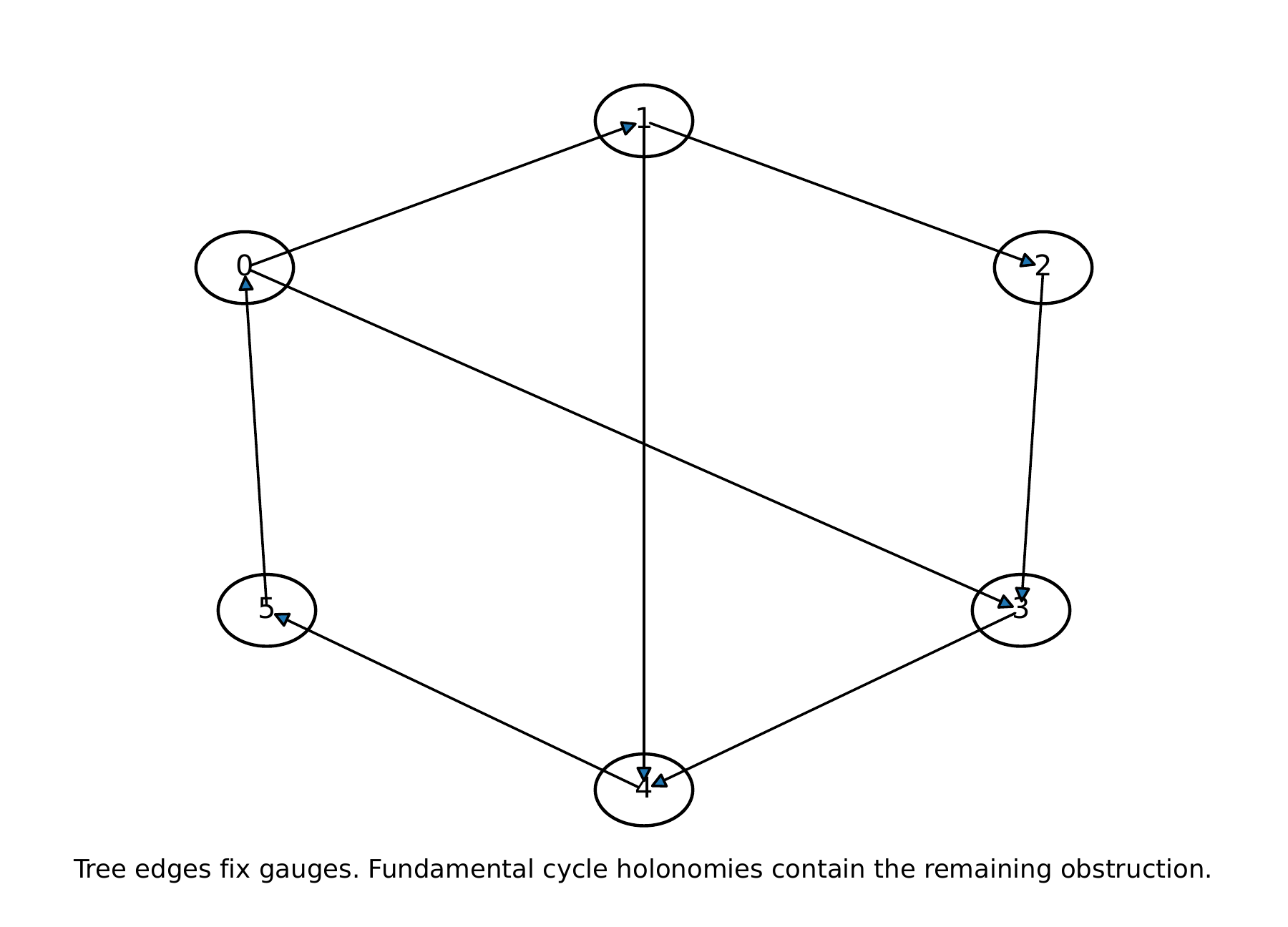
Conversely, choose a spanning tree. Starting from \(U_r\), define \(U_v\) by transport along the unique tree path from \(r\) to \(v\). The edge equations hold on every tree edge by construction. Every non tree edge closes one fundamental cycle. The edge equation on that edge is equivalent to the root holonomy identity for its fundamental cycle. Condition two therefore gives all remaining edge equations.
Back to statement · Read statement and proof side by side · Permalink · Source line 1654 · Claim record · Lean coverage · Code · Worked examples
Corollary 14.3: Unbased gauge classification
There exists some family of vertex isomorphisms if and only if the two holonomy representations
are conjugate.
Read proof · Read statement and proof side by side · Permalink · Source line 1660 · Claim record · Lean coverage · Code · Worked examples
Proof of Corollary 14.3
Apply Theorem 14.2 and allow \(U_r\) to vary.
Back to statement · Read statement and proof side by side · Permalink · Source line 1670 · Claim record · Lean coverage · Code · Worked examples
Corollary 14.4: Scalar and projective gluing
If every based loop acts by a scalar, finite gluing is equivalent to equality of the scalar holonomies on a fundamental cycle basis. The number of independent tests is
Read proof · Read statement and proof side by side · Permalink · Source line 1674 · Claim record · Lean coverage · Code · Worked examples
Proof of Corollary 14.4
A connected graph has a spanning tree with \({\left\lvert V\right\rvert}-1\) edges. Every remaining edge gives one fundamental cycle. In the scalar case, conjugacy has no effect.
Back to statement · Read statement and proof side by side · Permalink · Source line 1683 · Claim record · Lean coverage · Code · Worked examples
Proposition 14.5: Projective cocycle form
Suppose the edge maps are defined only up to scalar, in the setting where all based holonomies of both systems are scalar. Choose representatives. The ratio of the two scalar holonomies on each loop is unchanged by vertex rescaling. It defines a character of the first homology group when the scalar transport is abelian.
Read proof · Read statement and proof side by side · Permalink · Source line 1687 · Claim record · Lean coverage · Code · Worked examples
Proof of Proposition 14.5
A vertex rescaling appears once with positive exponent and once with negative exponent around a closed path, so it cancels. Multiplication of loops multiplies the scalar ratios. In the abelian case, the ratio factors through the abelianization of the fundamental group, which is the first homology group.
Back to statement · Read statement and proof side by side · Permalink · Source line 1691 · Claim record · Lean coverage · Code · Worked examples
Proposition 14.6: Exact edge residual from cycle defect
Fix a spanning tree and construct the vertex maps by tree transport from \(U_r\). Let \(e:u\to v\) be a non tree edge. Let \(p_u\) and \(p_v\) be the tree paths from the root to \(u\) and \(v\). Define the fundamental cycle defect
Then the edge residual is exactly
Read proof · Read statement and proof side by side · Permalink · Source line 1696 · Claim record · Lean coverage · Code · Worked examples
Proof of Proposition 14.6
Substitute
into the left side and factor \(B_{p_v}\) on the left and \(A_{p_u}^{-1}\) on the right.
Back to statement · Read statement and proof side by side · Permalink · Source line 1715 · Claim record · Lean coverage · Code · Worked examples
Corollary 14.7: Quantitative finite gluing
With the notation of Proposition 14.6,
Thus small fundamental cycle defects give small non tree edge residuals whenever the tree transports are uniformly conditioned.
Read proof · Read statement and proof side by side · Permalink · Source line 1725 · Claim record · Lean coverage · Code · Worked examples
Proof of Corollary 14.7
Take operator norms in the exact identity.
Back to statement · Read statement and proof side by side · Permalink · Source line 1735 · Claim record · Lean coverage · Code · Worked examples
Remark 14.8
The theorem is an exact finite gluing result. It assumes that the packet spaces and edge transports have already been constructed on both sides.