13 Dyadic quadratic refinements
On this page · Visual guide: Two dyadic refinements can have opposite signs · Visual guide: Refinements form an affine family · Permalink · Source line 1468
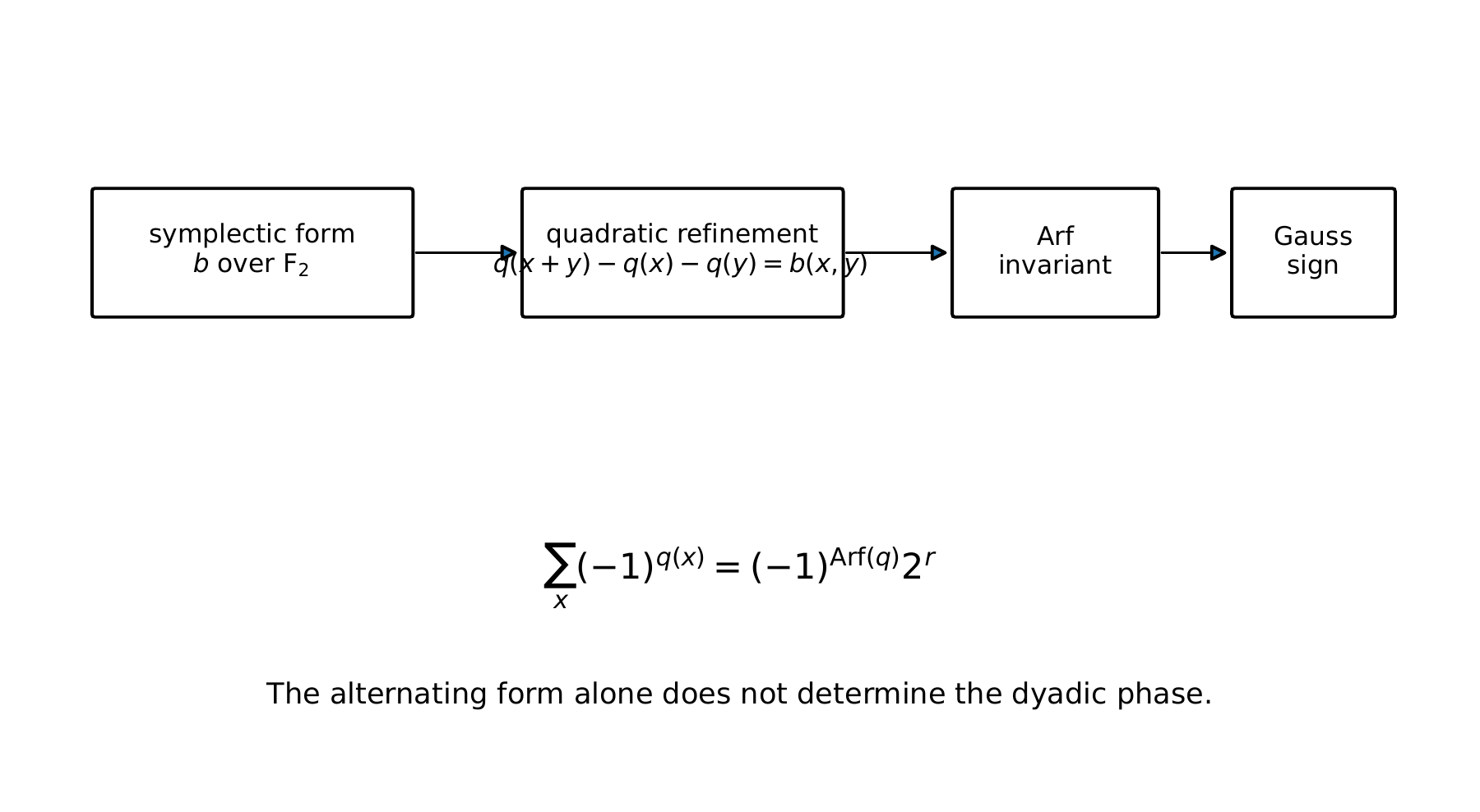
Let \((V,b)\) be a symplectic vector space over \({\mathbb F}_2\). The alternating form alone is not enough to determine the finite phase.
Definition 13.1: Quadratic refinement
A quadratic refinement of \(b\) is a map
satisfying
Permalink · Source line 1472 · Claim record · Lean coverage · Code · Worked examples
Proposition 13.2: Affine space of refinements
If one quadratic refinement exists, then the set of all quadratic refinements is an affine space over \(V^*\).
Read proof · Read statement and proof side by side · Permalink · Source line 1483 · Claim record · Lean coverage · Code · Worked examples
Proof of Proposition 13.2
The difference of two refinements has zero polar form, so it is additive and hence linear over \({\mathbb F}_2\). Conversely, adding a linear form does not change the polar form.
Back to statement · Read statement and proof side by side · Permalink · Source line 1487 · Claim record · Lean coverage · Code · Worked examples
Definition 13.3: Arf invariant
Choose a symplectic basis \((e_i,f_i)_{i=1}^{r}\). Define
Permalink · Source line 1491 · Claim record · Lean coverage · Code · Worked examples
Standard fact 13.4: Arf invariance and classification
The value in Definition 13.3 is independent of the symplectic basis. Two nondegenerate quadratic refinements of one finite symplectic space are isometric exactly when their Arf invariants agree.
Permalink · Source line 1501 · Claim record · Lean coverage · Code · Worked examples
This is the classical classification of nonsingular quadratic forms over \({\mathbb F}_2\) [24].
Theorem 13.5: Dyadic Gauss sign
Let \(\dim V=2r\), and let \(q\) be nondegenerate. Then
Read proof · Read statement and proof side by side · Permalink · Source line 1507 · Claim record · Lean coverage · Code · Worked examples
Proof of Theorem 13.5
Orthogonally decompose \((V,q)\) into two dimensional nonsingular planes. On a plane with Arf invariant zero, the four values of \((-1)^q\) sum to \(2\). On a plane with Arf invariant one, they sum to \(-2\). The total sum is the product of the plane sums. The parity of the number of anisotropic planes is the Arf invariant.
Back to statement · Read statement and proof side by side · Permalink · Source line 1518 · Claim record · Lean coverage · Code · Worked examples
Corollary 13.6: Orthogonal dyadic multiplicativity
For an orthogonal sum
we have
and the normalized Gauss sign is the product of the two normalized signs.
Read proof · Read statement and proof side by side · Permalink · Source line 1522 · Claim record · Lean coverage · Code · Worked examples
Proof of Corollary 13.6
Take symplectic bases of the two summands and concatenate them. The Gauss sum factors as a product over the Cartesian decomposition.
Back to statement · Read statement and proof side by side · Permalink · Source line 1534 · Claim record · Lean coverage · Code · Worked examples
Proposition 13.7: The form alone does not determine the phase
On every nonzero symplectic \({\mathbb F}_2\) space, there are quadratic refinements of both Arf invariants. Their polar forms agree, but their normalized Gauss signs are opposite.
Read proof · Read statement and proof side by side · Permalink · Source line 1538 · Claim record · Lean coverage · Code · Worked examples
Proof of Proposition 13.7
On a symplectic plane, the standard hyperbolic refinement has Arf invariant zero. Adding a suitable nonzero linear form produces a refinement with Arf invariant one. Orthogonally adjoining a fixed refinement on the complement gives the two choices in every positive even dimension. The signs differ by Theorem 13.5.
Back to statement · Read statement and proof side by side · Permalink · Source line 1542 · Claim record · Lean coverage · Code · Worked examples
Proposition 13.8: Translation of quadratic refinements
For \(v\in V\), put
Then
Read proof · Read statement and proof side by side · Permalink · Source line 1547 · Claim record · Lean coverage · Code · Worked examples
Proof of Proposition 13.8
Using the quadratic identity,
Therefore
Compare the signs in Theorem 13.5.
Back to statement · Read statement and proof side by side · Permalink · Source line 1560 · Claim record · Lean coverage · Code · Worked examples
Theorem 13.9: Number of dyadic refinements
Let \(\dim V=2r\). The number of quadratic refinements with Arf invariant zero is
and the number with Arf invariant one is
Read proof · Read statement and proof side by side · Permalink · Source line 1575 · Claim record · Lean coverage · Code · Worked examples
Proof of Theorem 13.9
Every refinement is \(q_v\) for a unique \(v\in V\), because \(b\) identifies \(V\) with \(V^*\). By Proposition 13.8, the Arf invariant changes according to \(q(v)\). Let \(Z\) and \(O\) be the numbers of zeros and ones of \(q\). Then
and Theorem 13.5 gives
Solving gives the two displayed numbers, with their roles exchanged when the starting refinement has Arf invariant one. Since translation runs through every refinement, the final counts are independent of the starting choice.
Back to statement · Read statement and proof side by side · Permalink · Source line 1590 · Claim record · Lean coverage · Code · Worked examples