
12 Odd residue characteristic phases
On this page · Visual guide: Odd phases have a determinant certificate · Permalink · Source line 1289
Let \(p\) be odd, let \((V,b)\) be a finite symplectic \({\mathbb F}_p\) space of dimension \(2r\), and let
have no fixed vector. Fix one of the standard finite Weil normalizations used in the literature [15], [25], [16].
Standard fact 12.1: Fixed point free Weil trace
Under the declared normalization,
Here \((\frac{\cdot}{p})\) denotes the quadratic character of \({\mathbb F}_p^{\times}\).
Permalink · Source line 1297 · Claim record · Lean coverage · Code · Worked examples
Definition 12.2: Odd finite Weil phase
For fixed point free \(g\), define
Permalink · Source line 1310 · Claim record · Lean coverage · Code · Worked examples
Proposition 12.3: Symplectic invariance
If
is a symplectic isometry and \(g'=\iota g\iota^{-1}\), then
Read proof · Read statement and proof side by side · Permalink · Source line 1320 · Claim record · Lean coverage · Code · Worked examples
Proof of Proposition 12.3
The dimensions agree, and conjugate matrices have the same determinant of \(g-I\).
Back to statement · Read statement and proof side by side · Permalink · Source line 1331 · Claim record · Lean coverage · Code · Worked examples
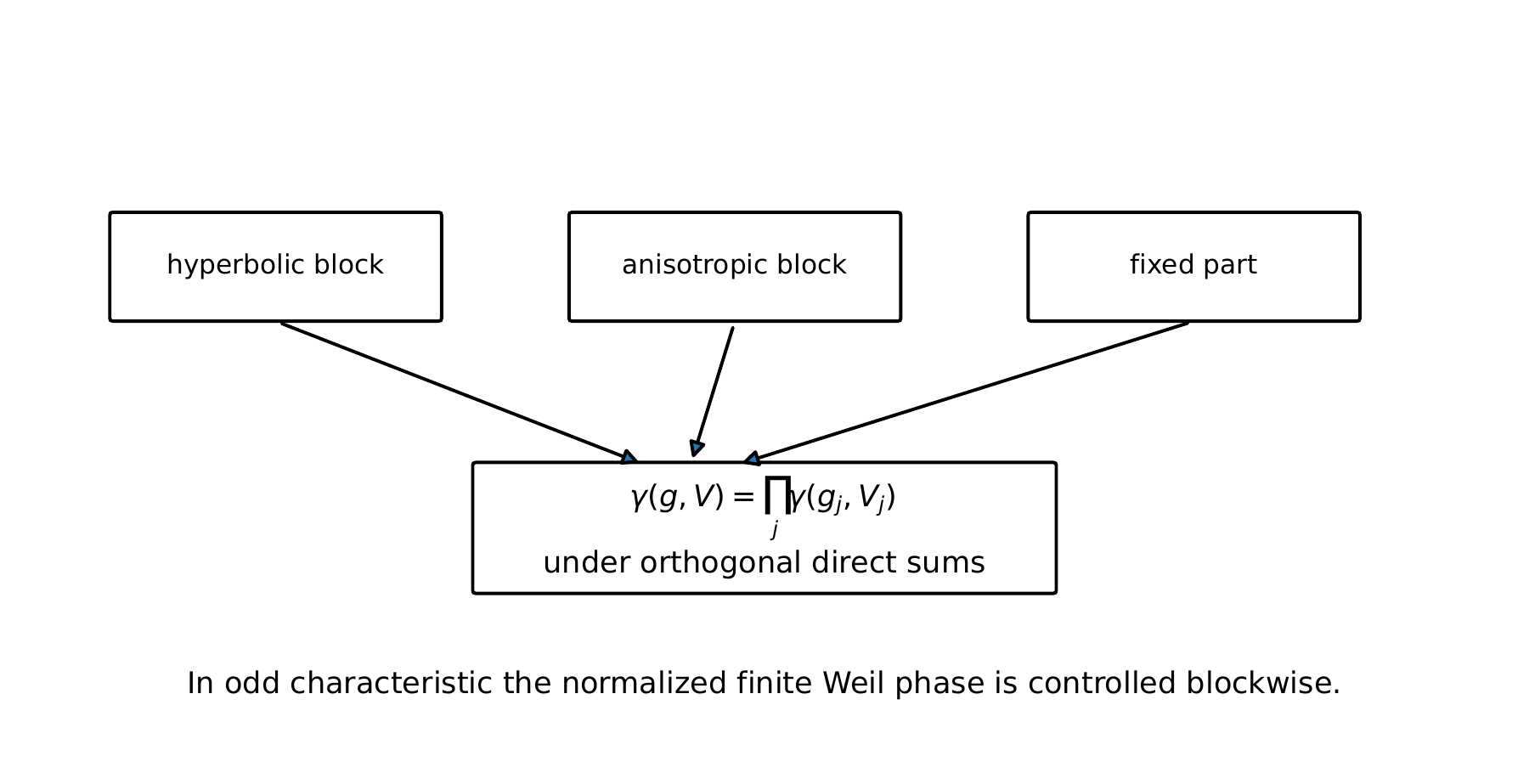
Proposition 12.4: Orthogonal multiplicativity
Suppose
and \(g\) preserves every summand. If no \(g|_{V_j}\) has a fixed vector, then
Read proof · Read statement and proof side by side · Permalink · Source line 1335 · Claim record · Lean coverage · Code · Worked examples
Proof of Proposition 12.4
The half dimensions add, and
The quadratic character is multiplicative.
Back to statement · Read statement and proof side by side · Permalink · Source line 1351 · Claim record · Lean coverage · Code · Worked examples
Corollary 12.5: Characteristic polynomial certificate
Let
Then
Read proof · Read statement and proof side by side · Permalink · Source line 1361 · Claim record · Lean coverage · Code · Worked examples
Proof of Corollary 12.5
Since \(\dim V\) is even,
Back to statement · Read statement and proof side by side · Permalink · Source line 1377 · Claim record · Lean coverage · Code · Worked examples
Proposition 12.6: Fixed and moving decomposition
Assume that \(g\in{\operatorname{Sp}}(V)\) has order prime to \(p\). Then
The restriction of the symplectic form to \({\operatorname{im}}(g-I)\) is nondegenerate, and \(g-I\) is invertible on that moving summand.
Read proof · Read statement and proof side by side · Permalink · Source line 1385 · Claim record · Lean coverage · Code · Worked examples
Proof of Proposition 12.6
The order hypothesis makes \(g\) semisimple, so
If \(x\in\ker(g-I)\) and \(y=(g-I)z\), then
Thus the two summands are orthogonal. Nondegeneracy on each summand follows from nondegeneracy on \(V\). The last statement is immediate from the direct sum decomposition.
Back to statement · Read statement and proof side by side · Permalink · Source line 1393 · Claim record · Lean coverage · Code · Worked examples
Definition 12.7: Moving phase
Under the hypotheses of Proposition 12.6, define
Permalink · Source line 1405 · Claim record · Lean coverage · Code · Worked examples
Proposition 12.8: Hyperbolic phase formula
Let \(U\) be a finite dimensional \({\mathbb F}_p\) space, let \(a\in{\operatorname{GL}}(U)\) have no eigenvalue one, and let \(g\) act on
by
Then
Read proof · Read statement and proof side by side · Permalink · Source line 1414 · Claim record · Lean coverage · Code · Worked examples
Proof of Proposition 12.8
Put \(d=\dim U\). We have
Hence
Multiplying its quadratic character by the normalization factor \((\frac{-1}{p})^d\) cancels the sign and the square. Since a quadratic character equals its inverse, the result is \((\frac{\det a}{p})\).
Back to statement · Read statement and proof side by side · Permalink · Source line 1433 · Claim record · Lean coverage · Code · Worked examples
Corollary 12.9: Phase only bridge test
Two odd characteristic moving packets have the same normalized phase whenever their moving half dimensions agree and the determinants of \(g-I\) lie in the same square class.
Read proof · Read statement and proof side by side · Permalink · Source line 1449 · Claim record · Lean coverage · Code · Worked examples
Proof of Corollary 12.9
Apply the definition of \(\Phi_p\).
Back to statement · Read statement and proof side by side · Permalink · Source line 1453 · Claim record · Lean coverage · Code · Worked examples
Remark 12.10
When \(g\) has fixed vectors, one first separates the fixed part and applies the formula to the moving quotient. Additional normalization data may enter the full trace on the fixed part.