3 Tame Frobenius packets
On this page · Visual guide: Fourier projectors isolate tame inertia · Visual guide: One orbit gives one tame atom · Visual guide: Regular orbits have exact counts · Visual guide: The closing scalar carries noncompact information · Permalink · Source line 315
Assume that \(P_K\) acts trivially. After passing to a finite quotient, tame inertia is cyclic. Let \(t\) generate a quotient of order \(M\), and put \(\zeta_M={\mathrm e}^{2\pi i/M}\). For \(j\in{\mathbb Z}/M{\mathbb Z}\), define
Proposition 3.1: Tame character projectors
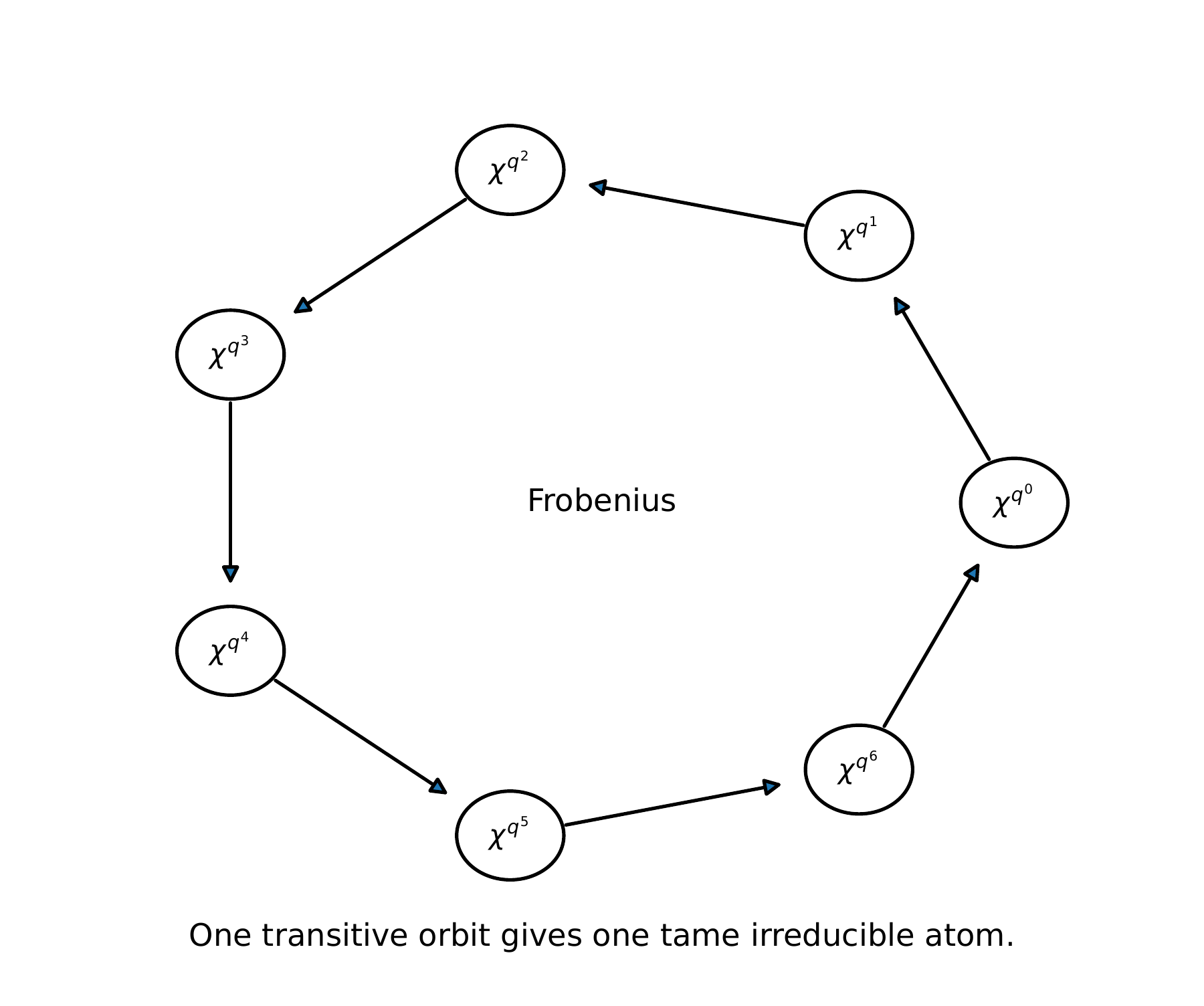
The operators \(P_j\) are pairwise orthogonal idempotents whose sum is the identity. Frobenius permutes them by
Read proof · Read statement and proof side by side · Permalink · Source line 326 · Claim record · Lean coverage · Code · Worked examples
Proof of Proposition 3.1
The first assertion is the Fourier idempotent calculation for a cyclic group. For the geometric Frobenius convention of Section 2, the relation is \(\Phi^{-1}t\Phi=t^q\). Equivalently, \(\Phi t\Phi^{-1}=t^{q^{-1}}\), with inverse taken modulo \(M\) since \(\gcd(q,M)=1\). Conjugating the Fourier sum and changing its summation index therefore gives \(\Phi P_j\Phi^{-1}=P_{qj}\). The inverse Frobenius convention reverses the label direction while preserving the same orbits.
Back to statement · Read statement and proof side by side · Permalink · Source line 333 · Claim record · Lean coverage · Code · Worked examples
Theorem 3.2: Tame orbit induction
Let \(\tau\) be an irreducible complex representation of \(W_K\) with trivial wild inertia. Then the nonzero tame character packets form one transitive Frobenius orbit of length \(f\). If \(K_f/K\) is the unramified extension of degree \(f\), there is a character \(\xi\) of \(W_{K_f}\) such that
Read proof · Read statement and proof side by side · Permalink · Source line 337 · Claim record · Lean coverage · Code · Worked examples
Proof of Theorem 3.2
The nonzero tame packets are permuted by Frobenius. A union of Frobenius orbits is stable under \(W_K\), so irreducibility forces one orbit. Choose one packet \(V_\theta\). Its stabilizer is \(W_{K_f}=\langle I_K,\Phi^f\rangle\). A nonzero proper stable subspace of \(V_\theta\) would generate a nonzero proper \(W_K\) stable subspace after summing its Frobenius translates. Thus \(V_\theta\) is irreducible for the stabilizer. Inertia acts on it by the scalar character \(\theta\), and the remaining action is generated by \(\Phi^f\). The stabilizer action on this packet is therefore one dimensional. Induction reconstructs the complete orbit.
Back to statement · Read statement and proof side by side · Permalink · Source line 346 · Claim record · Lean coverage · Code · Worked examples
Corollary 3.3: Dimension and regularity
The dimension of \(\tau\) equals the Frobenius orbit length of its tame inertia character. The inducing character is regular, meaning that no smaller positive power of Frobenius fixes it.
Read proof · Read statement and proof side by side · Permalink · Source line 350 · Claim record · Lean coverage · Code · Worked examples
Proof of Corollary 3.3
The induced representation has one line for every Frobenius translate of the chosen character. A shorter orbit would produce a proper stabilizer and contradict the minimality of \(f\).
Back to statement · Read statement and proof side by side · Permalink · Source line 354 · Claim record · Lean coverage · Code · Worked examples
Proposition 3.4: Dual and self dual tame packets
For a tame atom
we have
The atom is self dual exactly when
for some \(j\in{\mathbb Z}/f{\mathbb Z}\).
Read proof · Read statement and proof side by side · Permalink · Source line 359 · Claim record · Lean coverage · Code · Worked examples
Proof of Proposition 3.4
Duality commutes with finite index induction, giving the first statement. Two regular induced tame atoms are isomorphic exactly when their inducing characters lie in the same Frobenius orbit. Applying this to \(\xi\) and \(\xi^{-1}\) gives the criterion.
Back to statement · Read statement and proof side by side · Permalink · Source line 377 · Claim record · Lean coverage · Code · Worked examples
Proposition 3.5: Unramified twist
Let \(\nu\) be an unramified character of \(W_K\). Then
The tame inertia orbit is unchanged. If the original Frobenius cycle has closing scalar \(a\), the twisted cycle has closing scalar
Read proof · Read statement and proof side by side · Permalink · Source line 381 · Claim record · Lean coverage · Code · Worked examples
Proof of Proposition 3.5
The tensor identity follows from the projection formula for induction. Since \(\nu\) is trivial on inertia, it does not change any tame character packet. It multiplies every Frobenius step by \(\nu(\Phi)\), so a closed cycle of length \(f\) gains the factor \(\nu(\Phi)^f\).
Back to statement · Read statement and proof side by side · Permalink · Source line 397 · Claim record · Lean coverage · Code · Worked examples
3.1 Regular orbit counts
On this page · Permalink · Source line 408
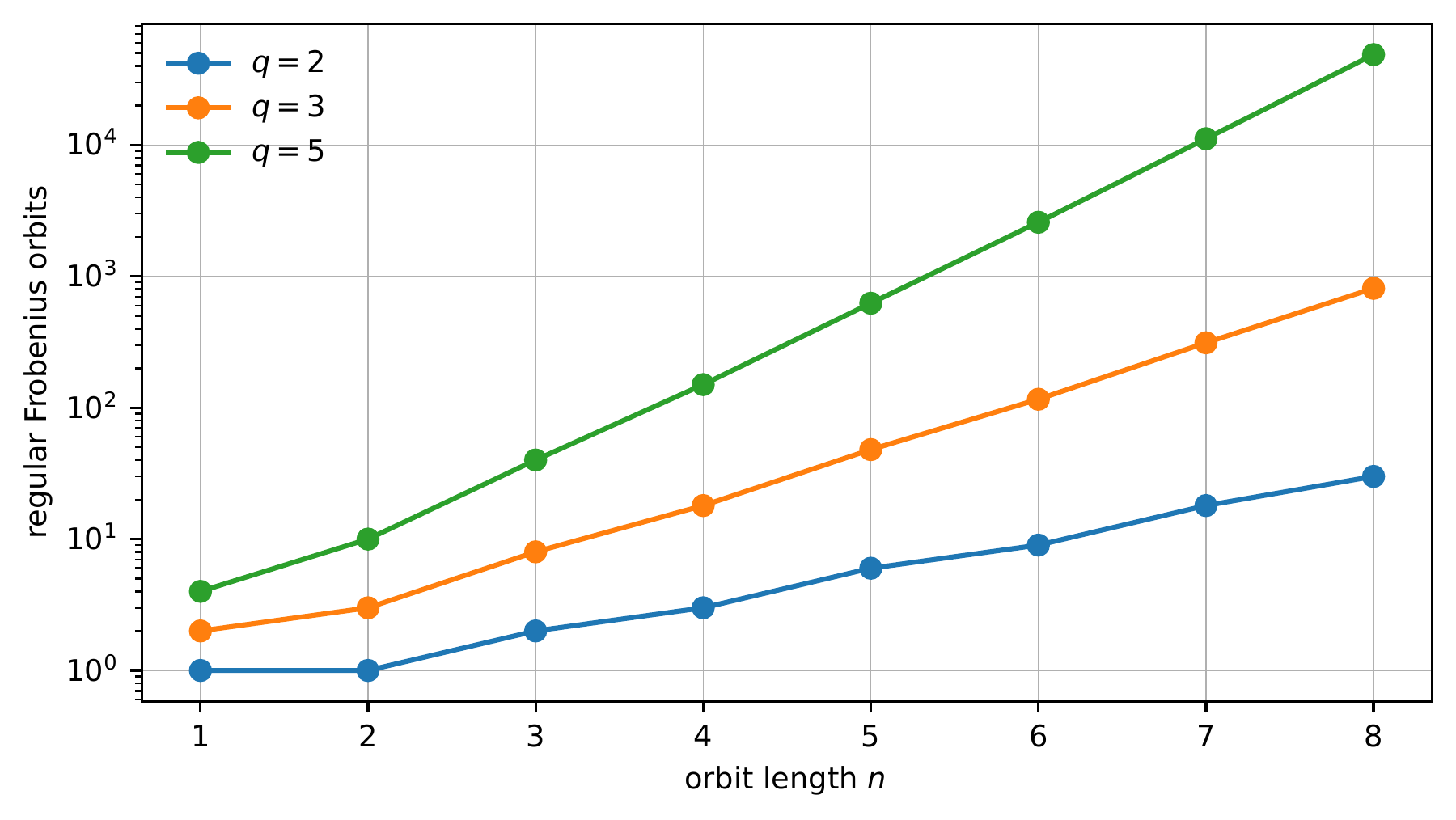
Characters of \({\mathbb F}_{q^n}^{\times}\) are indexed by exponents modulo \(q^n-1\), and Frobenius acts by multiplication by \(q\).
Proposition 3.6: Möbius orbit count
The number of regular Frobenius orbits of length \(n\) is
Read proof · Read statement and proof side by side · Permalink · Source line 412 · Claim record · Lean coverage · Code · Worked examples
Proof of Proposition 3.6
For every divisor \(r\mid n\), the characters fixed by \({\operatorname{Frob}}^r\) are exactly those descending to \({\mathbb F}_{q^r}^{\times}\), and there are \(q^r-1\) of them. Möbius inversion gives the number of characters of exact orbit length \(n\). Division by \(n\) gives the number of orbits.
Back to statement · Read statement and proof side by side · Permalink · Source line 426 · Claim record · Lean coverage · Code · Worked examples
Example 3.7: Degree four over \({\mathbb F}_2\)
The regular exponent orbits modulo fifteen are
The formula gives