
4 Finite field cuspidal projectors
On this page · Visual guide: A primitive projector selects a cuspidal block · Visual guide: The closing scalar carries noncompact information · Permalink · Source line 452
Let
with \(T_n\) an elliptic maximal torus.
Standard fact 4.1: Regular elliptic torus characters
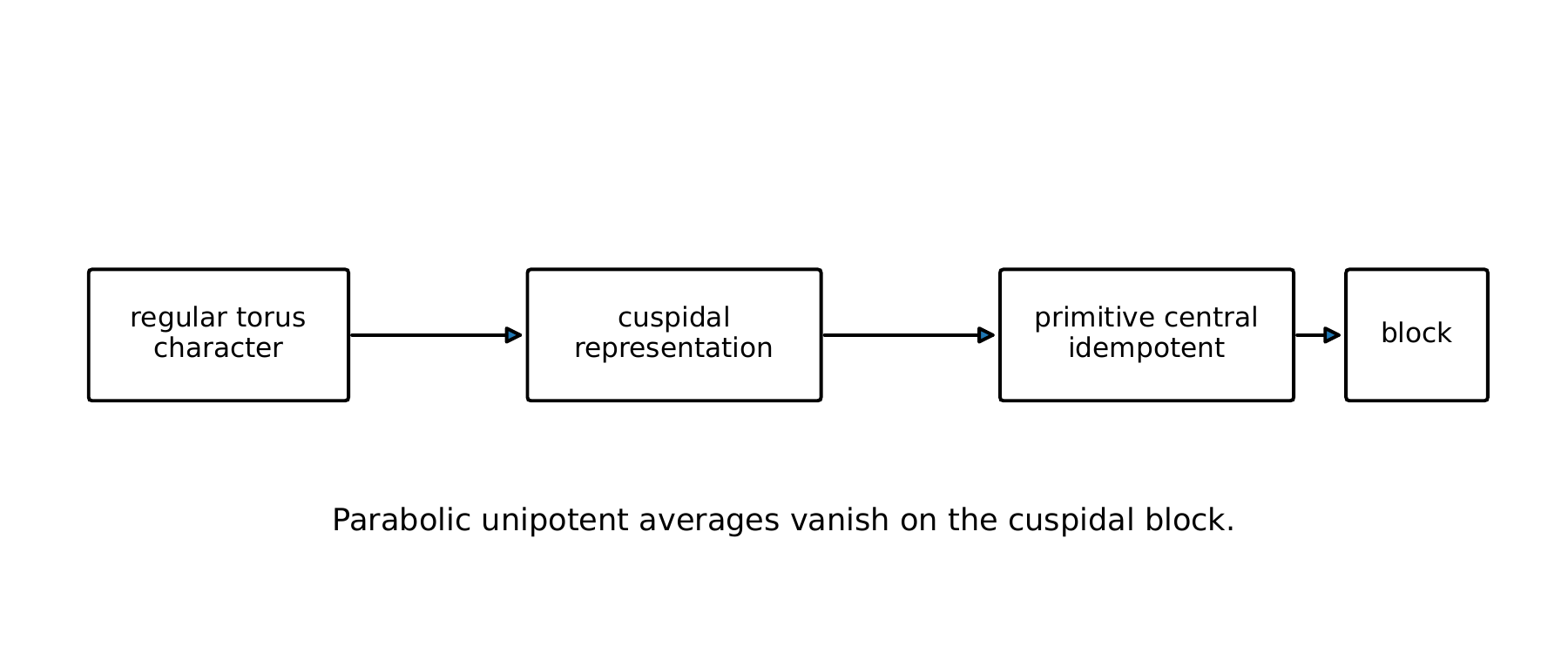
A regular character \(\theta:T_n\to{\mathbb C}^{\times}\) determines an irreducible cuspidal representation \(\kappa_\theta\) of \(G_n\). Frobenius conjugate characters determine isomorphic representations, and every irreducible cuspidal representation of \(G_n\) occurs in this way.
Permalink · Source line 462 · Claim record · Lean coverage · Code · Worked examples
This is the finite field input from Deligne and Lusztig theory [13]. We use standard finite group character theory for the central idempotents [28], [21]. Once \(\kappa_\theta\) is known, its block is selected by a central idempotent.
Proposition 4.2: Primitive cuspidal idempotent
Let \(\chi_\theta\) be the irreducible character of \(\kappa_\theta\), and let \(d_\theta=\chi_\theta(1)\). Then
is the primitive central idempotent selecting the \(\kappa_\theta\) block in \({\mathbb C}[G_n]\).
Read proof · Read statement and proof side by side · Permalink · Source line 468 · Claim record · Lean coverage · Code · Worked examples
Proof of Proposition 4.2
On an irreducible representation of character \(\psi\), the central element acts by a scalar. Taking traces shows that the scalar is
Character orthogonality makes this scalar one for \(\psi=\chi_\theta\) and zero otherwise. The element is therefore central, idempotent, and primitive.
Back to statement · Read statement and proof side by side · Permalink · Source line 480 · Claim record · Lean coverage · Code · Worked examples
Proposition 4.3: Parabolic annihilation
Let \(P=LU\) be a proper parabolic subgroup of \(G_n\), and put
If \(\kappa_\theta\) is cuspidal, then
Read proof · Read statement and proof side by side · Permalink · Source line 490 · Claim record · Lean coverage · Code · Worked examples
Proof of Proposition 4.3
The operator \(e_U\) projects onto the subspace of \(U\) fixed vectors. A cuspidal representation has no nonzero fixed vector under the unipotent radical of a proper parabolic. Thus \(e_U\) acts by zero on the \(\kappa_\theta\) block. Since \(e_\theta\) is central, both products vanish.
Back to statement · Read statement and proof side by side · Permalink · Source line 503 · Claim record · Lean coverage · Code · Worked examples
4.1 Depth zero reconstruction and cycle orientation
On this page · Permalink · Source line 514
The depth zero construction inflates a finite cuspidal representation to \({\operatorname{GL}}_n({\mathcal O}_K)\), extends it to the standard compact modulo center subgroup, and then compactly induces it to \({\operatorname{GL}}_n(K)\). This is classical type theory [11], [8].
The induced tame Weil atom has an elementary cycle invariant. In an orbit basis \(e_0,\ldots,e_{n-1}\), write
for \(j<n-1\), and
Proposition 4.4: Frobenius cycle polynomial
The Frobenius transfer matrix has characteristic polynomial
and determinant
Read proof · Read statement and proof side by side · Permalink · Source line 527 · Claim record · Lean coverage · Code · Worked examples
Proof of Proposition 4.4
The matrix is the companion matrix of \(X^n-a\). Its only nonzero determinant term is the closed \(n\) cycle. That cycle has sign \((-1)^{n-1}\), and the closing edge contributes \(a\).
Back to statement · Read statement and proof side by side · Permalink · Source line 540 · Claim record · Lean coverage · Code · Worked examples
Corollary 4.5: Unramified orientation character
The sign \((-1)^{n-1}\) is the orientation of the closed Frobenius packet cycle. It is unchanged by rescaling the individual orbit basis vectors.
Read proof · Read statement and proof side by side · Permalink · Source line 544 · Claim record · Lean coverage · Code · Worked examples
Proof of Corollary 4.5
A basis rescaling conjugates the transfer matrix by a diagonal matrix, so the determinant and characteristic polynomial remain unchanged.
Back to statement · Read statement and proof side by side · Permalink · Source line 548 · Claim record · Lean coverage · Code · Worked examples