
2 Weil Deligne chains
On this page · Visual guide: Three mathematical objects · Visual guide: Monodromy is a finite transfer chain · Permalink · Source line 232
Let \(W_K\) be the Weil group of \(K\), let \(I_K\) be inertia, let \(P_K\) be wild inertia, and choose a geometric Frobenius lift \(\Phi\). A Weil Deligne representation is a pair \((r,N)\) with
Standard fact 2.1: Indecomposable monodromy blocks
Every Frobenius semisimple Weil Deligne representation is a direct sum of blocks
where \(\tau\) is an irreducible Weil representation and the nilpotent operator is one Jordan chain of length \(m\).
Permalink · Source line 239 · Claim record · Lean coverage · Code · Worked examples
This standard decomposition reduces the construction of a local correspondence to two tasks. One must understand irreducible Weil atoms, then one must attach the correct generalized Steinberg chain. The second task is formal once the first is known.
Definition 2.2: Monodromy packet chain
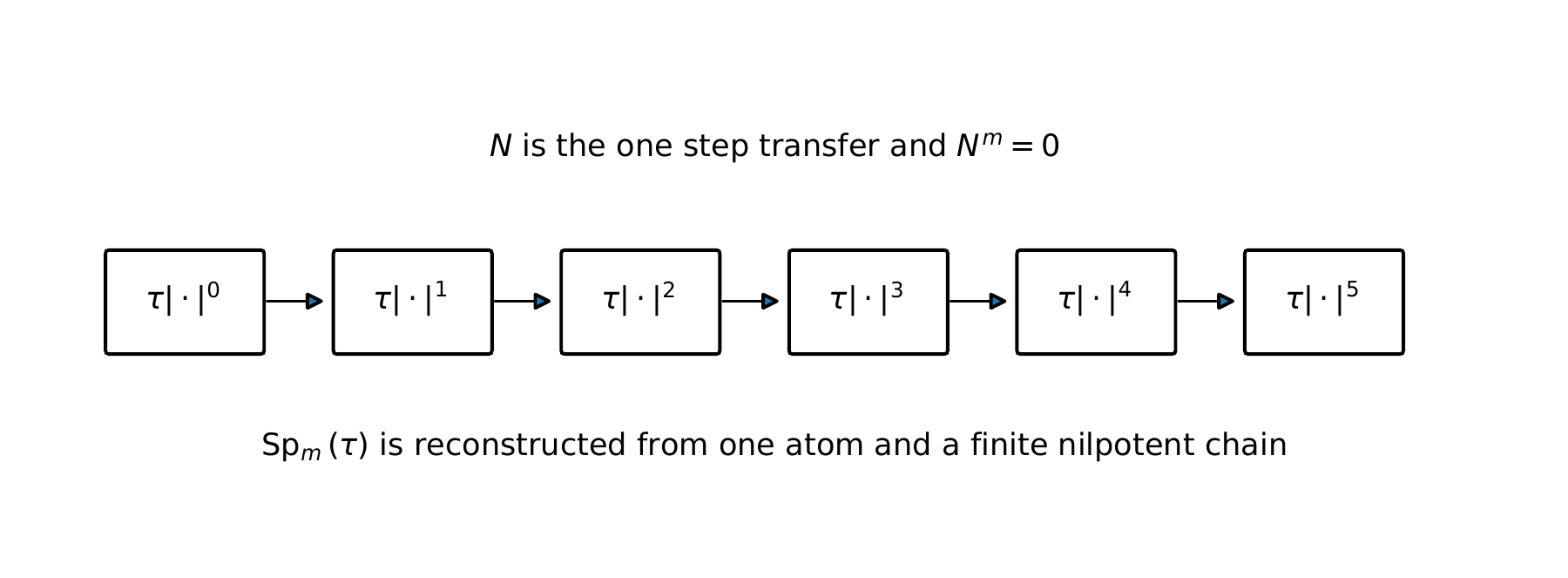
Let \(V_0,\ldots,V_{m-1}\) be copies of the space of \(\tau\). Put
A monodromy packet chain is a nilpotent operator \(N\) with
for \(j>0\), with \(N(V_0)=0\), together with a Frobenius operator whose conjugation scales \(N\) by \(q^{-1}\).
Permalink · Source line 249 · Claim record · Lean coverage · Code · Worked examples
Proposition 2.3: Exact block reconstruction
Let \(P_j\) be the projector onto \(V_j\). Then
Every power \(N^r\) is the sum of the packet paths of length \(r\) along the chain.
Read proof · Read statement and proof side by side · Permalink · Source line 261 · Claim record · Lean coverage · Code · Worked examples
Proof of Proposition 2.3
The projectors resolve the identity. Since \(N\) maps only from \(V_j\) to \(V_{j-1}\), every block except the displayed nearest neighbor blocks vanishes. A product of \(r\) nonzero blocks moves down exactly \(r\) levels. No path of length \(m\) exists, so \(N^m=0\).
Back to statement · Read statement and proof side by side · Permalink · Source line 271 · Claim record · Lean coverage · Code · Worked examples
Proposition 2.4: Scalar covariance model
Let
and let \(N_{j-1,j}=1\). Then
Read proof · Read statement and proof side by side · Permalink · Source line 275 · Claim record · Lean coverage · Code · Worked examples
Proof of Proposition 2.4
The only nonzero entry in column \(j\) and row \(j-1\) is multiplied by \(q^{j-1}q^{-j}=q^{-1}\) under conjugation.
Back to statement · Read statement and proof side by side · Permalink · Source line 286 · Claim record · Lean coverage · Code · Worked examples
Theorem 2.5: Formal atomic reconstruction
Assume that every irreducible Weil representation \(\tau\) has been assigned a supercuspidal representation \(\sigma_\tau\), compatibly with isomorphism and unramified twist. Then the rules
and normalized parabolic induction determine a candidate correspondence on all Frobenius semisimple Weil Deligne parameters.
Read proof · Read statement and proof side by side · Permalink · Source line 297 · Claim record · Lean coverage · Code · Worked examples
Proof of Theorem 2.5
Decompose the parameter into indecomposable monodromy blocks. Replace each Weil atom by its assigned supercuspidal atom and each monodromy chain by the corresponding generalized Steinberg block. Order the resulting essentially square integrable factors in Langlands order and take the unique irreducible quotient. The multiset of indecomposable Weil Deligne blocks is intrinsic, so the result does not depend on the chosen display.
Back to statement · Read statement and proof side by side · Permalink · Source line 307 · Claim record · Lean coverage · Code · Worked examples
Remark 2.6
Theorem 2.5 is a reconstruction theorem. It does not produce the atomic assignment \(\tau\mapsto\sigma_\tau\), and it does not prove the required local factor identities.