
8 Twisted group algebras and commutator envelopes
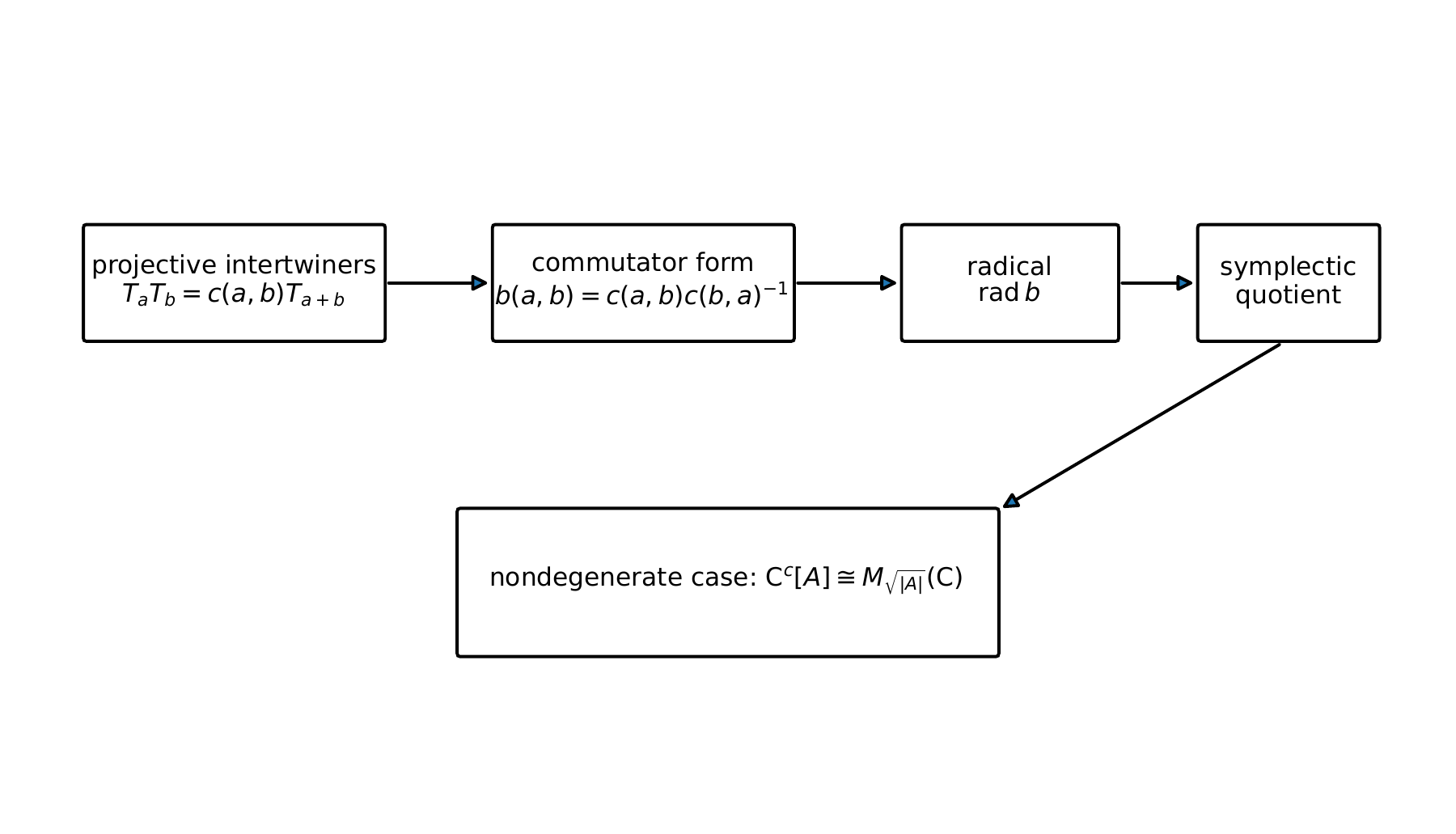
On this page · Visual guide: Projective choices leave a commutator invariant · Permalink · Source line 916
Let \(A\) be a finite abelian group, and let
be a normalized two cocycle. The twisted group algebra \({\mathbb C}^c[A]\) has basis \((u_a)_{a\in A}\) and multiplication
Define the commutator bicharacter
Proposition 8.1: Scalar choice invariance
Replacing \(u_a\) by \(\lambda_au_a\), with \(\lambda_a\in{\mathbb C}^{\times}\), changes \(c\) by a coboundary and leaves \(b_c\) unchanged.
Read proof · Read statement and proof side by side · Permalink · Source line 931 · Claim record · Lean coverage · Code · Worked examples
Proof of Proposition 8.1
The new cocycle is
The scalar coboundary factor is symmetric in \(a\) and \(b\), so it cancels from \(c'(a,b)c'(b,a)^{-1}\).
Back to statement · Read statement and proof side by side · Permalink · Source line 935 · Claim record · Lean coverage · Code · Worked examples
Proposition 8.2: Alternating commutator form
The map \(b_c\) is an alternating bicharacter. Its radical
is a subgroup, and \(b_c\) descends to a nondegenerate alternating bicharacter on \(A/R\).
Read proof · Read statement and proof side by side · Permalink · Source line 945 · Claim record · Lean coverage · Code · Worked examples
Proof of Proposition 8.2
Associativity of the twisted product gives multiplicativity of scalar commutators in each variable. We have \(b_c(a,a)=1\) and \(b_c(b,a)=b_c(a,b)^{-1}\). The radical is the kernel of the homomorphism from \(A\) to its character group defined by \(a\mapsto b_c(a,\cdot)\). The induced pairing on the quotient is nondegenerate by construction.
Back to statement · Read statement and proof side by side · Permalink · Source line 953 · Claim record · Lean coverage · Code · Worked examples
Theorem 8.3: Nondegenerate twisted group algebra
Assume that \(b_c\) is nondegenerate. Then \({\left\lvert A\right\rvert}\) is a square, and
Consequently, \({\mathbb C}^c[A]\) has one irreducible module up to isomorphism, of dimension \(\sqrt{{\left\lvert A\right\rvert}}\).
Read proof · Read statement and proof side by side · Permalink · Source line 957 · Claim record · Lean coverage · Code · Worked examples
Proof of Theorem 8.3
Let
be central. Commuting with \(u_x\) gives
for every \(x\). Nondegeneracy forces \(z_a=0\) for every nonzero \(a\). Thus the center is \({\mathbb C}\). To prove semisimplicity directly, choose a linear projection \(P\) onto a submodule of a finite dimensional \({\mathbb C}^c[A]\)-module and form
Every summand maps into the submodule and is the identity there. Conjugation by any \(u_x\) permutes the summands: the cocycle scalars cancel between each operator and its inverse. Hence \(\overline P\) is an equivariant projection, and its kernel is an invariant complement. The algebra is therefore semisimple. Its center \({\mathbb C}\) permits only one simple factor. A finite dimensional central simple algebra over \({\mathbb C}\) is a full matrix algebra. Its dimension is \({\left\lvert A\right\rvert}\), so the matrix size is \(\sqrt{{\left\lvert A\right\rvert}}\).
Back to statement · Read statement and proof side by side · Permalink · Source line 969 · Claim record · Lean coverage · Code · Worked examples
Corollary 8.4: Radical free envelope
For an arbitrary scalar projective action of \(A\), the quotient
is the maximal quotient detected by noncommuting projective intertwiners. If \(A\) is an elementary abelian \(p\) group, then \(A^{\mathrm{symp}}\) is a symplectic \({\mathbb F}_p\) space.
Read proof · Read statement and proof side by side · Permalink · Source line 985 · Claim record · Lean coverage · Code · Worked examples
Proof of Corollary 8.4
Every radical element commutes with all projective generators, so it contributes only central data. Quotienting by the radical leaves the nondegenerate commutator form. In the elementary abelian case, multiplicative values in the group of \(p\)th roots can be written as an alternating bilinear form over \({\mathbb F}_p\).
Back to statement · Read statement and proof side by side · Permalink · Source line 995 · Claim record · Lean coverage · Code · Worked examples
Remark 8.5
The envelope depends only on the projective representation. It does not by itself prove that a given wild inertia representation carries a canonical finite quotient with the required projective action.