
Reading the figure
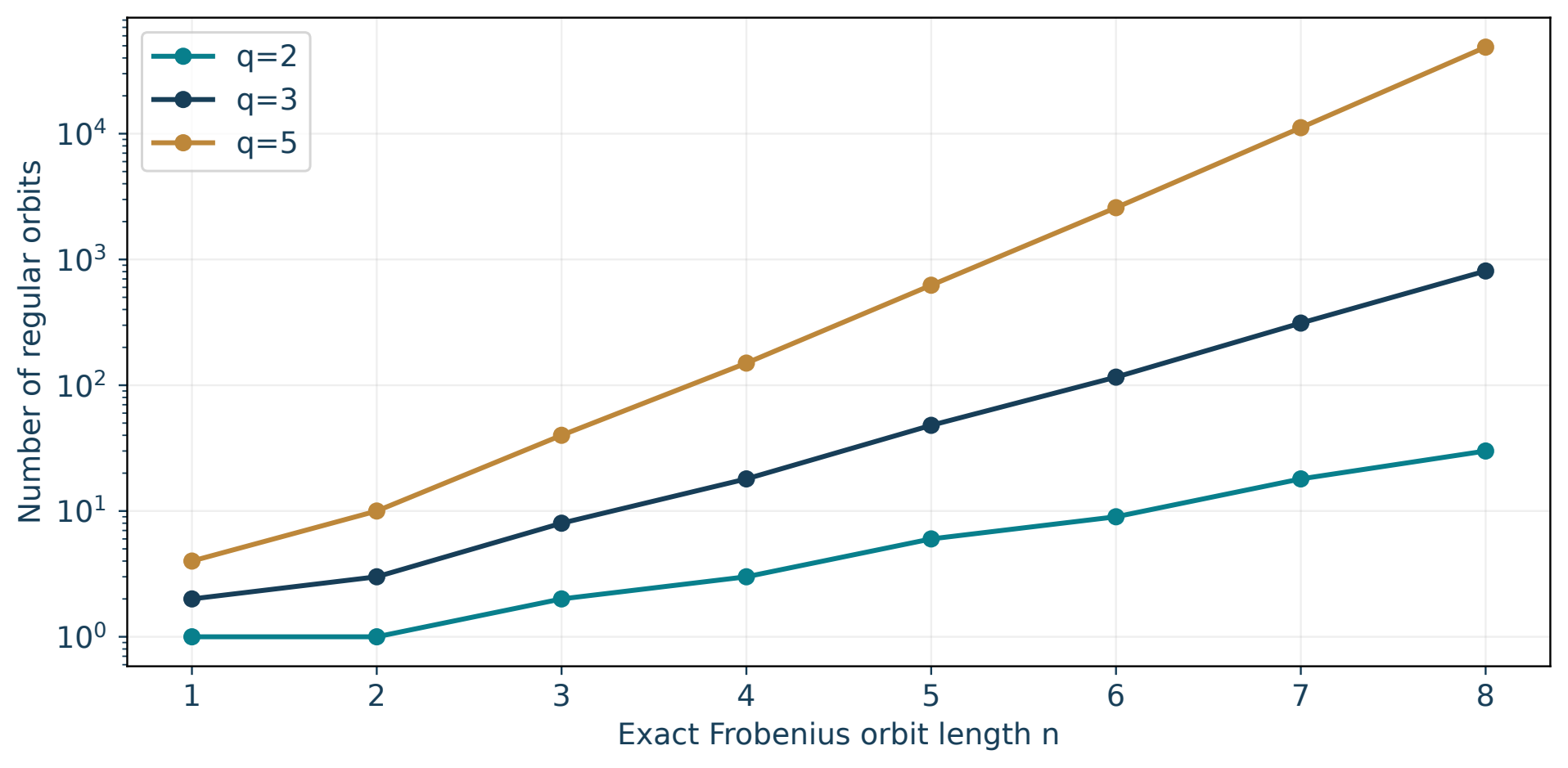
Three series give regular orbit counts for residue sizes two, three and five, at orbit lengths one through eight. The vertical axis is logarithmic. The following table retains the recorded integers.
| Orbit length n | q = 2 | q = 3 | q = 5 |
|---|---|---|---|
| 1 | 1 | 2 | 4 |
| 2 | 1 | 3 | 10 |
| 3 | 2 | 8 | 40 |
| 4 | 3 | 18 | 150 |
| 5 | 6 | 48 | 624 |
| 6 | 9 | 116 | 2580 |
| 7 | 18 | 312 | 11160 |
| 8 | 30 | 810 | 48750 |
Selectable labels from the original PDF
Native PDF text retains the figure’s extraction order. Equations and data tables above provide the reading order.
1
2
3
4
5
6
7
8
Exact Frobenius orbit length n
1
0
0
1
0
1
1
0
2
1
0
3
1
0
4
Number of regular orbits
q=2
q=3
q=5
Original figure caption
Exact integer counts; the vertical scale is logarithmic.
Characters of \({\mathbb F}_{q^n}^{\times}\) are indexed modulo \(q^n-1\). Characters fixed by a Frobenius power of degree \(r\mid n\) number \(q^r-1\). Möbius inversion removes those belonging to smaller orbits:
For \(q=2,n=4\), the regular exponent orbits modulo 15 are
Their number is \(\tfrac14(15-3)=3\). The plotted values are computed by the exact divisor sum and retained in figure_data.json.
Reading the diagram
Regularity is an exact orbit property. The plot illustrates an integer formula rather than supplying its proof.