
Reading the figure
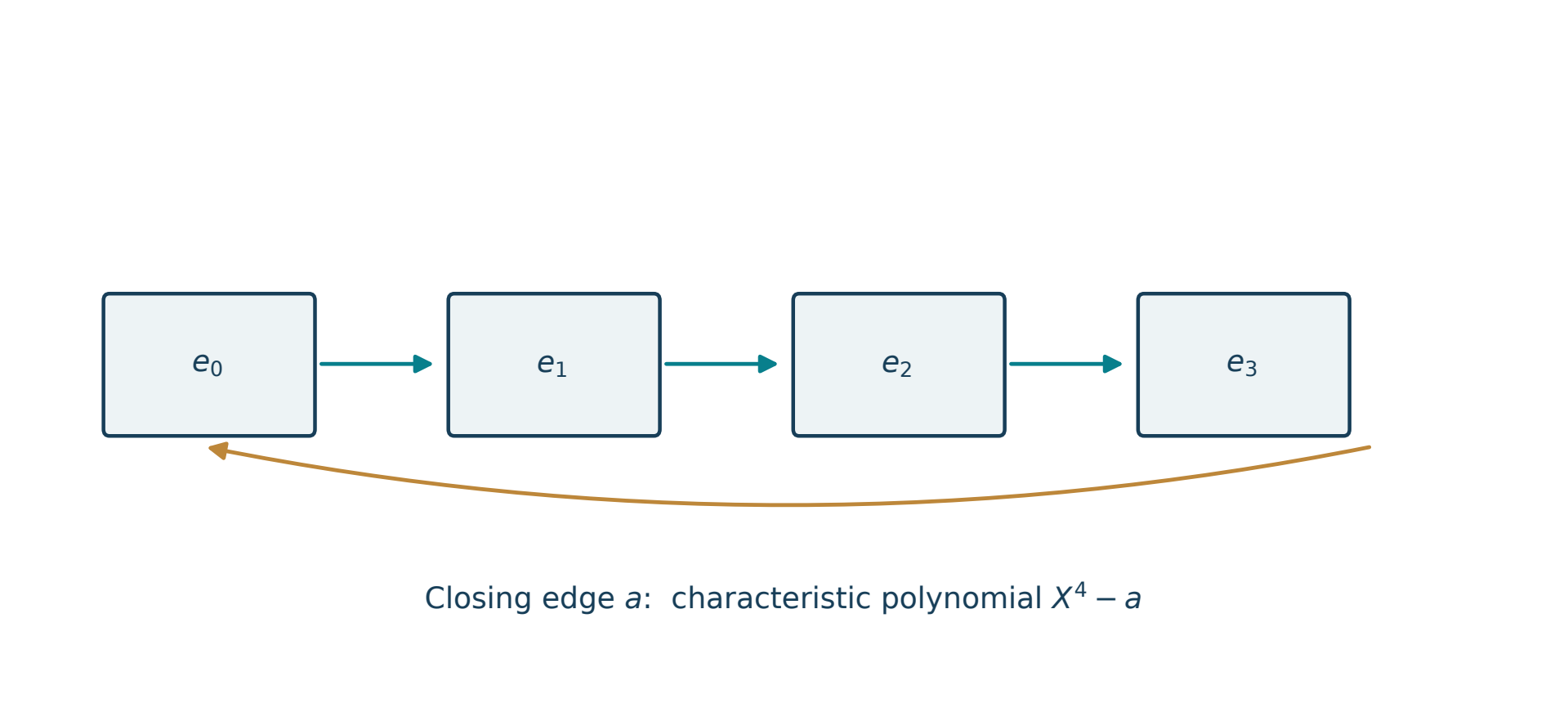
A four-step cycle has ordinary transfer edges and one closing edge marked a. Its characteristic polynomial is X to the fourth minus a. The closing scalar retains information beyond the inertia orbit.
Mathematical labels
Closing edge \(a\): characteristic polynomial \(X^4-a\)
Selectable labels from the original PDF
Native PDF text retains the figure’s extraction order. Equations and data tables above provide the reading order.
e0 e1 e2 e3
Closing edge a: characteristic polynomial X
4 − a
Original figure caption
The closing scalar is basis-invariant after multiplication around the cycle.
In an orbit basis let \(\Phi e_j=e_{j+1}\) for \(j<n-1\) and \(\Phi e_{n-1}=ae_0\). Then
Rescaling the individual basis vectors changes edge coefficients, but their product remains \(a\). An unramified twist \(\nu\) does not change the inertia orbit and sends the closing scalar to \(a\nu(\Phi)^n\).
Reading the diagram
Compact inertia information alone does not determine the unramified completion. The cyclic scalar is additional data.