
Reading the figure
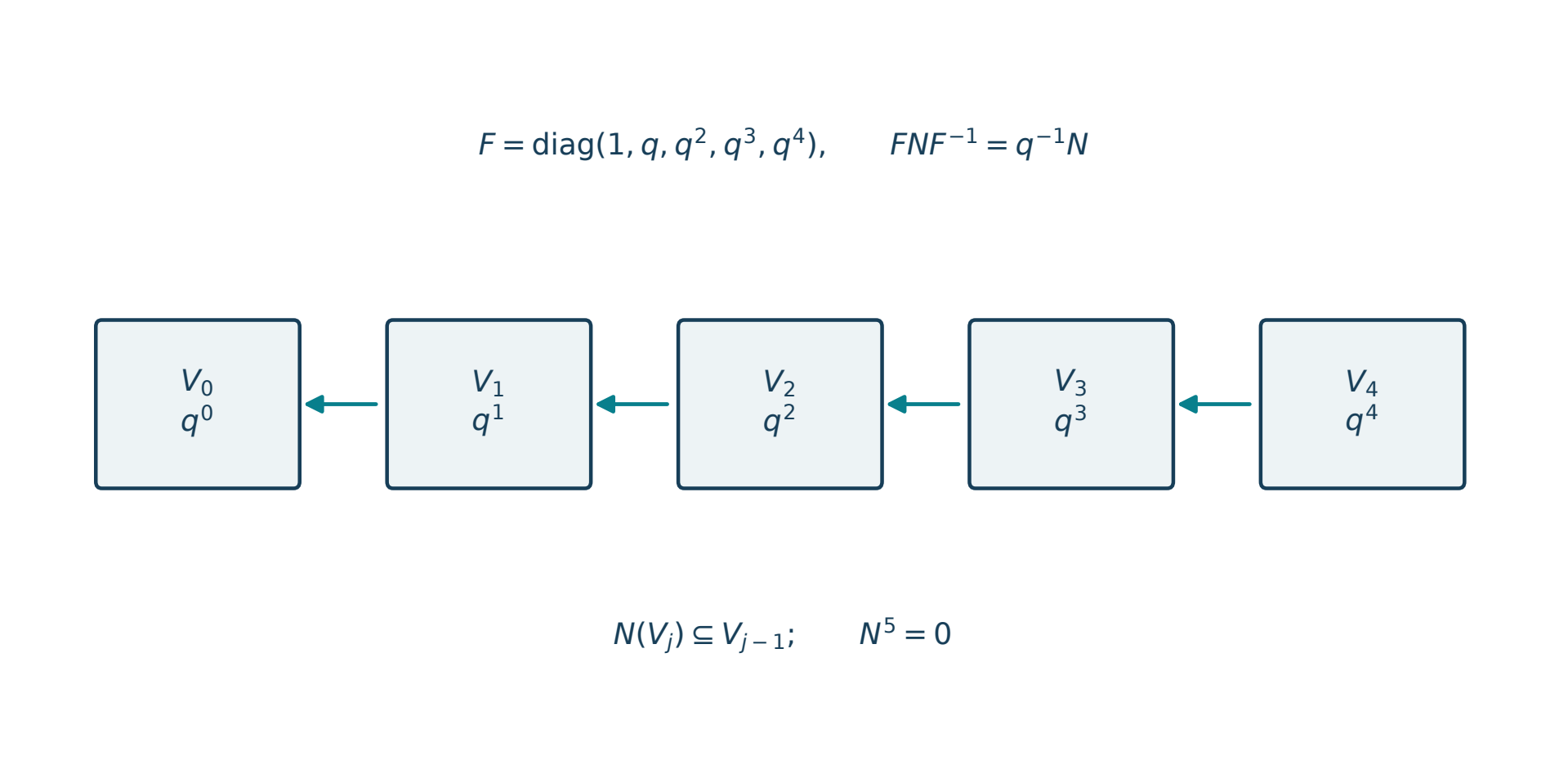
Five spaces run from V zero to V four. The arrows for N point toward the preceding space. A path of five transfers cannot exist, giving the illustrated nilpotence statement.
Mathematical labels
\(F=\mathrm{diag}(1,q,q^2,q^3,q^4),\qquad FNF^{-1}=q^{-1}N\)
\(N(V_j)\subseteq V_{j-1};\qquad N^5=0\)
Selectable labels from the original PDF
Native PDF text retains the figure’s extraction order. Equations and data tables above provide the reading order.
V0
q
0
V1
q
1
V2
q
2
V3
q
3
V4
q
4
F = diag(1, q, q
2
, q
3
, q
4
), FNF
−1 = q
−1N
N(Vj) ⊆ Vj − 1; N
5 = 0
Original figure caption
The arrows point from \(V_j\) to \(V_{j-1}\), the direction of \(N\).
Put \(V=\bigoplus_{j=0}^{m-1}V_j\) and let \(P_j\) be the coordinate projector. If \(N(V_j)\subseteq V_{j-1}\) and \(N(V_0)=0\), then
Every term in \(N^r\) follows a path of length \(r\) down the chain. There is no path of length \(m\). With \(F=\operatorname{diag}(1,q,\ldots,q^{m-1})\), each nonzero transfer block gains the conjugation factor \(q^{j-1}q^{-j}=q^{-1}\).
Reading the diagram
Nilpotence and covariance follow from the displayed block structure. Assigning the initial supercuspidal atom is a separate arithmetic input.