
Reading the figure
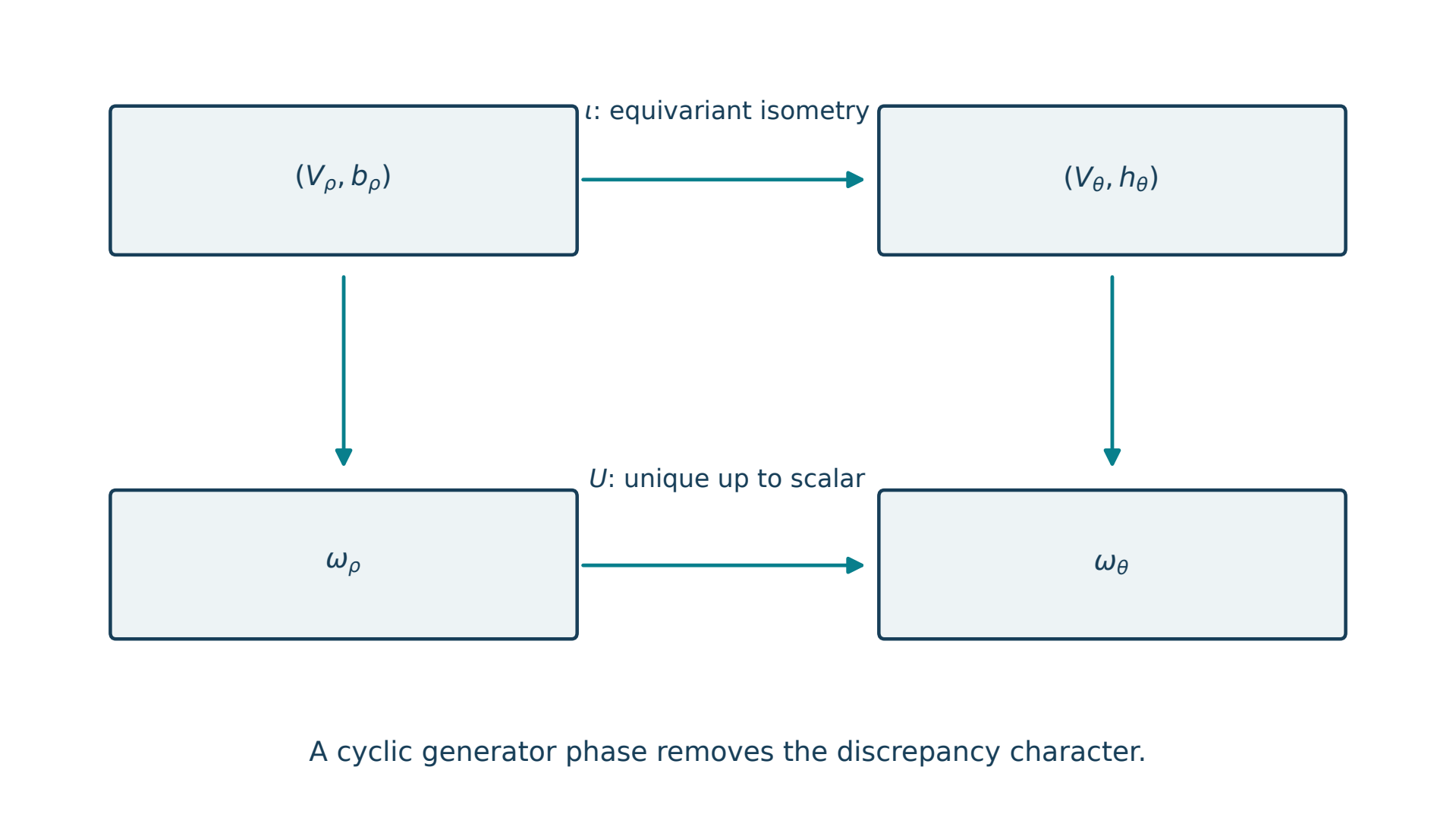
The two representations are related by a supplied intertwiner. Their remaining discrepancy is a scalar character, which a cyclic generator phase can remove under the stated assumptions.
Mathematical labels
\((V_\rho,b_\rho)\)
\((V_\theta,h_\theta)\)
\(\omega_\rho\)
\(\omega_\theta\)
\(\iota\): equivariant isometry
\(U\): unique up to scalar
Selectable labels from the original PDF
Native PDF text retains the figure’s extraction order. Equations and data tables above provide the reading order.
(Vρ, bρ) (Vθ, hθ)
ωρ ωθ
ι: equivariant isometry
U: unique up to scalar
A cyclic generator phase removes the discrepancy character.
Original figure caption
The symplectic isometry is an input. Stone–von Neumann supplies the lower intertwiner.
Supply an equivariant symplectic isometry \(\iota:V_\rho\to V_\theta\), a common nontrivial central character, and, in characteristic two, the compatible refinements and lift of central extensions.
The two pulled-back irreducible Heisenberg representations then have the same central character. Stone–von Neumann gives an invertible \(U\) with
Schur's lemma makes \(U\) unique up to a nonzero scalar. After honest cyclic stabilizer linearizations, their discrepancy is a character \(\delta:C\to{\mathbb C}^\times\). Equality at one generator kills this character.
Scope
Finite linearization does not identify the stabilizer action with an arithmetic action on a newly constructed common candidate.