
Reading the figure
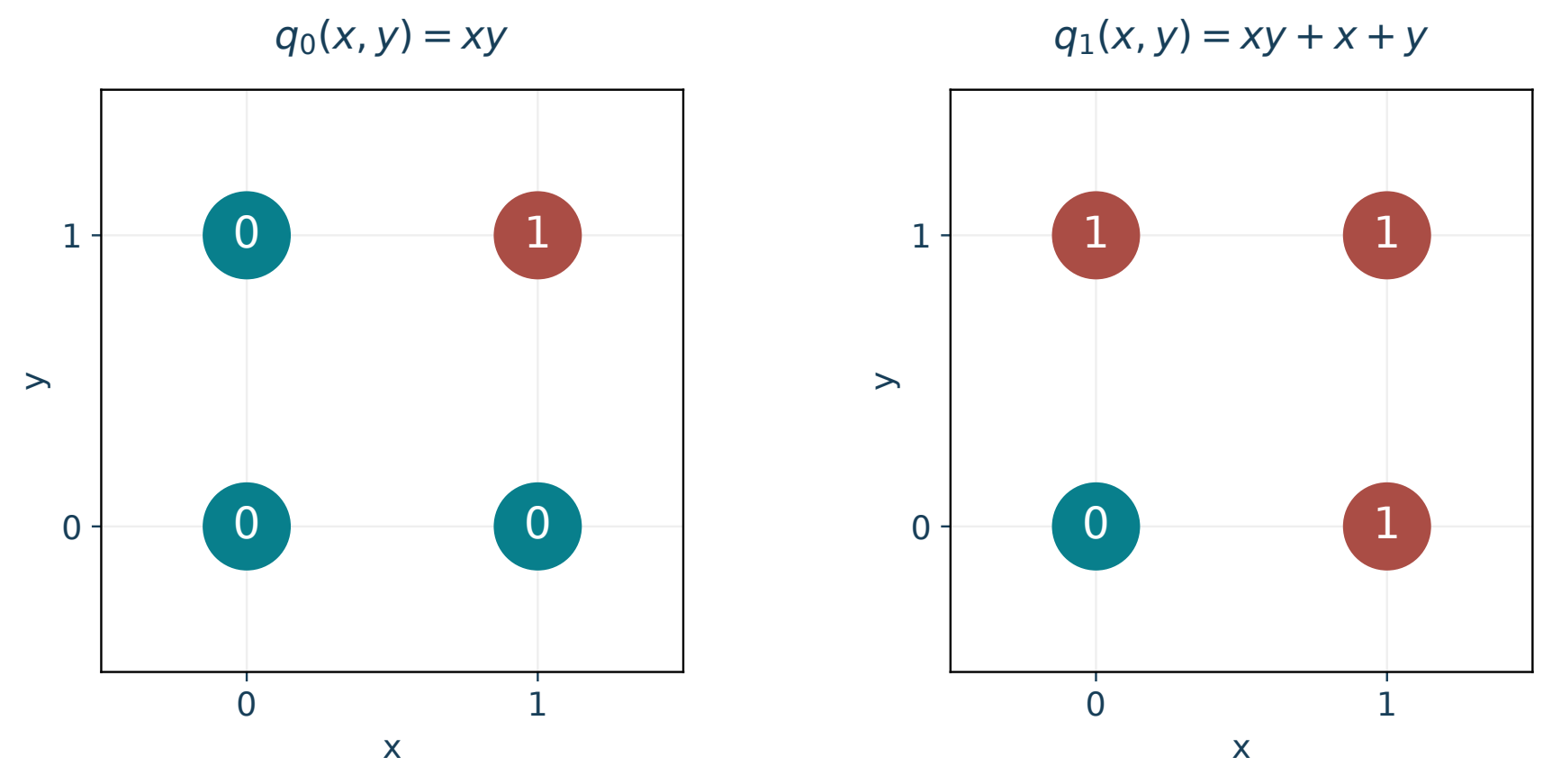
Two four-point diagrams share the underlying alternating plane but assign different quadratic values. The retained point table records the two refinements and distinguishes their signs.
Mathematical labels
\(q_0(x,y)=xy\)
\(q_1(x,y)=xy+x+y\)
| Point (x, y) | q0 | q1 |
|---|---|---|
| (0, 0) | 0 | 0 |
| (1, 0) | 0 | 1 |
| (0, 1) | 0 | 1 |
| (1, 1) | 1 | 1 |
Selectable labels from the original PDF
Native PDF text retains the figure’s extraction order. Equations and data tables above provide the reading order.
0 1
x
0
1
y
0 0
0 1
q0(x, y) = xy
0 1
x
0
1
y
0 1
1 1
q1(x, y) = xy + x + y
Original figure caption
The entries are exact values in \({\mathbb F}_2\); both polar forms are \(xy'+x'y\).
A quadratic refinement satisfies \(q(x+y)+q(x)+q(y)=b(x,y)\). On a plane,
For \(q_0\) there are three zeros and one one, so its Gauss sum is \(2\). For \(q_1\) there is one zero and three ones, so its sum is \(-2\). The alternating forms agree but the Arf invariants differ.
Reading the diagram
Keeping the alternating form alone loses dyadic phase information. The refinement and the marked central extension must travel with the packet.