
1 Introduction
On this page · Permalink · Source line 171
Automorphy lifting joins several kinds of mathematics that are easy to conflate. A residual representation must first occur in an automorphic carrier. The chosen characteristic zero representation must lie on a deformation problem controlled by local conditions. A patching argument must show that the automorphic module reaches the relevant part of the deformation space. A comparison such as \(R\cong{\mathbb T}\) must identify the arithmetic and Hecke coordinates. Finally, the resulting Hecke point must be classical and must carry the expected Galois representation with the required local compatibility.
None of these steps is merely a change of notation. A deeper lift above one residual representation cannot create a missing residual companion. Freeness over an auxiliary group algebra does not imply that every component of a deformation ring is occupied. An isomorphism of rings transports support that already exists, but it does not create a nonzero automorphic vector. A nonzero class in completed or torsion cohomology need not be classical without a theorem that says so.
The Taylor Wiles method and its later forms solve these problems in many important settings [27], [24], [9], [14], [12]. Higher dimensional and derived versions use a broader range of local deformation rings, residual image conditions, torsion classes, and cohomological carriers [8], [3], [6], [25], [17], [22], [7], [19]. The present article does not replace those theorems. It isolates the algebraic support statements that explain exactly what a patching package supplies once its arithmetic hypotheses have been verified.
The first correction concerns local packets. A local deformation ring is usually complete and local. Its irreducible components are rarely open and closed. They cannot generally be represented by central idempotents. The correct object is a quotient ring defining a local condition, together with the support of a module or complex on the resulting spectrum. Central idempotents reappear later, where they belong, inside finite Artin Hecke algebras and finite dimensional characteristic zero carriers.
The second correction concerns patching. The useful global conclusion is full support, often expressed as near faithfulness. For a finite module over a Noetherian ring, near faithfulness is equivalent to full support. Full support descends through the quotient that removes the auxiliary variables. This statement is elementary, but it is the exact bridge from a patched module to componentwise occupancy at finite level. The same conclusion holds for perfect complexes through derived support.
The third correction concerns Hecke packets. Semisimplicity is not required to isolate a maximal Hecke packet. Every finite commutative algebra over a field is a product of Artin local algebras. Its canonical central idempotents project onto simultaneous generalized eigenspaces. Trace is only a secondary criterion in characteristic zero. Support and localization are the primary notions.
The last part assembles these statements into a conditional theorem. A characteristic zero point of \(R\) is automorphic when it lies in the support of the automorphic carrier, the comparison with the Hecke algebra is available, and the corresponding Hecke fiber satisfies the declared realization theorem. If the point belongs to a fixed strictly compatible system, equality of Frobenius polynomials propagates the automorphic identification to every coefficient place by Chebotarev density and Brauer Nesbitt [5], [18], [12].
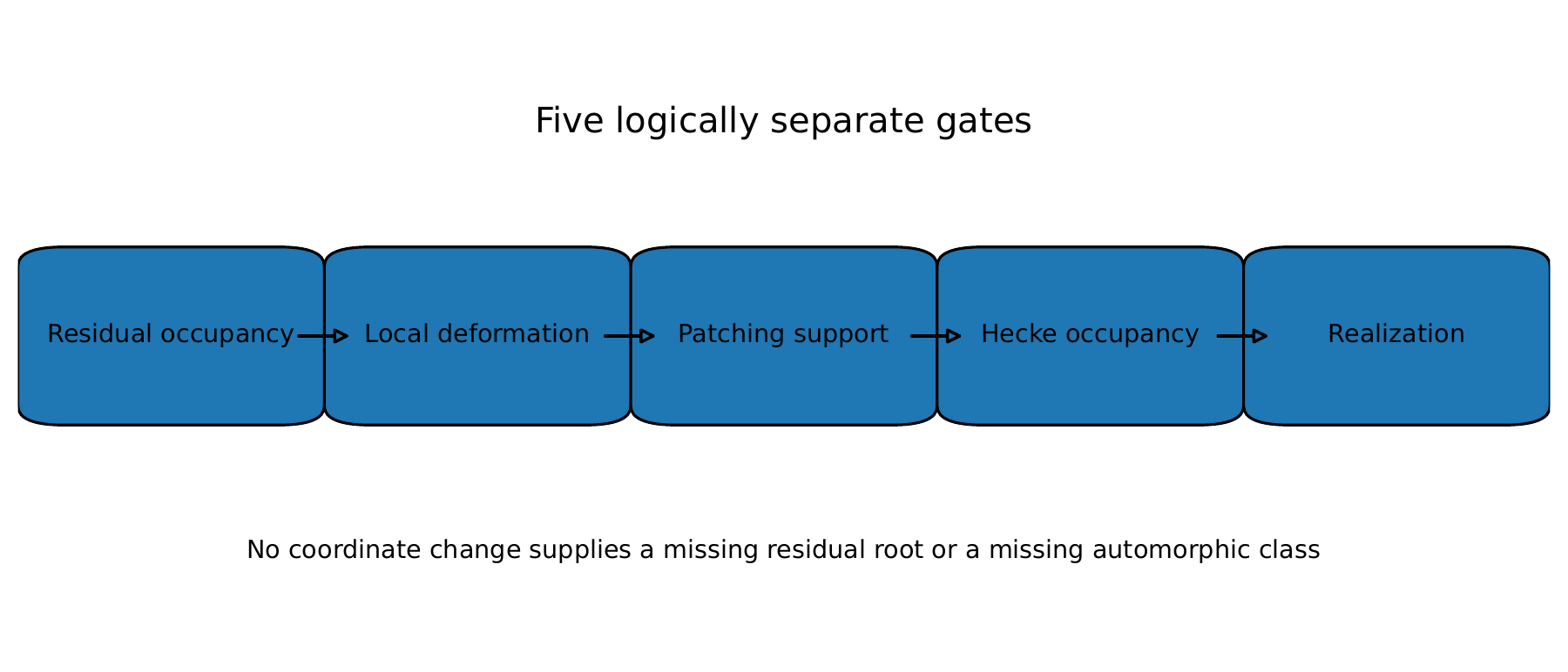
The organization is as follows. Local quotient conditions are developed in Section 3. Adequacy and residual occupancy appear in Section 4. Auxiliary group algebras are treated in Section 5. Ordinary and derived patching support appear in Section 6. The effect of \(R\cong{\mathbb T}\) is isolated in Section 7. Finite Hecke packets and infinite occupancy are developed in Section 8. Pointwise automorphy and compatible systems appear in Section 9 and Section 10. The coefficient prime two is discussed in Section 11. The final conditional theorem is stated in Section 12.