12 Conditional automorphic completion
On this page · Permalink · Source line 1635
We now assemble the preceding statements. The theorem is deliberately written as a chain of gates. Each gate has a distinct mathematical source.
Definition 12.1: Ordinary completion datum at a point
An ordinary completion datum at a characteristic zero point \(x:R\to E'\) consists of the following objects.
A represented global deformation ring \(R\) with declared local quotient conditions and universal representation \(\rho_R\).
An ordinary patching datum
\[ (R_\infty,{\mathfrak a},M_\infty,R,H) \]whose finite level module \(H\) is an automorphic Hecke carrier.
Full patched support
\[ {\operatorname{Supp}}_{R_\infty}(M_\infty)={\operatorname{Spec}} R_\infty. \]An isomorphism
\[ R\cong{\mathbb T} \]with the Hecke algebra acting on \(H\). The \(R\) action on \(H\) supplied by the patched control isomorphism is the restriction of this \({\mathbb T}\) action along the displayed isomorphism.
An automorphic Hecke datum \(({\mathbb T},H,(P_v))\) and a pointwise classicality and Galois realization theorem satisfying all the inputs of Theorem 9.4 for the nonzero fiber at \(x\): an occurring classical automorphic representation with a continuous semisimple attached representation; equality of the characteristic polynomials of both that representation and \(\rho_x=x\circ\rho_R\) with \(x(P_v(X))\) on the same declared Chebotarev dense union of Frobenius conjugacy classes; and the standard semisimplification, density, and general Brauer Nesbitt inputs. The coefficient topology and continuity requirements are retained in Theorem 12.2.
Permalink · Source line 1639 · Claim record · Lean coverage · Code · Worked examples
Theorem 12.2: Ordinary conditional automorphic completion
Let \(x:R\to E'\) admit an ordinary completion datum. Assume \(E'\) is a Hausdorff topological field of characteristic zero with continuous ring operations, and that both \(\rho_x=x\circ\rho_R\) and its attached comparison representation are continuous. Then
The specialization
is identified after semisimplification with the Galois representation attached to a classical automorphic representation in that fiber. If \(\rho_x\) is irreducible, it is itself automorphic.
Read proof · Read statement and proof side by side · Permalink · Source line 1661 · Claim record · Lean coverage · Code · Worked examples
Proof of Theorem 12.2
Full patched support descends to full support of \(H\) over \(R\) by Theorem 6.11. The isomorphism \(R\cong{\mathbb T}\) transports that support by Theorem 7.1. The field fiber is nonzero by Theorem 9.3. The declared classicality and realization theorem supplies an automorphic representation in the fiber and an attached Galois representation. The comparison with \(\rho_x\) follows from Theorem 9.4.
Back to statement · Read statement and proof side by side · Permalink · Source line 1675 · Claim record · Lean coverage · Code · Worked examples
Definition 12.3: Derived completion datum at a point
A derived completion datum is defined in the same way, with a perfect patched complex \(C_\infty\) of full derived support and a finite level automorphic complex
in place of the ordinary modules. Under the Hecke ring isomorphism \(e:R\cong{\mathbb T}\), require an actual derived carrier identification between the scalar transport of this finite level complex and the automorphic Hecke complex. This identification retains the \(R\) action induced by patched control as the restriction of the \({\mathbb T}\) action along \(e\).
Permalink · Source line 1681 · Claim record · Lean coverage · Code · Worked examples
Theorem 12.4: Derived conditional automorphic completion
Let \(x:R\to E'\) admit a derived completion datum, with Hecke identification \(e:R\cong{\mathbb T}\), and put \(y=x\circ e^{-1}\). Then
Some integer cohomological degree contains a nonzero Hecke eigensystem with character \(y\). Its degree lies between the bounds of any chosen finite projective model for \(C\).
For the conditional conclusion, retain the Hausdorff coefficient topology, continuous specialization, supplied semisimplification, and common Frobenius polynomial hypotheses in Theorem 9.6. If the declared classicality and Galois realization theorem applies to this eigensystem and supplies an occurring classical automorphic representation with a continuous semisimple attached representation and those Frobenius polynomials, then \(\rho_x\) is automorphic after semisimplification. If \(\rho_x\) is irreducible, it is itself isomorphic to the attached representation. This pointwise applicability condition does not require a uniform classicality assertion in other degrees.
Read proof · Read statement and proof side by side · Permalink · Source line 1693 · Claim record · Lean coverage · Code · Worked examples
Proof of Theorem 12.4
Full support descends from the patched perfect complex by Theorem 6.18. Scalar transport through \(e\), followed by the actual derived isomorphism with the automorphic Hecke complex, gives full support for \(C\). Its fiber at \(y\) is therefore nonzero. The bounded model and induced Hecke action argument in Theorem 9.6 supplies a nonzero cohomology eigenvector in an integer degree within the model's bounds.
If realization applies to this eigensystem, it supplies the occurring automorphic object and a continuous semisimple attached representation with the declared Frobenius polynomials. The representation comparison in Theorem 9.6 then identifies the supplied semisimplification of \(\rho_x\) with that attached representation. Only applicability to this eigensystem is used; a classicality theorem for every degree in a prescribed interval is unnecessary.
Back to statement · Read statement and proof side by side · Permalink · Source line 1705 · Claim record · Lean coverage · Code · Worked examples
Theorem 12.5: Compatible system completion from one automorphic member
Let
be a semisimple strictly compatible system with common Frobenius spine. Suppose the member at \(\lambda_0\) admits an ordinary or derived completion datum and is identified with the Galois representation attached to an automorphic representation \(\pi\). Assume that the compatible system attached to \(\pi\) has the same Frobenius spine. Then
Read proof · Read statement and proof side by side · Permalink · Source line 1711 · Claim record · Lean coverage · Code · Worked examples
Proof of Theorem 12.5
The completion theorem at \(\lambda_0\) gives the automorphic representation \(\pi\). Apply Theorem 10.7 to the two compatible systems.
Back to statement · Read statement and proof side by side · Permalink · Source line 1728 · Claim record · Lean coverage · Code · Worked examples
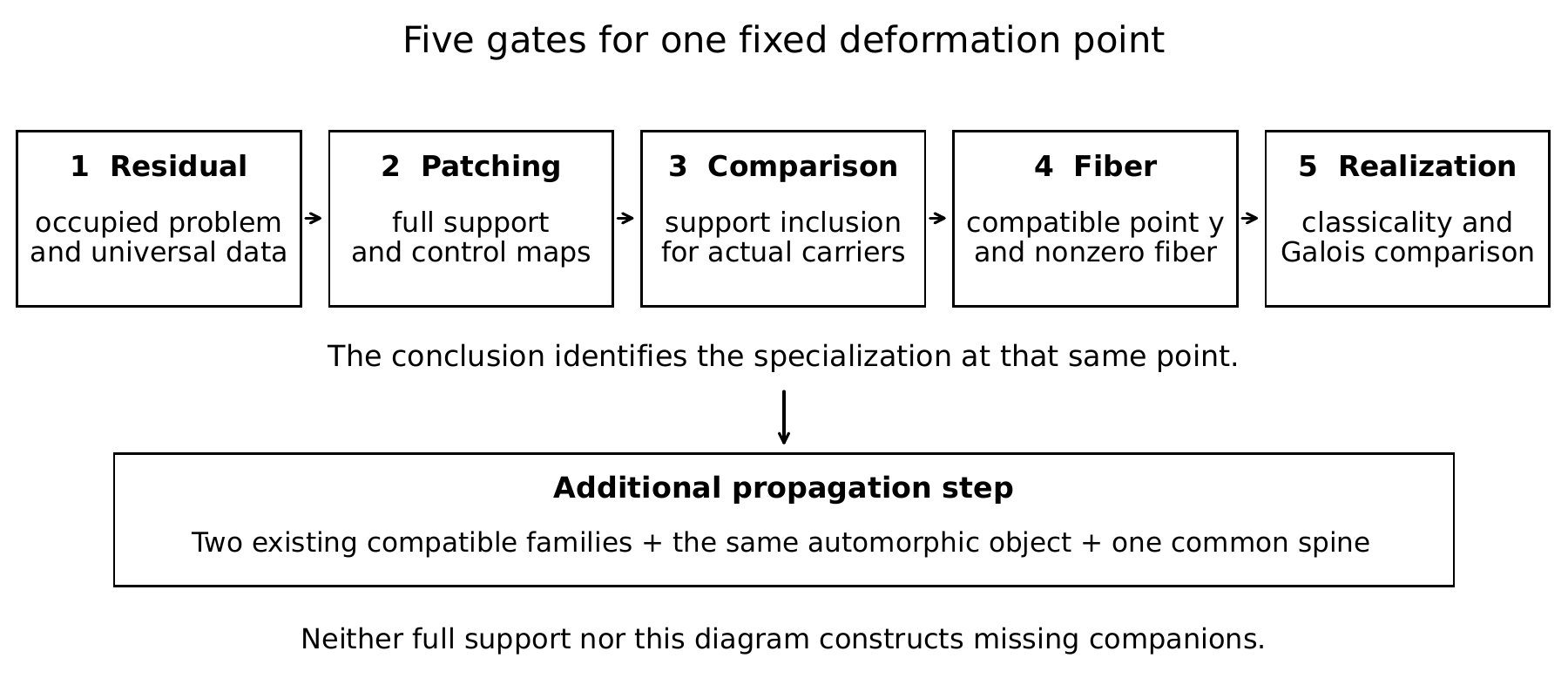
Theorem 12.6: Five gate formulation
Fix a characteristic zero deformation point \(x:R\to E'\). Give \(E'\) a Hausdorff topological field structure. The conditional argument uses the following five gates.
Residual gate. Residual occupancy in the declared automorphic carrier and representability of the chosen deformation problem are supplied arithmetic inputs. In particular, the deformation ring \(R\) and its universal representation \(\rho_R\) are available.
Patching gate. An applicable patching theorem supplies an ordinary finite module or a perfect complex with full patched support, together with the coefficient quotient and the module or derived control isomorphism. Write \(M\) for the resulting finite level carrier over \(R\).
Comparison gate. Let \(H\) be a finite ordinary Hecke module or a perfect Hecke complex over \({\mathbb T}\). Supply a ring map \(f:R\to{\mathbb T}\) satisfying
\[ (f^*)^{-1}\bigl({\operatorname{Supp}}_R(M)\bigr)\subseteq{\operatorname{Supp}}_{{\mathbb T}}(H). \]Use ordinary or derived support according to the carrier. Actual scalar extension satisfies this inclusion, as does transport through a ring isomorphism with the corresponding carrier identification.
Fiber gate. Supply a Hecke point \(y:{\mathbb T}\to E'\) with \(y\circ f=x\). Then the fiber of \(H\) at \(y\) is nonzero. It contains a nonzero Hecke eigenvector, in some integer cohomological degree in the derived case, with character \(y\).
Realization gate. The declared classicality theorem applies to the resulting eigensystem and supplies an occurring classical automorphic representation \(\pi\), with a continuous semisimple attached representation. Require the specialization \(\rho_x=x\circ\rho_R\) to be continuous and supply its semisimplification. On the same Chebotarev dense set, assume that the characteristic polynomials of both \(\rho_x\) and the attached representation are \(y(P_v(X))\). Retain the standard density and general Brauer Nesbitt inputs of Standard fact 9.2.
Then \(\rho_x^{\mathrm{ss}}\) is isomorphic to the representation attached to \(\pi\). If \(\rho_x\) is irreducible, the same conclusion holds for \(\rho_x\) itself.
For propagation, suppose both a semisimple compatible family \(\{\rho_\lambda\}\) containing \(\rho_x\) and a family \(\{\rho_{\pi,\lambda}\}\) attached to this same \(\pi\) already exist. Require the distinguished members to be \(\rho_x\) and its attached representation, respectively. Assume the coefficient, continuity, density, semisimplification and common algebraic Frobenius spine hypotheses of Theorem 10.7, with that spine agreeing with the specialized Hecke polynomials at the distinguished place. Then
Read proof · Visual guide: Seeing the objects · Visual guide: Where the arithmetic still enters · Visual guide: Read the exact claim contract · Visual guide: How to assess the evidence · Read statement and proof side by side · Permalink · Source line 1732 · Claim record · Lean coverage · Code · Worked examples
Proof of Theorem 12.6
The residual and representability inputs specify the setting in which the supplied patching theorem applies. The formal deduction begins with its actual rings, carriers, and comparison maps. In the ordinary branch, finite generation and full support at finite level follow from the coefficient quotient and module control isomorphism. In the derived branch, the derived control isomorphism gives a perfect finite level model, and Theorem 6.18 gives full support.
The comparison inclusion transports this full support to \(H\). More specifically, \(y\circ f=x\) identifies the contraction of \(\ker y\) with \(\ker x\), so support at the source point gives support at the Hecke point. In the ordinary case, Theorem 7.4 gives a nonzero actual tensor fiber. In the derived case, the support criterion gives a nonzero actual derived fiber and hence a nonzero cohomology vector. Its integer degree lies within the bounds of the chosen finite projective model. In both cases, multiplication on the original carrier induces the scalar \(y(t)\) on the specialized vector for every \(t\in{\mathbb T}\).
Choose this nonzero eigensystem and apply the declared realization theorem to it. No realization statement in other degrees is needed. The two continuous representations have the same characteristic polynomials on the declared dense Frobenius conjugacy classes. Continuity extends their equality to the whole group. The supplied semisimplification preserves those polynomials, and the general Brauer Nesbitt input gives the required invertible linear intertwiner. The irreducible conclusion follows as in Theorem 9.4.
Finally, retain the same \(\pi\) in its attached family. The distinguished member identities connect both families to the pointwise construction, while the common algebraic spine gives the required Frobenius polynomials at every coefficient place. Apply Theorem 10.7 to these two existing families. The construction does not produce a missing companion or an attached compatible family.
Back to statement · Read statement and proof side by side · Permalink · Source line 1754 · Claim record · Lean coverage · Code · Worked examples