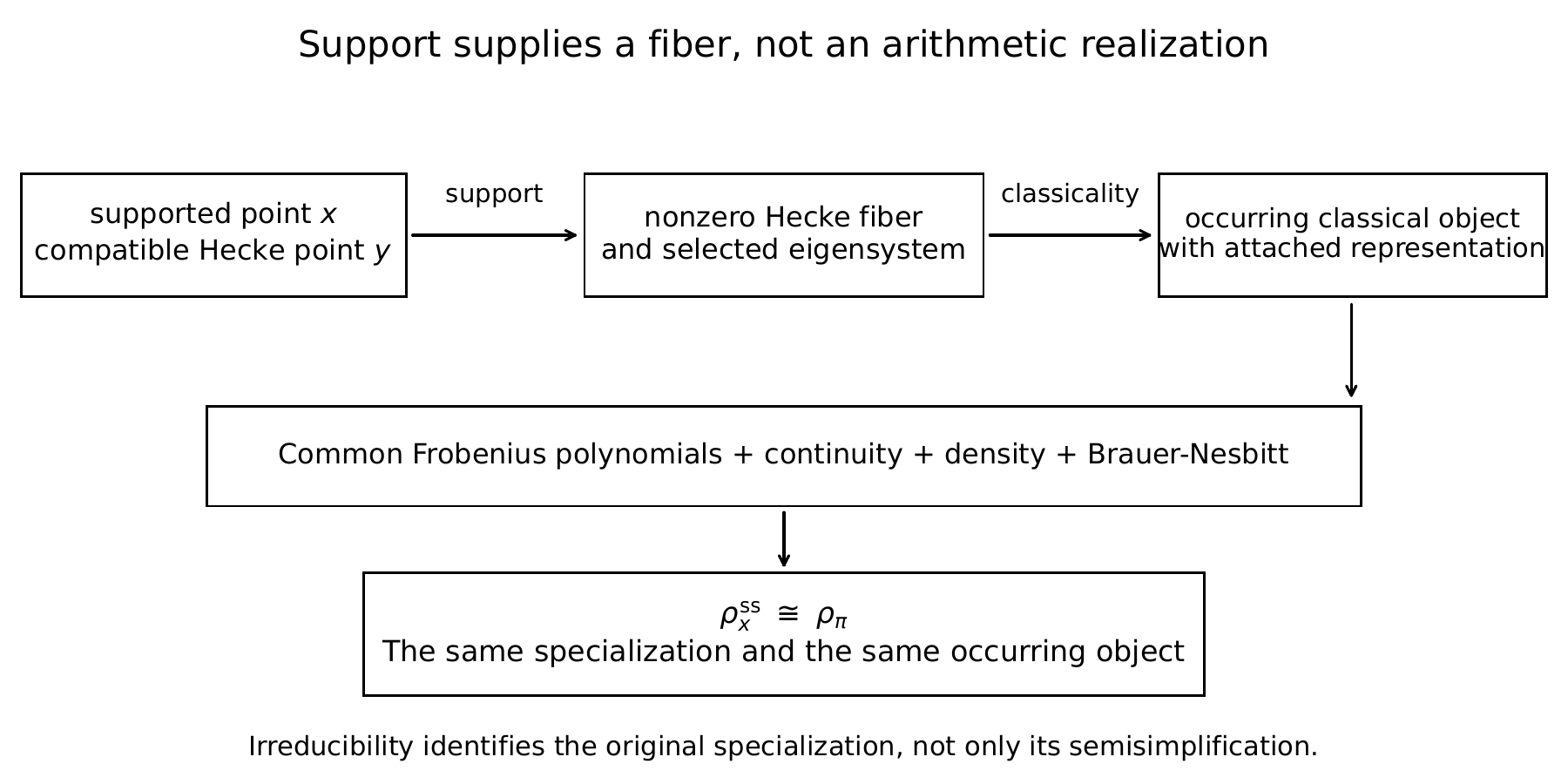
9 Pointwise automorphy from support
On this page · Permalink · Source line 1286
Support produces a nonzero Hecke fiber. A realization theorem is still required to turn that fiber into a classical automorphic representation and to identify its Galois representation.
Definition 9.1: Automorphic Hecke datum
An automorphic Hecke datum consists of the following objects.
A commutative \({\mathcal O}\) algebra \({\mathbb T}\).
A finite \({\mathbb T}\) module \(H\), or a perfect \({\mathbb T}\) complex \(C\), obtained from an automorphic or cohomological carrier.
For every unramified place \(v\) outside a finite set, a polynomial
\[ P_v(X)\in{\mathbb T}[X]. \]A declared characteristic zero locus on which a nonzero field fiber is known to be classical and is known to carry an attached Galois representation whose Frobenius polynomial at \(v\) is the specialization of \(P_v(X)\).
Permalink · Source line 1290 · Claim record · Lean coverage · Code · Worked examples
Standard fact 9.2: Chebotarev and Brauer Nesbitt identification
Let \(E'\) be a Hausdorff topological field of characteristic zero, with continuous ring operations. Let
be continuous semisimple representations. If their characteristic polynomials agree at every Frobenius element outside a density zero exceptional set, then
This follows from Chebotarev density and the Brauer Nesbitt theorem [5], [18], [12].
Permalink · Source line 1303 · Claim record · Lean coverage · Code · Worked examples
Theorem 9.3: Support gives a Hecke eigensystem
Let \(R\cong{\mathbb T}\), let \(H\) be a finite \({\mathbb T}\) module, and let \(x:R\to E'\) be a field valued point. If
then
Every element of \({\mathbb T}\) acts on \(H_x\) through the scalar prescribed by \(x\).
Read proof · Read statement and proof side by side · Permalink · Source line 1316 · Claim record · Lean coverage · Code · Worked examples
Proof of Theorem 9.3
Nonvanishing follows from Corollary 7.5. The tensor product relation
shows that \(t\in{\mathbb T}\) acts through \(x(t)\).
Back to statement · Read statement and proof side by side · Permalink · Source line 1331 · Claim record · Lean coverage · Code · Worked examples
Theorem 9.4: Pointwise Galois realization
Let \(E'\) be a Hausdorff topological field of characteristic zero, with continuous ring operations. Require both \(\rho_x=x\circ\rho_R\) and the attached representation below to be continuous. Assume the following data.
A represented deformation ring \(R\) with universal representation
\[ \rho_R:G_{F,S}\longrightarrow{\operatorname{GL}}_n(R). \]An isomorphism \(R\cong{\mathbb T}\).
An automorphic Hecke datum \(({\mathbb T},H,(P_v))\).
A characteristic zero point \(x:R\to E'\) lying in \({\operatorname{Supp}}_R(H)\).
A classical automorphic representation \(\pi_x\) occurring in the fiber \(H_x\), together with a semisimple attached representation
\[ \rho_{\pi_x}:G_{F,S}\longrightarrow{\operatorname{GL}}_n(E') \]whose unramified characteristic polynomial is \(x(P_v(X))\).
Equality
\[ \det\left(X-\rho_x({\operatorname{Frob}}_v)\right)=x(P_v(X)) \]for \(\rho_x=x\circ\rho_R\) at every unramified place in a Chebotarev dense set.
Then
If \(\rho_x\) is irreducible, then \(\rho_x\cong\rho_{\pi_x}\).
Read proof · Read statement and proof side by side · Permalink · Source line 1339 · Claim record · Lean coverage · Code · Worked examples
Proof of Theorem 9.4
The coefficients of the characteristic polynomials of \(\rho_x\) and \(\rho_{\pi_x}\) are continuous and constant on conjugacy classes. Their equality on the declared dense union of Frobenius conjugacy classes therefore extends to every element of \(G_{F,S}\), by Hausdorffness. A semisimplification has the same characteristic polynomials as the original representation. The algebraic Brauer Nesbitt input in Standard fact 9.2 thus gives \(\rho_x^{\mathrm{ss}}\cong\rho_{\pi_x}\). If \(\rho_x\) is irreducible, it is already semisimple.
Back to statement · Read statement and proof side by side · Permalink · Source line 1371 · Claim record · Lean coverage · Code · Worked examples
Corollary 9.5: Full support gives pointwise automorphy on the realized locus
In the setting of Theorem 9.4, suppose
For every characteristic zero point \(x:R\to E'\) with \(\ker x\in U\subseteq{\operatorname{Spec}} R\), assume the coefficient topology and continuity hypotheses of Theorem 9.4 and the declared classicality and Galois realization input. Then every such point is automorphic in the precise sense of Theorem 9.4.
Read proof · Read statement and proof side by side · Permalink · Source line 1375 · Claim record · Lean coverage · Code · Worked examples
Proof of Corollary 9.5
Every point of \(U\) lies in the support, so Theorem 9.3 gives a nonzero Hecke fiber. Apply the declared realization input and then Theorem 9.4.
Back to statement · Read statement and proof side by side · Permalink · Source line 1383 · Claim record · Lean coverage · Code · Worked examples
Theorem 9.6: Derived pointwise realization
Let \(e:R\cong{\mathbb T}\), and let \(C\) be a perfect automorphic Hecke complex with full derived support. Choose a bounded finite projective model for \(C\), supported in degrees \([a,b]\). For every characteristic zero point \(x:R\to E'\), write \(y=x\circ e^{-1}\). Then some integer \(i\in[a,b]\) has
Every \(t\in{\mathbb T}\) acts on this cohomology through \(y(t)\).
For the realization conclusion, give \(E'\) a Hausdorff topological field structure. Supply a universal representation \(\rho_R\), a continuous specialization \(\rho_x=x\circ\rho_R\), and a semisimplification of \(\rho_x\). Suppose its characteristic polynomials on a Chebotarev dense set are \(y(P_v(X))\). Let the declared classicality range contain \([a,b]\). Assume that every nonzero Hecke eigensystem in that range is realized by a classical automorphic representation occurring in that degree, with a continuous semisimple attached representation whose characteristic polynomials on the same dense set are \(y(P_v(X))\). With the standard Chebotarev density and Brauer Nesbitt inputs of Standard fact 9.2, the specialization \(\rho_x\) is automorphic after semisimplification. If \(\rho_x\) is irreducible, it is itself isomorphic to the attached representation.
Read proof · Read statement and proof side by side · Permalink · Source line 1387 · Claim record · Lean coverage · Code · Worked examples
Proof of Theorem 9.6
Full derived support gives a nonzero fiber at \(y\). Scalar extension of the chosen projective model preserves its degree bounds. Its cohomology therefore vanishes below \(a\) and above \(b\). Since vanishing in every degree is equivalent to being zero in the derived category, some degree \(i\in[a,b]\) has nonzero cohomology. Choose a nonzero vector in that cohomology module.
Multiplication by \(t\in{\mathbb T}\) is a cochain endomorphism of the original model. In the scalar extension the tensor relation identifies this endomorphism with \(y(t)\) times the identity. Passing to the derived category and then to cohomology preserves this equality. Thus the chosen vector is a common Hecke eigenvector with character \(y\).
The interval inclusion puts this eigensystem in the declared classicality range. Apply the realization input to obtain an occurring automorphic representation and its continuous semisimple attached representation. Its Frobenius characteristic polynomials agree with those of \(\rho_x\) on the prescribed dense set. Continuity extends the equality to every group element. The supplied semisimplification preserves these polynomials, so the general Brauer Nesbitt input gives an invertible linear intertwiner. If \(\rho_x\) is irreducible, it is already semisimple and the same comparison applies directly.
Back to statement · Read statement and proof side by side · Permalink · Source line 1397 · Claim record · Lean coverage · Code · Worked examples
Remark 9.7
Derived support does not identify the cohomological degree, Hodge type, or classical weight of the surviving eigensystem. Those properties must come from the external local and global realization theorem.