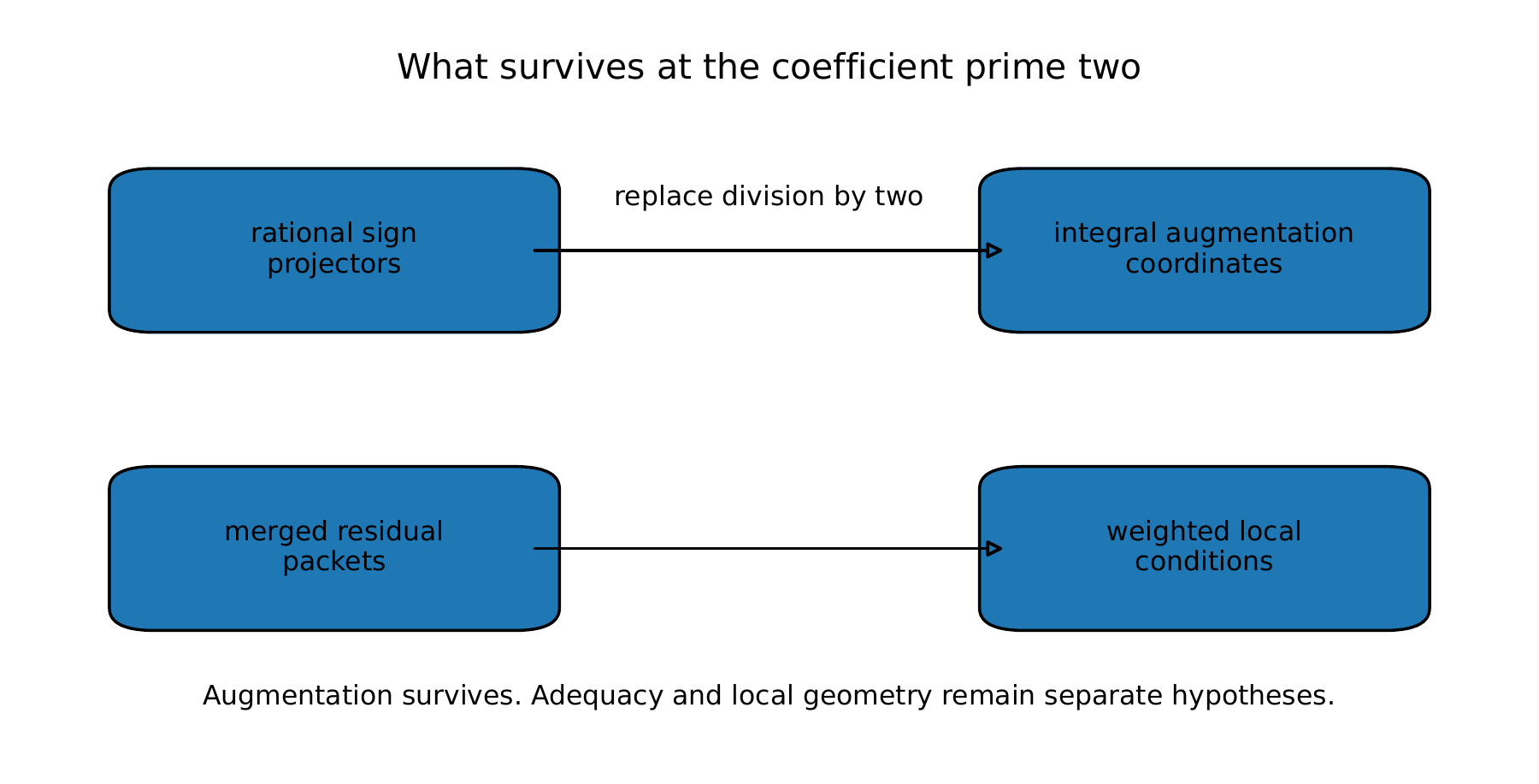
11 The coefficient prime two
On this page · Permalink · Source line 1574
The auxiliary augmentation algebra works at every coefficient prime. What changes at two is the availability of integral character projectors and, in many applications, the residual image and local deformation hypotheses.
Proposition 11.1: Failure of integral sign projectors
Let \(C_2=\langle g\rangle\). Over \({\mathbb Q}_2\), the two sign projectors are
Neither belongs to \({\mathbb Z}_2[C_2]\). After reduction modulo two,
This ring is local and has no nontrivial idempotents.
Read proof · Visual guide: At two, division is the obstruction · Read statement and proof side by side · Permalink · Source line 1578 · Claim record · Lean coverage · Code · Worked examples
Proof of Proposition 11.1
The displayed rational elements are the unique primitive idempotents because they project to the two characters of \(C_2\). Their coefficients contain \(1/2\), so they are not integral. In characteristic two,
The map \(X\mapsto g-1\) gives the displayed isomorphism. The quotient by \((X)\) is \({\mathbb F}_2\), and \((X)\) is nilpotent. Thus the ring is local.
Back to statement · Read statement and proof side by side · Permalink · Source line 1600 · Claim record · Lean coverage · Code · Worked examples
Corollary 11.2: Dyadic coinvariant recovery
Let \(\Delta\) be a finite two group, let \(\Lambda={\mathcal O}[\Delta]\) with \({\mathcal O}\) a finite extension of \({\mathbb Z}_2\), and let \(M\) be finite free over \(\Lambda\). Then
is free over \({\mathcal O}\) of the same \(\Lambda\) rank. No semisimple character decomposition is required.
Read proof · Read statement and proof side by side · Permalink · Source line 1608 · Claim record · Lean coverage · Code · Worked examples
Proof of Corollary 11.2
Use the right module convention fixed in Section 5. Quotienting by all balancing relations identifies \(M\otimes_{\Lambda,\epsilon}{\mathcal O}\) with \(M/{\mathfrak a} M\), without any commutativity assumption on \(\Delta\). Applying \(\epsilon\) to the coordinates of a finite \(\Lambda\) basis gives an \({\mathcal O}\) basis with the same index set.
Back to statement · Read statement and proof side by side · Permalink · Source line 1620 · Claim record · Lean coverage · Code · Worked examples
Remark 11.3
The corollary is an algebraic statement about augmentation and coinvariants. It does not supply a coefficient two adequacy theorem, a local deformation ring with the desired geometry, or a classicality theorem. Those inputs must be checked in the automorphy lifting theorem being used.