
1 Introduction
On this page · Permalink · Source line 1
A matrix can look dense while its action is not. Independent diagonal blocks, sparse transfers, low rank couplings, tensor factors, and transform coordinates can remove most of the arithmetic and storage before a kernel is launched. The gain is mathematical first. A device can exploit only the structure that the representation exposes.
This article begins with a finite direct sum
and a complete family of coordinate projectors
An operator has packet blocks
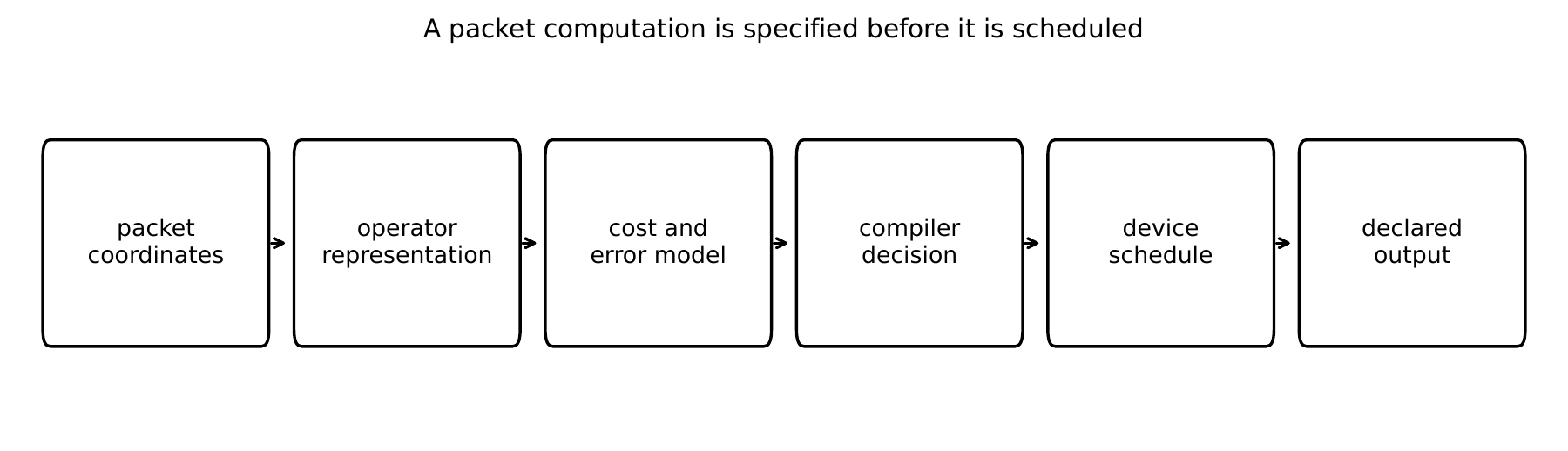
The active addresses form a directed graph. Block dimensions, block types, approximation tolerances, and output requirements turn this graph into a computational intermediate representation.
The underlying linear algebra is classical. Direct and iterative methods are treated in [GolubVanLoan2013], [Saad2003], [Davis2006]. Low rank approximation and updates are governed by singular value decomposition and the Sherman Morrison Woodbury identity [EckartYoung1936], [Mirsky1960], [Hager1989], [BunchNielsen1978]. Floating point analysis follows the standard model in [Higham2002], [IEEE7542019]. Randomized discovery of low rank structure is developed in [HalkoMartinssonTropp2011], [MartinssonTropp2020]. Communication and attainable performance are shaped by data movement and arithmetic intensity [HongKung1981], [WilliamsWatermanPatterson2009], [BallardDemmelHoltzSchwartz2011], [FrigoLeisersonProkopRamachandran1999].
The first task is semantic. A compressed representation must specify the operator that it denotes. It must also specify what an algorithm returns. A product represented by block and low rank factors is not the same output as an explicit matrix. A timing comparison is valid only after the output contract and timing scope agree.
The second task is algebraic. Block diagonal plus low rank operators are closed under multiplication before recompression. Their unrecompressed rank grows additively. Woodbury inversion reduces a large inverse to packet solves and one small dense inverse. The low rank factors can then be recompressed by orthogonalizing them and taking the singular value decomposition of a small core. This produces the best truncated approximation in spectral and Frobenius norm.
The third task is combinatorial. Sparse transfer graphs predict possible support under powers, polynomials, and Schur elimination. A directed acyclic graph gives a finite path expansion. A block triangular solve can be scheduled by topological level. Graph regularity matters because equal shapes can be batched, while irregular edges require indexing and accumulation.
The fourth task is numerical. Packet perturbations can be certified by their block sensitivities. A continuous model assigns tolerances through a convex calculation. Upper bounds on available tolerances produce a clipped allocation. A finite set of data types gives a multiple choice budget problem that can be solved exactly after the errors are quantized.
The central computational result concerns compilation. Suppose a finite rooted tree records candidate refinements. Each node may be kept as one representation or split into its children. If cost and error are additive across the selected leaves, the optimal pruning is found exactly by dynamic programming. A quantized error budget has a second exact dynamic program. The decision is stable when the score gap exceeds the perturbation in the local models. A change inside one subtree requires recomputation only along the ancestor chain. These results prove a restricted packet compiler. They do not solve unrestricted discovery or arbitrary device scheduling.
The measured part uses a sanitized corpus collected on one recorded CPU and one NVIDIA GeForce RTX 3070 Ti Laptop GPU. The preserved corpus contains 154 recorded rows from sixteen suites. The timings are inherited observations; no GPU timing is rerun for this edition. Regular equal block operators and block diagonal plus low rank operators show large gains. Recursive HODLR, Strassen multiplication, iterative refinement, a small Walsh Hadamard transform, and an attempted two stream overlap provide negative controls. These rows are retained because structure does not guarantee speed.
The article separates four sources of gain:
A single speedup number can mix all four. The benchmark protocol therefore requires case identity, output contract, timing scope, source precision, correctness reference, discovery time, compilation time, and reuse count. The archived rows do not satisfy every field of this ideal contract: source-value hashes and explicit correctness-reference fields are absent; setup, discovery, and reuse metadata are sparse. Recorded ratios are consequently descriptive comparisons under their stated scopes, rather than full-provenance fair matches.
The mathematical statements are finite. The empirical statements apply only to the recorded environment and generated cases. The article does not claim a new generic matrix multiplication exponent. Fast matrix multiplication and its stability form a separate theory [Strassen1969], [DemmelHoltzSchwartz2007]. It also does not claim that every structured matrix has a profitable GPU realization.