
26 Exact finite repairs can escape the intended ambient space
On this page · Permalink · Source line 2
This model links the algebraic obstruction, the numerical floor, the movement of approximations, and the semantic image of an inverse limit. It uses a diagonal operator whose entries are completely explicit. Every finite problem is solvable. The protected infinite problem is not.
26.1 The complete spaces and the preservation rule
On this page · Permalink · Source line 5
Index sequences by the positive integers. Set
Let \(w=(1/n)_{n\ge1}\). It belongs to \(\ell^2\), because
Define the defect and protected observable by
The diagonal map \(T:u\mapsto(u_n/n)_n\) has operator norm one. Since \(d(u,t)=Tu+tw\),
Thus both \(d\) and \(p\) are continuous linear maps between the declared complete spaces. No failure of completeness or continuity is built into the model.
Take the raw candidate \(f_0=(0,1)\). Its residual is \(w\), and the coordinate that must be preserved is \(t=1\). An exact protected answer would require
That sequence does not lie in \(\ell^2\). Consequently no answer in \(E\) is both exact and protected.
In fact \(\ker d=\{0\}\). If \(d(u,t)=0\), then \(u_n=-t\) for every \(n\). A constant square-summable sequence must be zero, so \(t=0\) and \(u=0\). There is an exact answer after abandoning the preservation rule, namely zero, but it changes \(p(f_0)=1\) to zero. Even a trivial ambiguity space does not imply feasibility.
26.2 The obstruction class is nonzero while its floor is zero
On this page · Permalink · Source line 36
The admissible correction space is \(\ker p=\ell^2\oplus\{0\}\), with correction image
It contains every finitely supported sequence, so it is dense in \(R\). But \(w\notin B\), because \((nw_n)_n=(1,1,\ldots)\) is not square summable. Therefore
This is the middle row of the preceding classification. The example is a worked Hilbert-space derivation without a separate Lean instance. Its finite-coordinate calculations are independently tested. The general floor and exactification results in Sections 24 and 25 have formal counterparts.
26.3 A complete calculation of the finite repairs
On this page · Permalink · Source line 48
Let \(\mathbf 1_N\) be one in coordinates \(1,\ldots,N\) and zero elsewhere. Put
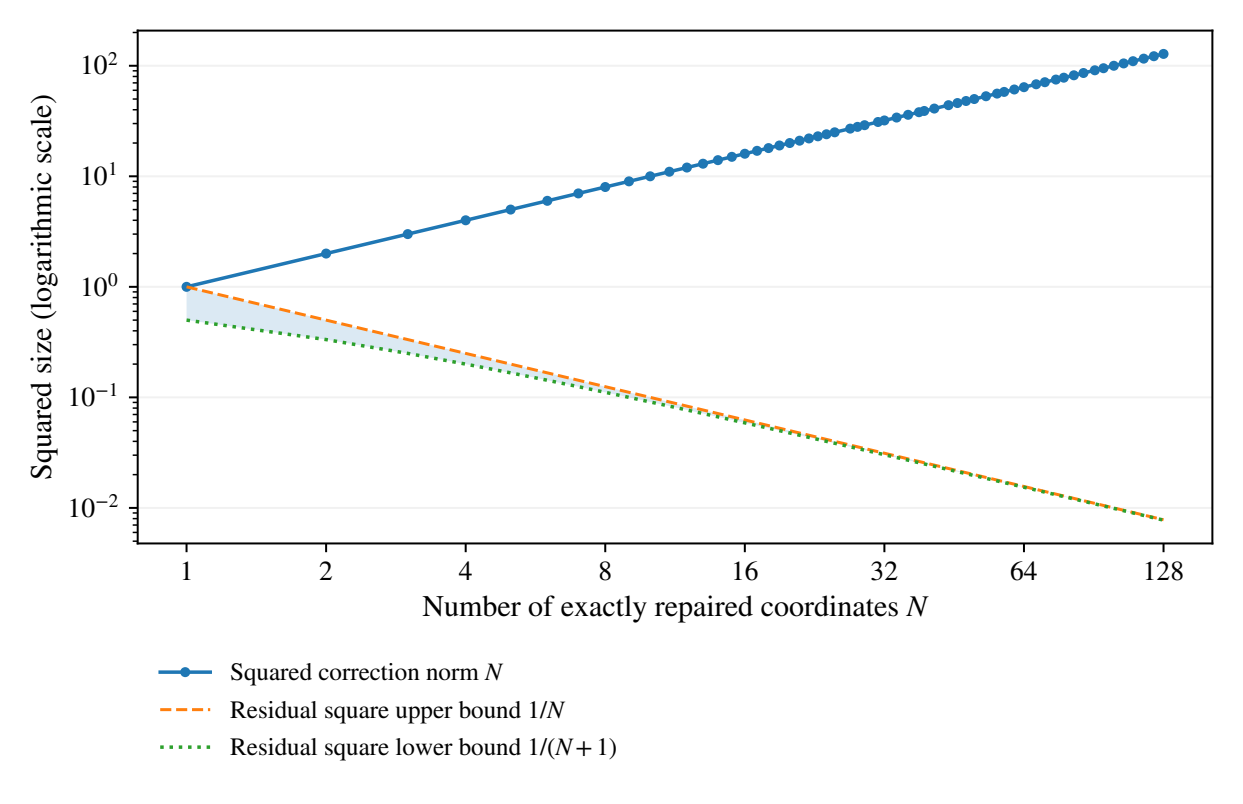
Then \(p(f_N)=1\), and the first \(N\) residual coordinates vanish exactly. The remaining residual and movement satisfy
For every \(N\ge1\), telescoping comparisons give
Indeed \(1/[n(n+1)]\le1/n^2\le1/[n(n-1)]\) for \(n\ge2\). Summing the two telescoping bounds proves (26.1) without numerically evaluating an infinite series.
The residual tends to zero, but the corrections grow like \(\sqrt N\). Successive candidates differ by a unit coordinate, so
The movement series diverges and the sequence is not Cauchy. This is exactly the hypothesis missing from the summable exactification theorem.
| Repaired coordinates \(N\) | \({\left\lVert a_N\right\rVert}\) | Residual square interval | Finite inverse gain |
|---|---|---|---|
| 1 | 1 | \([1/2,1]\) | 1 |
| 4 | 2 | \([1/5,1/4]\) | 4 |
| 16 | 4 | \([1/17,1/16]\) | 16 |
| 64 | 8 | \([1/65,1/64]\) | 64 |
The intervals bound the infinite residual remaining after the displayed repair. The inverse-gain column concerns a different finite operator, defined below. Keeping those meanings separate prevents a finite success from being mistaken for a uniform infinite certificate.
26.4 Escape is not an accident of this particular algorithm
On this page · Permalink · Source line 84
Suppose an arbitrary protected candidate \((u,1)\) satisfies \({\left\lVert d(u,1)\right\rVert}\le\varepsilon\). On its first \(N\) coordinates,
The reverse triangle inequality in \({\mathbb R}^N\) gives
If a sequence of protected candidates has residual tending to zero, then for each fixed \(N\), its eventual correction norms are at least, for example, \(\sqrt N/2\). Taking \(N\) arbitrarily large shows that these norms must tend to infinity. There is no uniformly bounded family of protected corrections with arbitrarily small residual.
Thus changing the iteration rule cannot fix the obstruction while preserving all the declared requirements. One must change the input, the preservation contract, or the intended ambient class. The inequality is a quantitative obstruction to a bounded repair procedure, rather than a failure report from one chosen recurrence.
26.5 Every finite operator is invertible, but the gains diverge
On this page · Permalink · Source line 99
On \({\mathbb R}^N\), let
It is invertible and \({\left\lVert T_N^{-1}\right\rVert}=N\) in the Euclidean norm. The upper bound follows by multiplying each coordinate by an integer at most \(N\), and equality is attained at the last coordinate vector. Full finite rank therefore supplies no uniform gain as \(N\to\infty\).
In the infinite space, \({\left\lVert e_n\right\rVert}=1\) but \({\left\lVert Te_n\right\rVert}=1/n\), while \(\ker T=\{0\}\). A uniform estimate \({\operatorname{dist}}(u,\ker T)\le C{\left\lVert Tu\right\rVert}\) would force \(1\le C/n\) for every \(n\), which is impossible. This agrees with the nonclosed range already established directly. The low residual directions do not reflect new exact vectors. They reflect increasingly ill-conditioned approximate directions.
26.6 A coherent inverse-limit point still exists in a larger space
On this page · Permalink · Source line 109
At each finite level, the protected exact equations have the unique solution
Truncation maps the solution at level \(N+1\) to the one at level \(N\). These finite solution sets are singletons, so their inverse limit is also a singleton. Its coordinate description is
The coherent point is not missing. It lies outside the intended \(\ell^2\)-based semantic space.
This example does not contradict finite-fiber existence. It distinguishes the ordinary inverse limit of finite views from the image of a separate comparison map that sends square-summable semantic objects to their finite prefixes. The prescribed coherent point is not in that image. Replacing \(\ell^2\) by all sequences makes the equation solvable, but changes the topology and the class of allowed objects.
How to read the result
Four statements, four answers. Every finite prefix is exactly solvable. The ordinary coherent inverse-limit point exists. Its protected Hilbert realization does not exist. Approximate protected Hilbert realizations have residuals tending to zero only at the cost of unbounded correction size. All four facts hold simultaneously in one explicit model.