Part II Resolution, repair, and retained detail
On this page · Permalink · Source line 1
Resolution gives a concrete family of views. Its compatibility differential connects exact maps, protected information, and residual coordinates. Recovering every finite coordinate is then separated from convergence in a chosen norm.
6 Resolution towers and exact transport
On this page · Permalink · Source line 2
6.1 The sequential model
On this page · Permalink · Source line 3
A tower in a category \(\mathcal C\) is a sequence
For sets, a point is a sequence \(x_n\in X_n\) with \(\rho_n(x_{n+1})=x_n\). Composite restrictions turn the tower into a view system on \({\mathbb N}\), with an arrow \(i\to j\) when \(i\le j\). Its section space is the same coherent point type, with the same coordinates.
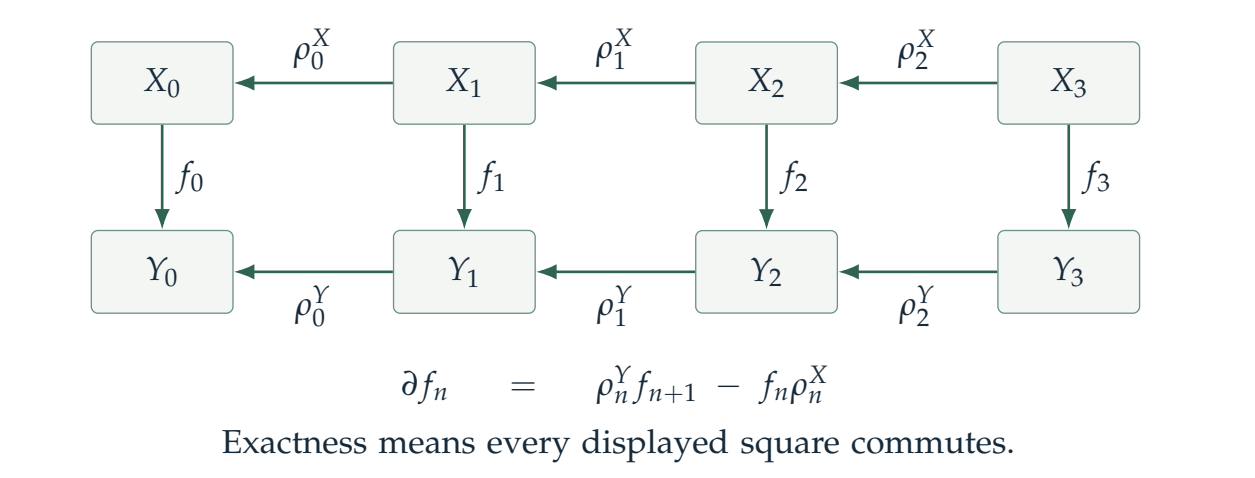
A candidate transport from \(X\) to \(Y\) consists of maps \(f_n:X_n\to Y_n\). It is exact when
Proposition 6.1: The exact tower category
Identity maps and composites of exact transports are exact. An exact transport induces a map of coherent point spaces by \(x\mapsto(f_nx_n)_n\), preserving identities and composition.
Proof
For two exact transports, substitute \(\rho^Z_ng_{n+1}=g_n\rho^Y_n\) and \(\rho^Y_nf_{n+1}=f_n\rho^X_n\) into the composite square. For a coherent point,
Identity, associativity, and composition on points are checked coordinatewise.
This is a category on a fixed schedule. A full procategory allows additional reindexing and equivalence relations on maps. Those constructions must be supplied rather than identified with the fixed schedule by terminology.
6.2 The actual residual of a transport
On this page · Permalink · Source line 30
Assume \(\mathcal C\) is preadditive, so differences of maps make sense. The tower differential is
Its target has components \({\operatorname{Hom}}(X_{n+1},Y_n)\), not \({\operatorname{Hom}}(X_n,Y_n)\).
Proposition 6.2: The transport Leibniz identity
For composable candidates,
In particular exactness is equivalent to vanishing of the differential.
Proof
Expand the right side. The terms \(-g_n\rho^Y_nf_{n+1}\) and \(+g_n\rho^Y_nf_{n+1}\) cancel, leaving \(\rho^Z_ng_{n+1}f_{n+1}-g_nf_n\rho^X_n\). This is the differential of the composite. The exactness statement is (6.1).
There is no additional mixed defect term in this identity. Such a term would require a different definition of the defect or a different expansion. Typed cancellation is a useful safeguard against importing an attractive but incorrect error formula.
6.3 Cofinal views preserve points, not every measurement
On this page · Permalink · Source line 50
Let \(\phi:{\mathbb N}\to{\mathbb N}\) be monotone and unbounded. The sampled tower uses levels \(X_{\phi(n)}\) and their composite restrictions.
Theorem 6.3: Cofinal reconstruction of points
Sampling induces an equivalence between the coherent points of \(X\) and of its sampled tower.
Proof
Write \(\rho_{i,j}:X_j\to X_i\) for the composite restriction when \(i\le j\), with \(\rho_{i,i}=I\). These maps satisfy \(\rho_{i,j}\rho_{j,k}=\rho_{i,k}\). A coherent sampled point obeys
by iterating its adjacent coherence equations.
For each \(k\), unboundedness gives an index \(n\) with \(k\le\phi(n)\). Set \(x_k=\rho_{k,\phi(n)}y_n\). If \(m\) is another permissible index, choose \(\ell\ge n,m\). Monotonicity permits both composite restrictions, and sampled coherence gives
Thus \(x_k\) is independent of the choice, including when the schedule repeats a level.
For the adjacent equation at \(k\), choose one \(n\) with \(k+1\le\phi(n)\). Then
The recovered family is therefore a point of the original tower.
Sampling a full point and recovering its \(k\)th coordinate gives \(\rho_{k,\phi(n)}x_{\phi(n)}=x_k\) by its original coherence. Recovering a sampled point and evaluating at \(k=\phi(n)\) allows the index \(n\) itself, giving \(\rho_{\phi(n),\phi(n)}y_n=y_n\). These are both inverse identities. No surjectivity of the bonding maps or of the point evaluations was used.
This theorem is about exact coherent points. Raw residual size is a different quantity. On identity scalar towers, \(f_n=(-1)^n\) has nonzero fine differences, but its even subsequence is constant. The coarse residual vanishes because adjacent fine defects cancel. A cofinal equivalence of limits does not imply equality of residual norms or an absence of aliasing in uncorrected data.