
5 Changing what is prescribed
On this page · Permalink · Source line 1
The observable is part of a realization problem, not an annotation added after it has been solved. Prescribing more views can remove ambiguity, but it can also exclude every completion. This section follows both effects through the actual obstruction groups. It then works through a three-view model in which an initially harmless choice creates a genuine dead end.
5.1 Three maps that must not be confused
On this page · Permalink · Source line 4
Keep the additive view system of Section 3. For a prescribed domain \(U\), there are three distinct maps:
The first restricts a raw family, whether or not it is coherent. The second restricts a global coherent family. The third detects whether an already coherent partial family has a global completion. Their domains are different. In particular, surjectivity of the raw coordinate projection does not imply surjectivity of \(r_U\).
The obstruction group is \(Q_U=R/B_U\), where \(B_U=\delta(\ker p_U)\). The ambiguity group is \(H_U=\ker\delta\cap\ker p_U\). Both depend on what has been fixed. Enlarging the prescription reduces the permitted correction space and the invisible exact space at the same time.
5.2 Forgetting a prescription gives a quotient map
On this page · Permalink · Source line 15
Let \(U\subseteq W\). Then
A correction invisible on all of \(W\) is certainly invisible on \(U\). The direction of the quotient map is consequently
The larger prescribed domain appears in the source. More protection means a smaller subgroup is divided out, so more obstruction information can remain.
Theorem 5.1: Functorial forgetting of protected views
The homomorphism \(\pi_{W,U}\) is well defined and surjective. For \(U\subseteq W\subseteq Z\), it satisfies
For every \(s\in\Gamma_W(A)\),
In particular an obstructed restriction remains obstructed when more compatible prescribed data are retained. A successful extension on the larger prescribed domain gives a successful extension of its restriction.
Proof
If \(r-r'\in B_W\), then \(r-r'\in B_U\), proving well-definedness. Every class modulo \(B_U\) has a representative \(r\), and the class of that same representative modulo \(B_W\) maps to it. This proves surjectivity. Identity and composition follow by applying the formulas to a representative.
Choose a raw extension \(\widetilde s\) of the partial section on \(W\). It is also a raw extension of \(s|_U\). Lift independence of the two extension obstructions therefore identifies both sides of (5.1) with the class of \(\delta\widetilde s\) modulo \(B_U\). A homomorphism sends zero to zero. Thus nonvanishing on the smaller domain rules out vanishing on the larger one, while vanishing on the larger domain implies vanishing after restriction.
The converse implication does not hold. The quotient map can annihilate the obstruction created by a newly fixed value. Surjectivity of \(\pi_{W,U}\) is also not a theorem that arbitrary larger partial sections extend. It is a statement about representatives in two obstruction groups, not about the image of restriction from global objects.
5.3 An initially free parameter can become an obstruction
On this page · Permalink · Source line 47
Consider the chain of views \(0\to1\to2\), with fiber \({\mathbb Z}^2\) at each view. Write the maps in the direction in which data are restricted:
The composite identity \(\rho_{0,1}\rho_{1,2}=\rho_{0,2}\) is literal. A global family is exactly
Indeed the first coordinate must agree at every view. The second coordinate at view zero is forced to vanish, and the second coordinate at view one must be twice the second coordinate at view two. These conditions also suffice.
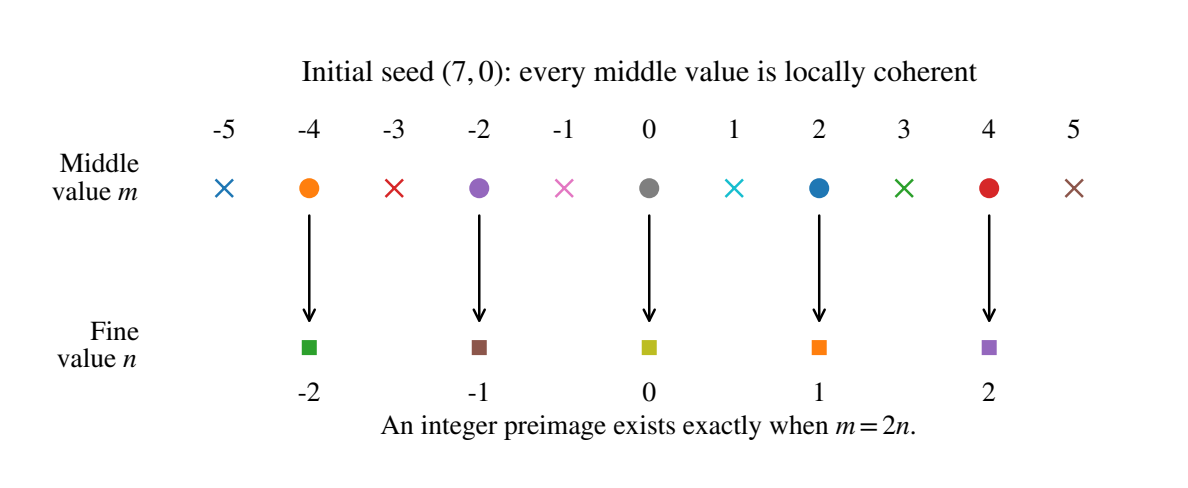
First prescribe only \(U=\{0\}\), with seed \((k,0)\). Every integer \(n\) in (5.2) gives a completion. Now prescribe \(W=\{0,1\}\), with values \((k,0)\) and \((k,m)\). This is a coherent partial section for every integer \(m\), because \(\rho_{0,1}\) forgets its second coordinate. Global extendability is a stronger requirement: \(m\) must be even.
Proposition 5.2: A coherent branch can be a dead end
Every initial seed \((k,0)\) in this model has a completion set in bijection with \({\mathbb Z}\). A fixed intermediate value \((k,m)\) extends precisely when \(m\in2{\mathbb Z}\), and then has a unique completion. In particular the nonzero initial seed \((7,0)\) extends, while the coherent intermediate choice \((7,1)\) does not.
Proof
Equation (5.2) supplies a completion for each \(n\), and the second coordinate of \(x_2\) recovers the parameter. Fixing the intermediate value imposes \(2n=m\). This equation has no integer solution for odd \(m\), and exactly one for even \(m\). Taking \(k=7\) and \(m=1\) proves the final assertion.
The invisible coherent changes for the initial prescription are
Thus \(H_U\simeq{\mathbb Z}\). Requiring invisibility also at view one forces \(2n=0\), hence \(n=0\), so \(H_W=0\). More observation removes all ambiguity in the successful branches. It does not turn the unsuccessful branches into solutions.
5.4 Why the extension space is a dependent sum
On this page · Permalink · Source line 78
Let \(s\) be the initial partial section. The stage theorem gives
In the present example the index \(t\) is the integer \(m\). The summand is empty for odd \(m\) and a singleton for even \(m\). Taking their disjoint union gives one integer's worth of completions again. No contradiction appears between many initial completions and unique completion after a successful intermediate choice.
This formula also explains a logical error in greedy reconstruction. The fact that some branch extends does not justify replacing the existential choice by an arbitrary coherent branch. A method that fixes an intermediate value must either retain the remaining extension obligation or supply a rule proved to preserve extendability. Coherence on the current patch alone provides no such guarantee.
For an increasing sequence of prescribed domains, the same warning applies repeatedly. The finite stage formula keeps each intermediate choice explicit. It does not by itself manufacture one compatible infinite sequence of choices. Proposition 35.2 supplies an existence criterion for towers of nonempty finite sets.
5.5 Changing the coefficients changes both questions
On this page · Permalink · Source line 90
The equations behind the example can be read over a general abelian coefficient group \(T\). With the initial first coordinate fixed, the possible completions are parametrized by \(n\in T\). Prescribing the middle value \(m\) gives the equation \(2n=m\). Direct substitution therefore gives
This calculation specializes as follows.
| Coefficient group | Which middle values extend? | Completions of an extendable value |
|---|---|---|
| \({\mathbb Z}\) | Even integers | One |
| \({\mathbb Q}\) | Every rational | One |
| \(\mathbb F_2\) | Only zero | Two |
| \(\mathbb F_3\) | Every element | One |
The integer instance is the actual formal example cited above. The other rows are worked coefficient calculations from the same two equations. In characteristic two, stronger prescription does not eliminate the hidden parameter because doubling annihilates it. Over the rationals it creates no parity obstruction because doubling is invertible.
A solver that changes the coefficient domain while leaving its user-facing description untouched changes the mathematical problem. The rational answer \(1/2\) is not an integral completion of the odd middle value one. Conversely, a failure over \({\mathbb Z}\) is not evidence of a failure over \({\mathbb Q}\). The coefficient structure belongs beside the views, restrictions, and preserved values in the problem specification.
How to read the result
More information can reduce the set of answers without making the problem easier. The obstruction quotient records which new demands become impossible, while the ambiguity kernel records which freedom survives the demands that can be met.