
23 A geometry of transformations needs its own cost
On this page · Permalink · Source line 2
The preceding analytic chapters measure the size of a residual or the distance from a candidate to an exact subspace. Neither measurement automatically defines a distance between mathematical objects. In an additive category, the zero map is often perfectly compatible and perfectly uninformative. A geometry that assigns zero cost to every compatible map can therefore identify all objects at distance zero.
A cost of transformation must be declared separately. It may measure an admissible computational expense, a loss of retained information, or another specified quantity. The interpretation alone proves none of its mathematical laws. The construction below begins only after the required laws have been established.
23.1 Extended directed distance
On this page · Permalink · Source line 7
Let \(\mathcal C\) be a category and let \(W\) assign each arrow a value in the extended nonnegative reals \([0,\infty]\). Suppose
The order of ordinary composition is first \(f\), then \(g\). Define
The infimum of an empty family is \(\infty\). No assumption of connectedness, finite cost, symmetry, or attainment is made.
Proposition 23.1: Directed cost geometry
For every arrow \(f:A\to B\),
and for all objects,
The symmetric function
has zero diagonal, is symmetric, and satisfies the extended triangle inequality. The relation \(d_W^{\mathrm{sym}}(A,B)=0\) is an equivalence relation.
Proof
The infimum is bounded above by each of its entries. Apply this to the identity to obtain the zero diagonal. If either term on the right of the triangle inequality is infinite, there is nothing to prove. Otherwise, for every \(\varepsilon>0\), choose arrows with costs less than the corresponding infima plus \(\varepsilon\). Their composite has cost less than \(d_W(A,B)+d_W(B,C)+2\varepsilon\). Letting \(\varepsilon\) tend to zero gives the result. This argument does not require an optimizing arrow.
Each of the two directed distances from \(A\) to \(C\) and from \(C\) to \(A\) is bounded by \(d_W^{\mathrm{sym}}(A,B)+d_W^{\mathrm{sym}}(B,C)\). Taking their maximum proves the symmetric triangle law. Zero diagonal and symmetry give reflexivity and symmetry of the zero-distance relation. The triangle inequality and nonnegativity give transitivity.
The formal source proves these laws directly in \({\mathbb R}_{\ge0}^{\infty}\) and constructs the zero-distance setoid. It does not identify zero distance with categorical isomorphism. Passing to the quotient can separate zero-distance classes, but would still not prove that those classes are the intended semantic objects.
23.2 A concrete path category
On this page · Permalink · Source line 42
Consider four vertices \(A,B,C,D\), and the free path category generated by
There are no arrows incident to \(D\), apart from its identity. A path costs the sum of its edge labels. Concatenation is additive and empty paths cost zero, so all cost axioms hold. The directed distances are
For example, the path from \(B\) through \(A\) to \(C\) costs two. Every path from \(C\) to \(B\) must first pay the edge cost five and can then move from \(A\) to \(B\) for free. Nonnegative loops cannot improve either cost.
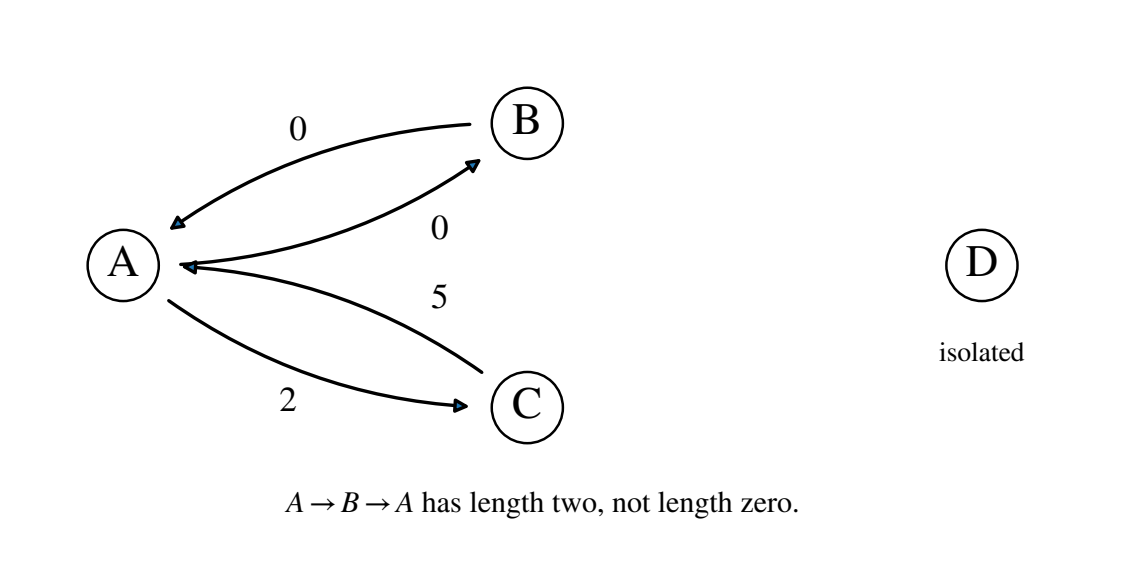
The symmetric zero-distance classes are \(\{A,B\}\), \(\{C\}\), and \(\{D\}\). The distance between the first two classes is five. The third class is infinitely far from each of them. Yet \(A\) and \(B\) are not isomorphic in this category. Any path from one to the other has positive length, so concatenating it with a return path cannot give the length-zero identity. This is a categorical distinction even though the numerical cost is zero.
One can instead impose relations declaring the two arrows inverses. That changes the category. The distance table alone does not record whether those relations were imposed.
23.3 Why compatibility alone can collapse the geometry
On this page · Permalink · Source line 66
Proposition 23.2: The zero-arrow collapse
Suppose \(\mathcal C\) has zero morphisms and \(W(0:A\to B)=0\) for every pair of objects. Then
Proof
The zero arrow is one member of the family over which the infimum is taken. Thus \(0\le d_W(A,B)\le W(0)=0\).
For the preadditive tower differential, the zero family of maps is exact. Consequently any proposed nonnegative arrow cost that vanishes on every exact map also vanishes on every zero map. If it satisfies the cost axioms at all, its object distance collapses by the proposition.
The qualification is important. A raw operator defect norm need not satisfy the unweighted composition inequality required of \(W\). The transport Leibniz identity gives coefficients involving the surrounding maps. It is not legitimate to first call an arbitrary defect norm a subadditive cost and then use the metric construction.
23.4 Preservation changes the admissible arrows
On this page · Permalink · Source line 81
One response to collapse is to restrict arrows to those satisfying a declared preservation contract. For objects equipped with maps \(p_A:A\to S\), a morphism can be required to satisfy
Identities and composition preserve this equation. Unless \(p_A=0\), the zero arrow is not admissible. In other applications the arrows might be required to be isomorphisms or to retain a particular observable. These are different choices of category, not automatic consequences of small residuals.
Even after this restriction, separation remains a theorem to prove rather than a consequence of terminology. Distinct objects can still be connected by arbitrarily cheap preserving maps. Symmetry can fail, and the infimum can fail to be attained. A quantitative comparison therefore needs four pieces of information: the objects, the admissible arrows, the actual cost, and the meaning of zero distance.
The role of this construction is modest but useful. It prevents a compatibility measure from being silently promoted to a universal geometry. It also gives a valid directed geometry when the separate categorical and cost assumptions really hold.