
10 Multiscale residuals and the limits of reconstruction
On this page · Permalink · Source line 304
10.1 A split coarsener retains its missing detail
On this page · Permalink · Source line 305
Let \(C:R\to\overline R\) and \(J:\overline R\to R\) be linear maps with \(CJ=I\). Put \(H=I-JC\). Then
The two coordinates \((Cr,Hr)\) retain all information. The coarse coordinate alone generally does not.
The actual dyadic tower coarsener has the typed formula
It is obtained by telescoping two adjacent compatibility squares. With target sections, a lift is
The section identity gives \(CJ=I\), so the missing detail is explicitly \(Hr\), not an unspecified reconstruction error. The normed construction imposes the bounds needed to make these maps bounded on its operator family spaces.
10.2 A whole cascade
On this page · Permalink · Source line 323
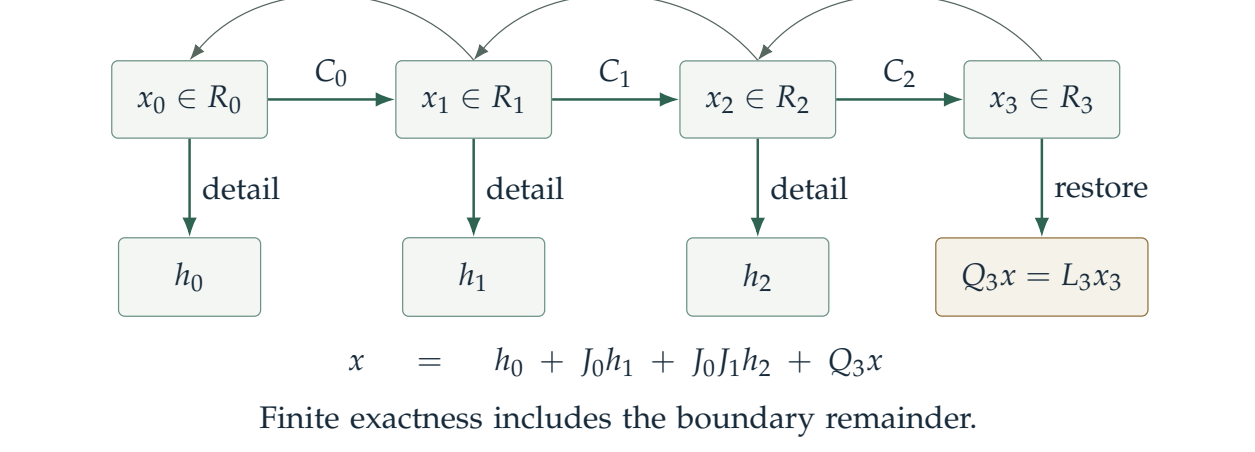
At scale \(j\), let \(C_j:R_j\to R_{j+1}\) and \(J_j:R_{j+1}\to R_j\) be bounded linear maps with \(C_jJ_j=I\). For \(x\in R_0\), define
The map \(Q_N\) restores the surviving coarse remainder to the original space. It is this restored remainder, not just \(x_N\), that controls reconstruction.
Theorem 10.1: Finite reconstruction and nested remainders
For every \(N\),
Each \(Q_N\) is a projection, and for \(N\le M\),
The vectors with all details zero are exactly the persistent subspace
Proof
Let \(D_0=I\) and \(D_N=C_{N-1}\cdots C_0:R_0\to R_N\). Thus \(x_N=D_Nx\), \(Q_N=L_ND_N\), and repeated use of \(C_jJ_j=I\) gives
This cancellation takes place between adjacent maps with matching domains. No identification of different residual spaces is needed.
Since \(L_{j+1}=L_jJ_j\) and \(x_{j+1}=C_jx_j\),
Summing from \(j=0\) to \(N-1\) leaves \(x-Q_Nx\) because \(Q_0=I\). This proves both finite reconstruction identities, including \(N=0\), when the detail sum is empty.
Idempotence follows from \(D_NL_N=I\):
For \(M\ge N\), put \(C_{N,M}=C_{M-1}\cdots C_N\) and \(J_{N,M}=J_N\cdots J_{M-1}\), using identities for \(M=N\). Then
The identities \(D_NL_M=J_{N,M}\) and \(D_ML_N=C_{N,M}\) now give
Both orders have been checked, rather than inferred from one range inclusion.
If all \(h_j\) vanish, the finite telescope gives \(Q_Nx=x\) for every \(N\). Conversely, if every \(Q_Nx=x\), then \(L_jh_j=Q_jx-Q_{j+1}x=0\). Apply the left inverse \(D_j\) of \(L_j\) to obtain \(h_j=0\). The injectivity of the restoration composite is the step that recovers the original detail from its transported value.
10.3 Convergence has its own theorem
On this page · Permalink · Source line 384
Call \(x\) norm recoverable when \(Q_Nx\to0\). This is equivalent to \(S_Nx\to x\), but it does not follow merely from vanishing persistent subspace. Let
be the finite core.
Theorem 10.2: Density criterion for norm recovery
Suppose \(\sup_N{\left\lVert Q_N\right\rVert}\le K<\infty\). Then the norm recoverable vectors are exactly \(\overline{\mathcal F}\). In particular all vectors are norm recoverable if and only if the finite core is dense.
Proof
The nested identities first imply that the kernels increase: if \(Q_My=0\) and \(N\ge M\), then \(Q_Ny=Q_NQ_My=0\). Thus the finite core really is an increasing union of linear subspaces.
Suppose \(Q_Nx\to0\). Put \(y_N=S_Nx=x-Q_Nx\). Idempotence gives \(Q_Ny_N=Q_Nx-Q_N^2x=0\), so \(y_N\in\mathcal F\). Since \(x-y_N=Q_Nx\to0\), these are finite-core approximants converging to \(x\). Hence \(x\in\overline{\mathcal F}\).
Conversely, fix \(x\in\overline{\mathcal F}\) and \(\epsilon>0\). If \(K=0\), the common operator bound gives \({\left\lVert Q_Nx\right\rVert}=0\) for every \(N\), so convergence is immediate. Suppose \(K>0\). Choose \(y\in\mathcal F\) satisfying \({\left\lVert x-y\right\rVert}<\epsilon/(K+1)\). Some \(M\) has \(Q_My=0\). For every \(N\ge M\), nesting and the common operator bound give
The approximation \(y\) is chosen before the depth \(N\), giving precisely the quantifier order in norm convergence. This proves equality of the two sets. Applying it to every \(x\in R_0\) gives the density criterion.
There are other sufficient conditions. If the transported details are absolutely summable in the Banach space \(R_0\), their sum exists and the remaining boundary lies in \(\mathcal P_\infty\). If that persistent subspace is zero, the sum equals \(x\). Alternatively,
gives a direct sufficient decay test. A decreasing coarse norm by itself is not enough when restoration gains grow.
10.4 The actual dyadic result
On this page · Permalink · Source line 413
For the dyadic residual hierarchy defined above, the persistent residual is zero. Zero detail at a scale reveals every even coordinate, while an odd coordinate is passed to a smaller index at the next scale. Strong induction on the coordinate index therefore proves that a residual with all details zero is zero.
Theorem 10.3: Dyadic determination and finite coordinate recovery
In the actual dyadic system, all detail coordinates jointly determine the residual. Moreover,
Thus every fixed residual coordinate is recovered exactly at a sufficiently large finite depth. The statement does not assert convergence in the supremum norm over all coordinates.
Proof
Write \(R_j\) for the residual space at scale \(j\). Its lift has the actual coordinate formula
where \(s^{(j)}_{2m}\) is the corresponding target section at that scale. The expression on the right is composition of the section with the residual operator. Its source and target are those of the odd coordinate at scale \(j\).
Set \(L_{j,0}=I_{R_j}\) and \(L_{j,N+1}=J_jL_{j+1,N}\). We prove, simultaneously for all starting scales \(j\), that
For \(N=0\), the inequality \(k+1<1\) has no solution. Suppose the assertion holds at depth \(N\). At depth \(N+1\), an even coordinate vanishes by the displayed lift formula. For an odd coordinate \(k=2m+1\), the hypothesis gives
The induction hypothesis at starting scale \(j+1\) makes \((L_{j+1,N}z)_m\) zero. Composing that zero operator with \(s^{(j)}_{2m}\) gives zero at coordinate \(k\). This completes the induction without identifying residual spaces at different scales.
Now \(Q_Nr=L_{0,N}x_N\), so the support assertion applies to the restored remainder. Since \(S_Nr=r-Q_Nr\), it gives the reconstruction equation. Finally, if two residuals have identical details at every scale, the finite telescope makes their \(S_N\) reconstructions equal for every \(N\). At any fixed coordinate choose \(N\) with \(k+1<2^N\). The reconstruction equation then makes their original coordinates equal. Hence the residuals are equal.
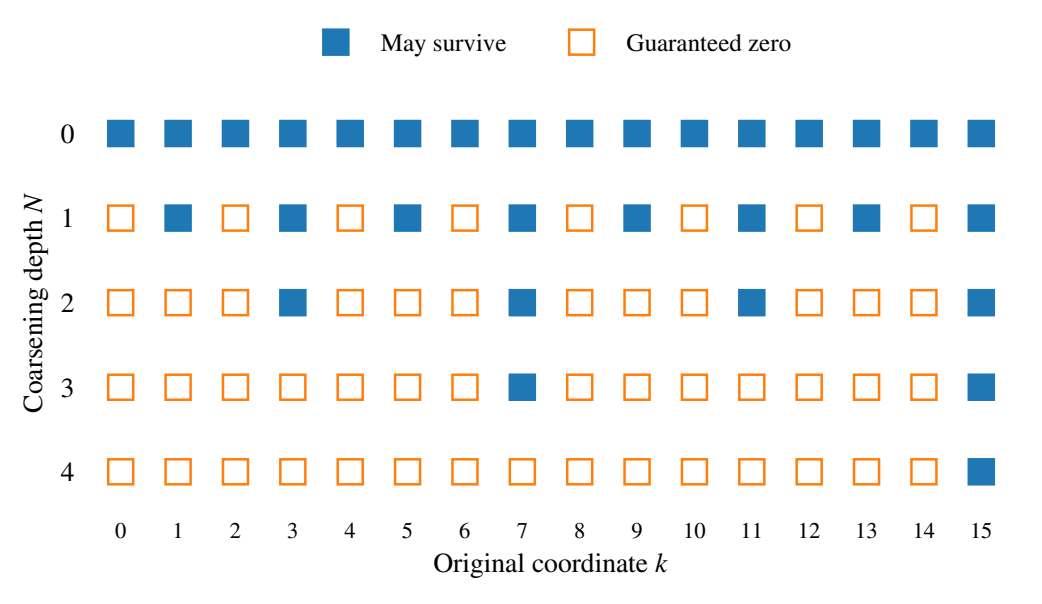
The strict inequality matters: the next coordinate, \(k=2^N-1\), can still have a nonzero remainder. There is also a sharper, nonconsecutive description of the support.
Proposition 10.4: The dyadic support pattern
For the same lifts,
Thus coordinate \(k\) is certainly recovered once \(N>\nu_2(k+1)\), where \(\nu_2(m)\) is the largest power-of-two exponent dividing the positive integer \(m\). The only possible unrecovered coordinates at depth \(N\) are
Proof
Prove the assertion for \(L_{j,N}\) by induction, uniformly in \(j\). At depth zero every positive integer is divisible by one, so there is nothing to prove. At depth \(N+1\), even coordinates vanish. If \(k=2m+1\), then
When divisibility fails, the inner coordinate in \(J_jL_{j+1,N}\) vanishes by induction. The formula for the odd lift finishes the proof. Apply the result to \(Q_Nr=L_{0,N}x_N\).
This refinement is formalized by a scale-uniform induction on the actual varying-fiber residual system in DyadicSupport.lean. It asserts where a remainder may survive, not that every allowed coordinate is nonzero. In the scalar identity-bonding model with \(C(a,b)=a+b\), the residual constantly equal to one has value \(2^N\) at every surviving position. That example proves sharpness of the uniform prefix cutoff.
10.5 Two boundary examples
On this page · Permalink · Source line 469
On \(\ell^\infty({\mathbb N},{\mathbb R})\), let \(C\) remove the first coordinate and let \(J\) prepend zero. Then \(Q_Nx\) is the tail of \(x\), placed at its original coordinates with zeros before \(N\). Every fixed coordinate is eventually zero in the remainder, and \({\left\lVert Q_N\right\rVert}\le1\). Nevertheless the constant sequence \(\mathbf1\) satisfies \({\left\lVert Q_N\mathbf1\right\rVert}=1\) for every \(N\).
Proposition 10.5: The recovery domain is \(c_0\)
For this shift cascade,
For \(x_n=q^n\), \(0\le q<1\), the error is exactly \(q^N\).
Proof
The error norm is \(\sup_{n\ge N}|x_n|\). It tends to zero precisely when the sequence tends to zero. For a geometric sequence its largest tail value is the first one, \(q^N\).
As a second example, take scalar spaces with \(C=\tfrac12I\), \(J=2I\). The coarse value \(x_N=2^{-N}x\) tends to zero, but restoration gives \(Q_Nx=x\). Every detail is zero and the entire input is persistent. The example belongs to this scalar cascade, not to the actual dyadic hierarchy, whose persistent subspace was proved to vanish.
How to read the result
Retained packets make omission explicit. They do not guarantee convergence. Coordinate recovery, bounded reconstruction, summability, and attainment remain different mathematical properties.