
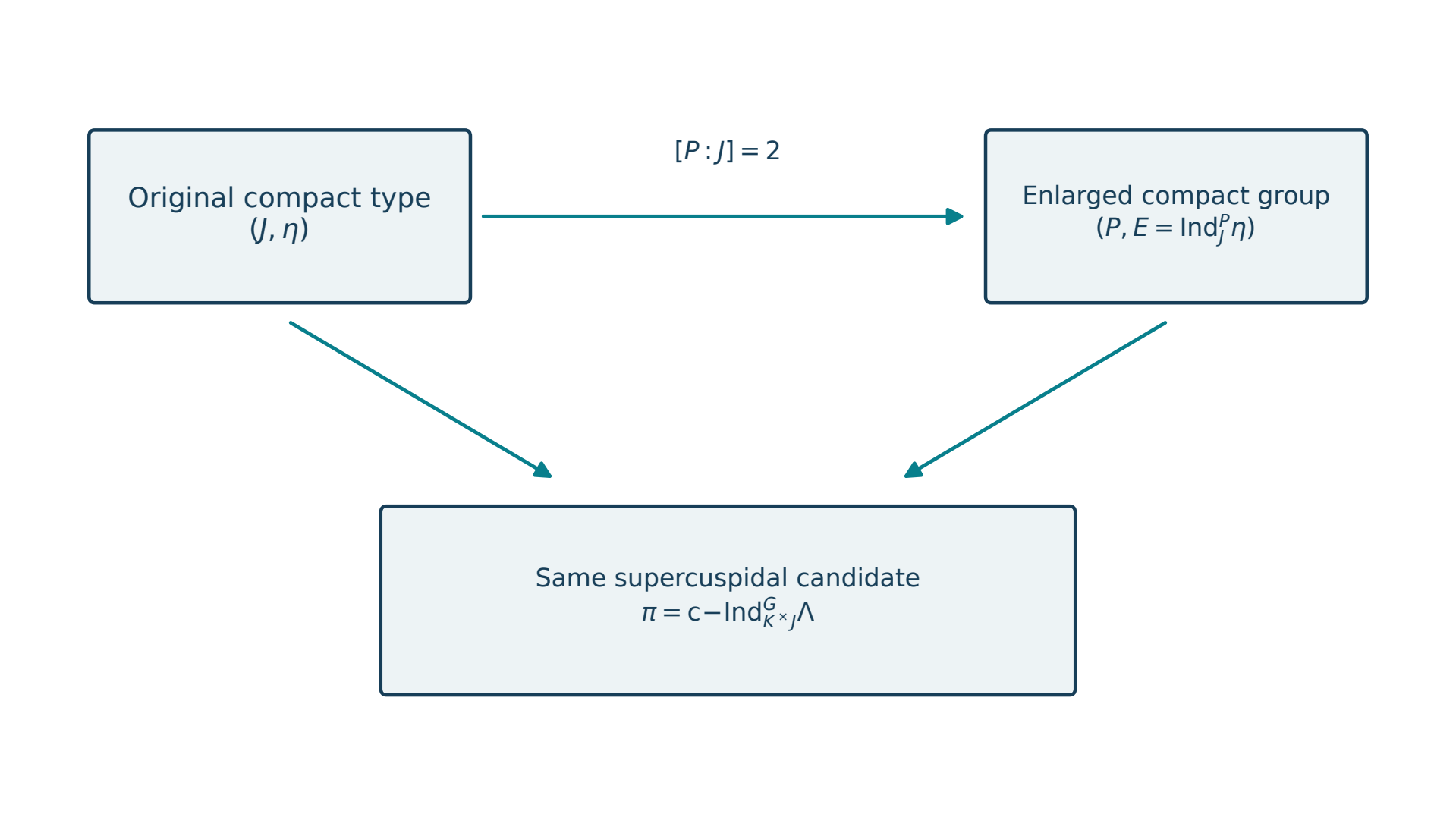
Reading the figure
The original compact type maps to an enlarged compact group of index two. Both lead to the same supercuspidal candidate. The enlargement changes the assembly carrier while retaining the inducing representation.
Mathematical labels
\((J,\eta)\)
\((P,E=\mathrm{Ind}_J^P\eta)\)
\(\pi=\mathrm{c\!-\!Ind}_{K^\times J}^G\Lambda\)
\([P:J]=2\)
Selectable labels from the original PDF
Native PDF text retains the figure’s extraction order. Equations and data tables above provide the reading order.
Original compact type
(J, η)
Enlarged compact group
(P, E = Ind
P
J η)
Same supercuspidal candidate
π = c−Ind
G
K
× JΛ
[P : J] = 2
Original figure caption
The new carrier occurs in the original candidate; it is not an abstract extra tensor factor.
At rank two, write \(q=2m+1\), \(m\ge1\), and use
Then \(J\triangleleft P\), \([P:J]=2\), and \(P\cap(K^\times J)=J\). The conjugate character ratio \(\lambda=\theta^g/\theta\) is nontrivial and sign-valued. With \(H_0=\ker\lambda\),
The represented diagonal sign and off-diagonal generators anticommute, proving the nondegenerate Heisenberg structure.
Scope
The original quotient \(J^1/H^1\) is still zero-dimensional. The new pair is a separate arithmetic assembly carrier.