
Reading the figure
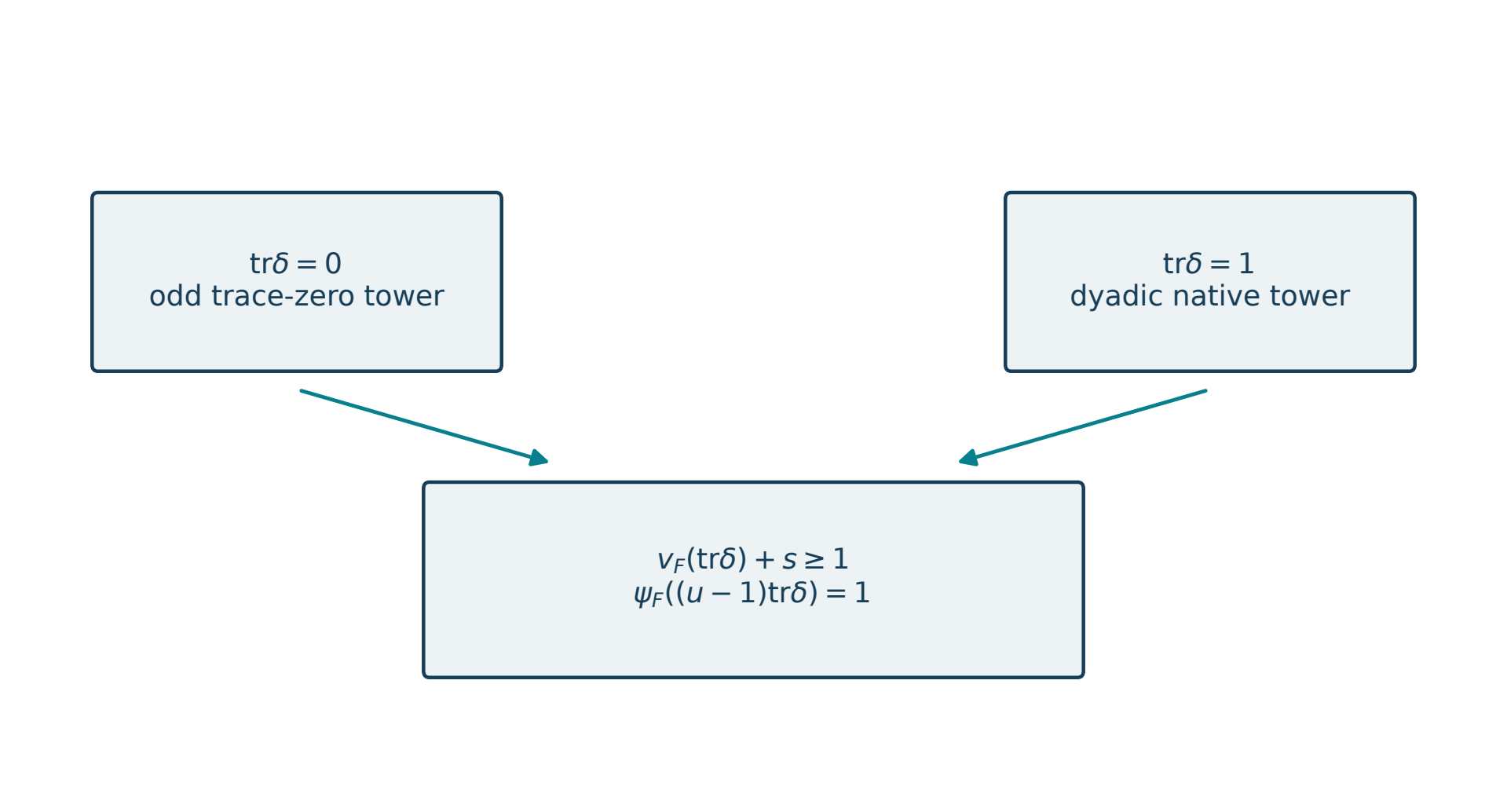
The odd tower has native trace zero; the dyadic tower has native trace one. Both feed a depth inequality ensuring the displayed additive character is trivial on the required scalar perturbations.
Mathematical labels
\(\mathrm{tr}\delta=0\)
\(\mathrm{tr}\delta=1\)
\(v_F(\mathrm{tr}\delta)+s\geq1\)
\(\psi_F((u-1)\mathrm{tr}\delta)=1\)
Selectable labels from the original PDF
Native PDF text retains the figure’s extraction order. Equations and data tables above provide the reading order.
trδ = 0
odd trace-zero tower
trδ = 1
dyadic native tower
vF(trδ) + s ≥ 1
ψF((u − 1)trδ) = 1
Original figure caption
The scalar correction disappears when its argument lies in \(t{\mathcal O}_F\).
Fix \(\psi_F\) of conductor \(t{\mathcal O}_F\). On a scalar unit \(u\in U_F^s\), the additive correction sees \((u-1){\operatorname{tr}}\delta\). Hence
The dyadic native corrections have trace 1. Its valuation is 0, so \(s=1\) already satisfies the inequality. Thus trace zero is sufficient but unnecessary.
Scope
Euler's weighted-visibility viewpoint motivated this step. No Euler coefficient theorem is an arithmetic proof input here. In characteristic two, the weights are uniformizer depths, not integer powers of two in the coefficient field.