
Global meromorphic continuation
For every integer \(N\ge2\), the orbit zeta has a meromorphic continuation to the whole complex plane with exactly one pole:
Its exact absolute-convergence abscissa is \(1/N\). At nonpositive integers,
The zeta-regularized product of the orbit coordinates is consequently \(\exp[-\mathcal Z_N'(0)]=N\).
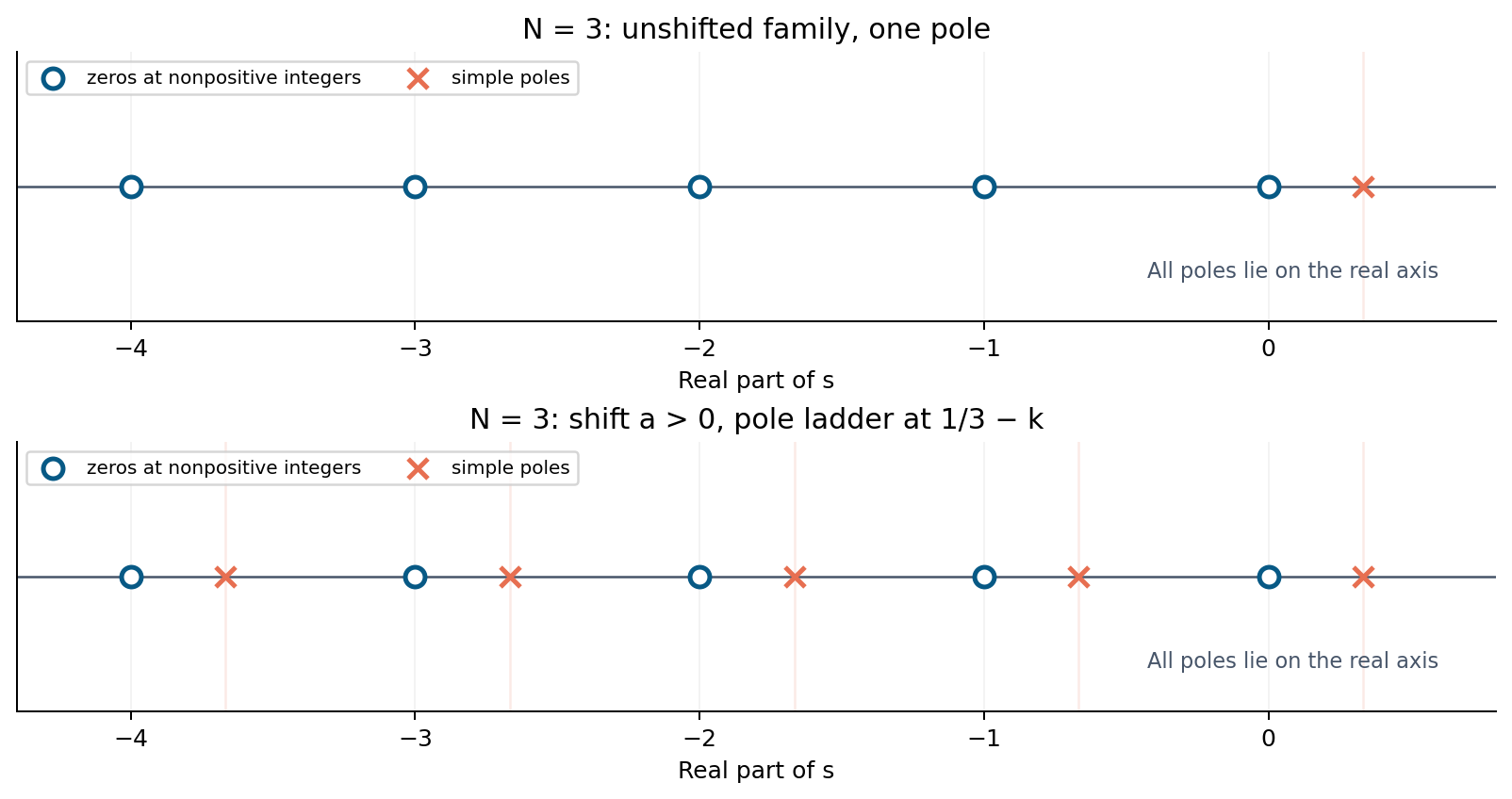
The continuation uses classical Mellin regularization. The contribution here is a complete local application with multiplicities, principal branches, and all convergence hypotheses checked.
A finite exponential sum controls the tail
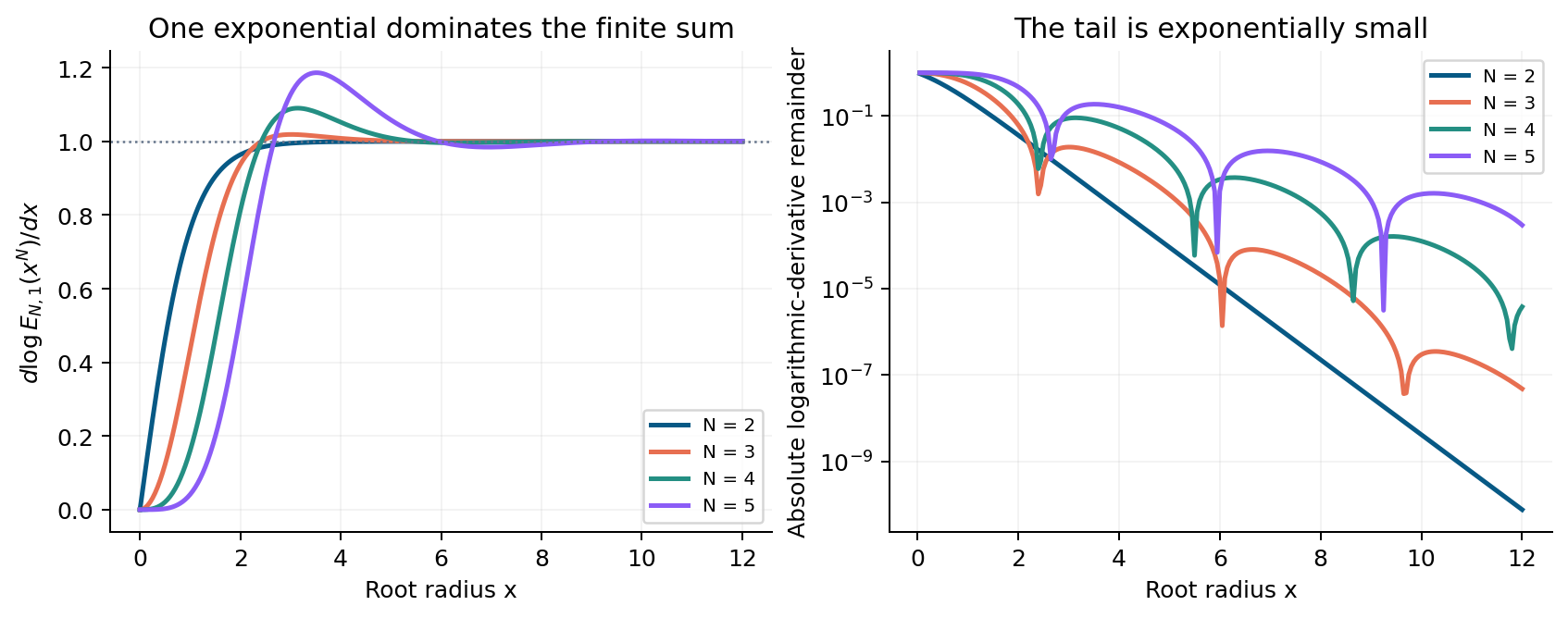
Put \(E_N(t)=d_N(-t)=\sum_{n\ge0}t^n/(Nn)!\) and \(\omega=e^{2\pi i/N}\). For \(x\ge0\),
Root filtering proves this identity term by term: only powers divisible by \(N\) remain. The positive real exponential is dominant, so
with corresponding differentiated estimates on the positive ray.
Why complex zero arguments do not break the integral
In a sufficiently narrow sector around negative \(w\), choose the root \(x=(-w)^{1/N}\) near the positive real ray. The first exponential dominates the other \(N-1\) terms by a uniform real-part gap at large radius, so this sector is eventually zero free. The finitely many remaining zeros avoid the negative real ray because \(d_N(-t)>0\) for \(t\ge0\). Thus all zero arguments have a uniform gap from the branch cut. In particular \(|t+w_j|\ge c_N(t+|w_j|)\) for \(t\ge0\).
The two ends have different jobs
For \(1/N<\Re s<1\), the genus-zero log derivative and the angular gap give absolute interchange in
Each term uses the principal-branch beta integral \(\int_0^\infty t^{-s}(t+w)^{-1}{\,d} t=\pi w^{-s}/\sin\pi s\). The denominator estimate bounds the absolute integral by a constant times \(|w|^{-\Re s}\), whose sum converges in this strip.
Near zero write \(f(t)=(\log E_N)'(t)=\sum_{k\ge1}\alpha_kt^{k-1}\), where \(\alpha_k=(-1)^{k+1}\mathcal Z_N(k)\). For any integer \(K\ge1\), subtract \(K\) terms on \([0,1]\):
The first integral is holomorphic for \(\Re s<K+1\). The second is entire because its remainder decays exponentially in \(t^{1/N}\). The factor \(\sin\pi s\) cancels the positive-integer poles. Increasing \(K\) covers the plane, leaving only \(1/N\). At nonpositive integers \(I_K\) is regular, so the sine factor gives zero.
At zero the finite parts give \(I_K(0)=\lim_{T\to\infty}[\log E_N(T)-T^{1/N}]=-\log N.\) Since \((\sin\pi s/\pi)'_{s=0}=1\), this equals \(\mathcal Z_N'(0)\). Absolute convergence at a smaller real exponent would give a holomorphic series across \(1/N\), contradicting the pole and proving the exact abscissa.
A Hurwitz-type deformation and its determinant
For real \(a\ge0\), define initially
The rightward shift preserves avoidance of the negative branch cut. Normalize the product with \(E_N(a)\) and use \(\log E_N(a+t)\) in the Mellin argument. For \(a>0\) there are genuine simple poles at \(s=1/N-k\), \(k\ge0\):
Indeed the large-radius derivative expands as
as an asymptotic series. The alternating sign is canceled by \(\sin(\pi(1/N-k))=(-1)^k\sin(\pi/N)\). At \(a=0\) all secondary residues vanish.
The negative-integer values remain zero, and
The finite part \(-\log N\) and normalization \(-\log E_N(a)\) give a zeta-regularized product, not an ordinary product. At \(N=2\) it is \(2\cosh\sqrt a\), the classical half-integer spectral determinant reproduced by the four shifted benchmarks. Functional equations and derivative-weighted zero sums remain open here.