
The function encodes its parameters
The complete exact analytic germ determines
Precisely, two admissible triples define the same germ if and only if these three quantities agree. Prime powers in \(Q\) are invisible because the terms use only coprimality. A finite Taylor polynomial or noisy measurements are different inputs from the complete germ in this theorem.
Let the support integers be \(n_1<n_2<\cdots\), frequencies \(\lambda_j=-2\log(1-n_j^{-\beta})\), and weights \(w_j=n_j^{-2a}\). Starting at \(R_1=A\), peel the ordered atoms:
Every limit follows from the isolated largest remaining frequency and the positive summable tail. Thus the exact function determines its spectral list.
The counting law \(N_Q(x)=\delta_Qx+O_Q(\sqrt x)\) gives
Once \(\beta\) is recovered,
Prime membership in this integer support then recovers the excluded prime set. The reconstruction is exact from infinite data; it does not certify that a finite search has found every excluded prime.
Classical Laplace uniqueness provides a comparison for the inverse mechanism. The parameter-specific extraction, frequency-rank law, and explicit instability are proved locally in the complete arithmetic route.
Separation improves while subtraction worsens
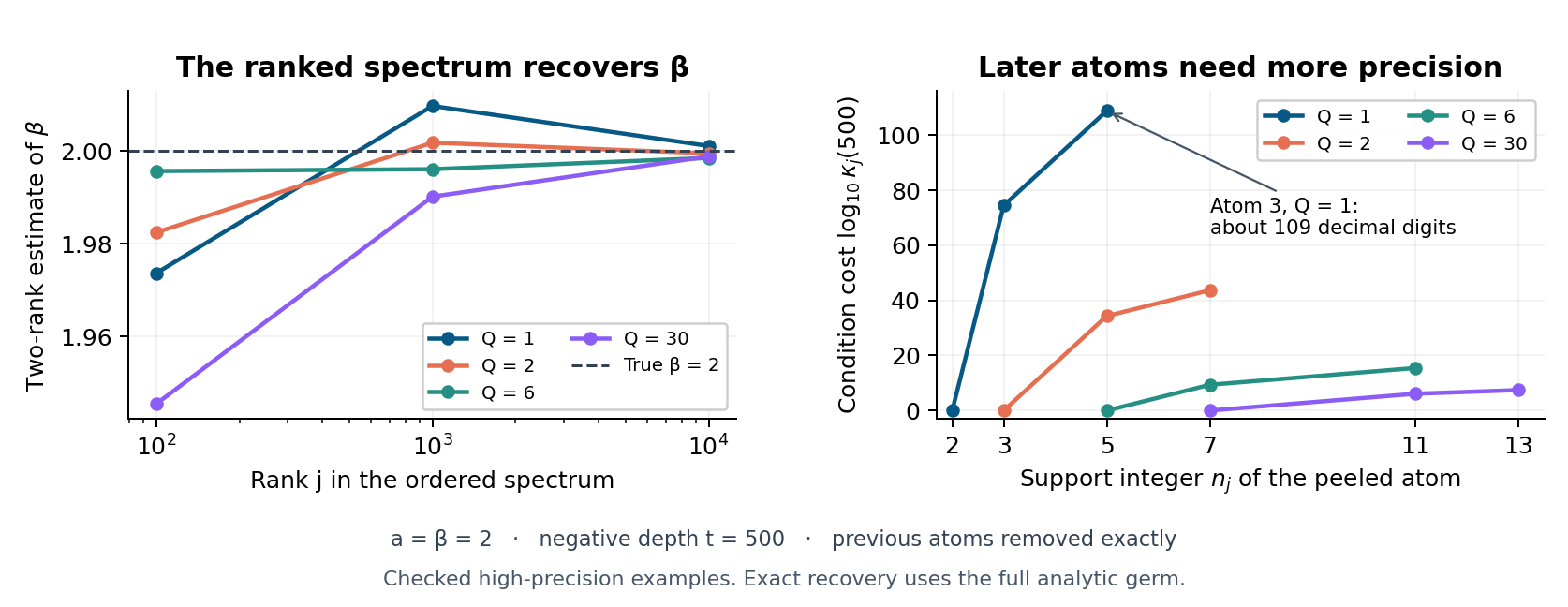
If earlier atoms have been removed exactly, set \(\Delta_j=\lambda_j-\lambda_{j+1}>0\), \(M_{j+1}=\sum_{k>j}w_k\). The logarithmic secant
obeys, for \(t\ge0\), \(h>0\),
This improves with negative depth. But relative error in \(A(-t)\) can be amplified after subtraction by
For the displayed \(Q=1\) example, the third-atom subtraction at \(t=500\) has a condition factor of roughly \(10^{108.8}\). Exact uniqueness therefore does not promise easy recovery from ordinary precision.
A large prime can hide in every finite window
For a prime \(p\nmid Q\), any \(R\ge0\), and integer \(k\ge0\),
The difference consists of the \(p\)-divisible admissible squarefree atoms. Their frequencies are at most \(\lambda_p\) and their total weight is the Euler-factor expression on the right. Termwise differentiation proves the bound for every derivative.
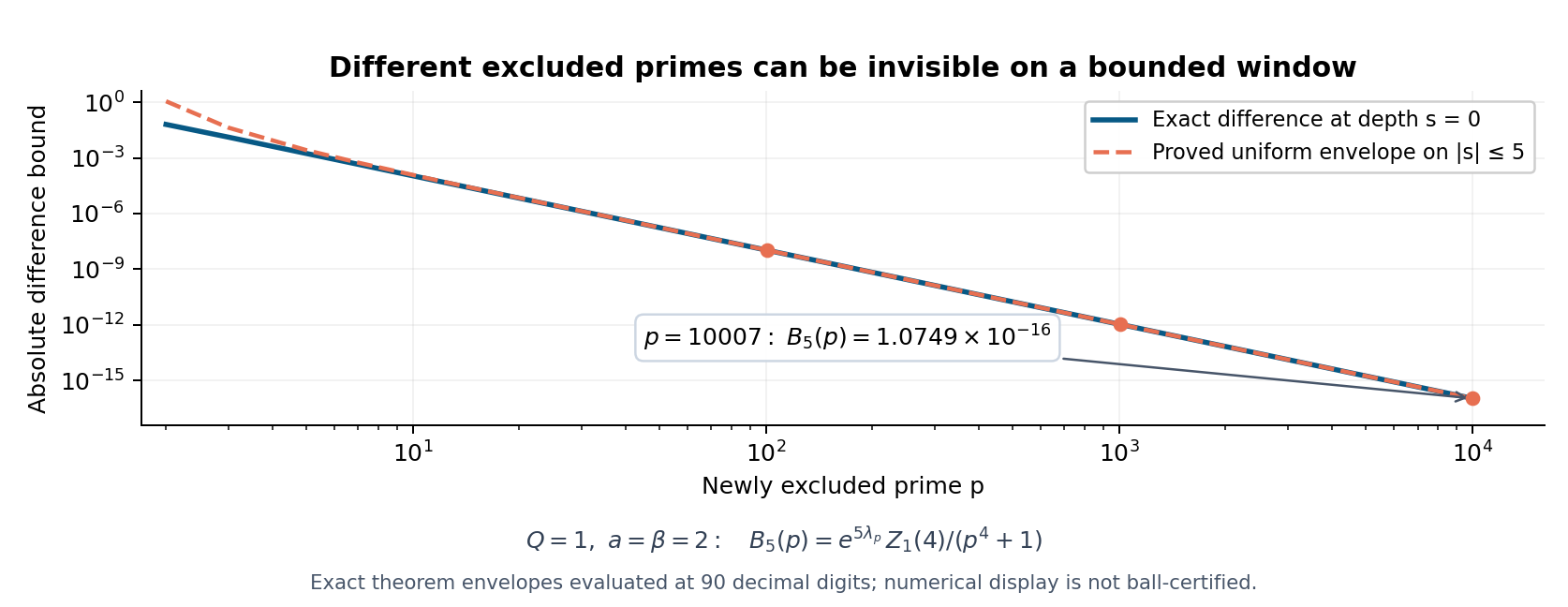
The radical differs for every such prime, while all bounded-window derivatives converge to those of \(A_Q\). Without a bound on excluded primes, there is no uniformly stable inverse from these windows to the radical parameter.
The same distinction appears in weak taps: exact structural invariants can change under perturbations that are small at finite resolution.
An infinite feature space with arithmetic labels
For the ordered support, define \(\phi_s(j)=\sqrt{w_j}e^{-\lambda_js}\). The kernel \(A(s+\overline t)\) is its weighted \(\ell^2\) Gram kernel. Summability and bounded frequencies make every feature vector well defined.
If a weighted \(\ell^2\) combination produces the zero entire function, Cauchy–Schwarz makes its coefficients absolutely summable. Successive dominant-frequency peeling then forces every coefficient to vanish. This gives an injective Hilbert realization, and all finite derivative Hankel matrices have full rank: a nonzero polynomial in \(\lambda\) cannot vanish on the infinite frequency support.
Fixed-modulus character resolution
For characters \(\chi,\psi\) modulo a fixed \(Q\), let \(\eta=\chi\overline\psi\). When \(\eta\) is nonprincipal, the elementary squarefree character sum is \(O_Q(\sqrt x)\), with no density term. The same sector partial-integration argument therefore gives
Compared with the principal \(|s|^{-(2a-1)/\beta}\) scale, this is faster by \(|s|^{-1/(2\beta)}\). The modulus is fixed; the constants are not asserted uniform as \(Q\) grows. Individual off-diagonal functions can be complex and are not asserted completely monotone.