
A quantitative compact-continuity law
Fix the contractions and let \(h,g\) be two normalized nonnegative tap vectors. Set \(Q=\max_j\max(q_j,r_j)<1\) and \(d=\|h-g\|_1\). Then
The right side is an explicitly defined entire majorant. It measures local sensitivity without asserting continuity of the asymptotic growth order.
Each \(c_n(h)\) is a positive polynomial homogeneous of degree \(n\) in the weights. Coefficientwise comparison gives \(c_n(h)\le d_n(Q)(\sum_jh_j)^n\), where \(f_Q=\sum_nd_n(Q)z^{2n+1}\). Every weight partial derivative on the simplex lies in \([0,nd_n(Q)]\). The positive and negative parts of \(h-g\) each have mass \(d/2\), giving \(|c_n(h)-c_n(g)|\le(d/2)nd_n(Q)\). Summing this inequality uses \(\sum_nnd_n(Q)R^{2n+1}=[Rf_Q'(R)-f_Q(R)]/2\).
An analytic family with a discontinuous invariant
For fixed finite \(J\), allow complex \(h_j,q_j,r_j\), with \(|q_j|,|r_j|<1\). The coefficient recurrence defines polynomials in all these parameters. On a compact parameter set choose \(Q<1\) and \(W>0\) such that \(|q_j|,|r_j|\le Q\) and \(\sum_j|h_j|\le W\). Then
Normal convergence proves joint holomorphic dependence on parameters and argument throughout this domain. Signed and complex banks have entire solutions, but the positive-bank growth theorem is not asserted for them.
The weak-tap example now has both sides quantified
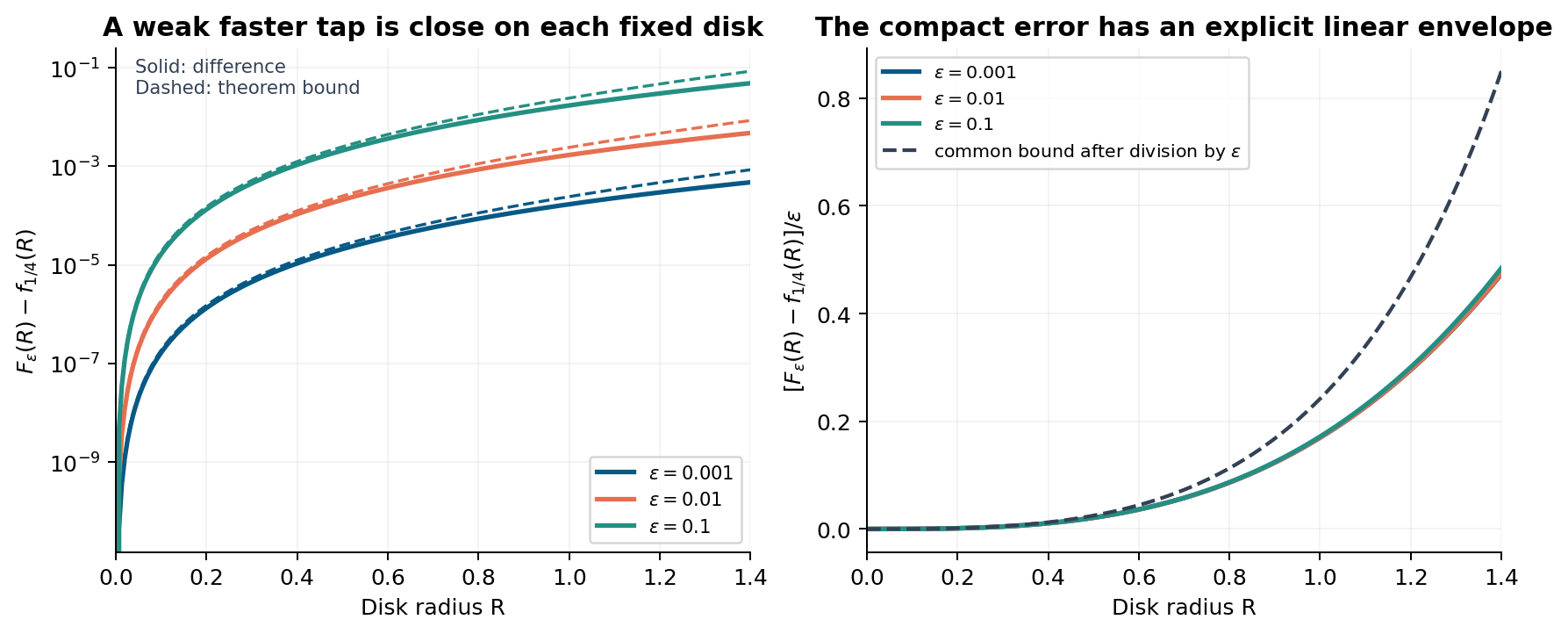
For the bank with scales \((1/4,1/4)\) and \((3/4,3/4)\), weights \(1-\varepsilon,\varepsilon\), the functions converge on every compact set as \(\varepsilon\downarrow0\). The preceding envelope gives a linear bound in \(\varepsilon\). At every \(\varepsilon>0\), the order is \(\log2/\log(4/3)\), while at zero it is \(1/2\).
The new lower-type theorem does not contradict this: its lower constant depends on the active faster weight and can tend to zero as that channel vanishes. For \(\varepsilon=10^{-3}\) one constructive lower constant is about \(1.4496\times10^{-9}\); a conservative upper constant is about \(90.4392\).
Identifying a bank has unavoidable equivalences
Permuting channels, swapping the scales within a channel, or merging duplicate scale pairs by adding their weights leaves the function unchanged. The two-scale single-channel inverse is exact up to swapping. A general minimal-bank identifiability theorem beyond these equivalences is not proved.
The resulting research target is specific: determine optimal growth type, possible logarithmic oscillations, and minimal-bank identifiability. A finite plot cannot settle any of those questions.