
Overlap is part of the arithmetic
For a finite set \(F\) of distinct primes, define
For real strengths, the exact positivity domain is
Sufficiency is termwise positivity. If one strength is below \(-1\), the atom \(n=p\) isolates its negative factor. The other strengths do not occur at that atom. At every simultaneous deletion endpoint, primes outside \(F\) still supply infinitely many positive nodes, so all Hankel matrices remain strictly positive definite.
The exact coordinate formula is
Coefficients of the monic families lie in \(\mathbb Q(\pi^{-2},\lambda_p:p\in F)\). For two primes, the overlap term is visible:
Here \(U_{pq,j}>0\) is the \(pq\)-divisible submeasure moment. The family does not reduce to adding separate prime responses without their overlap.
Moment positivity is a weaker requirement
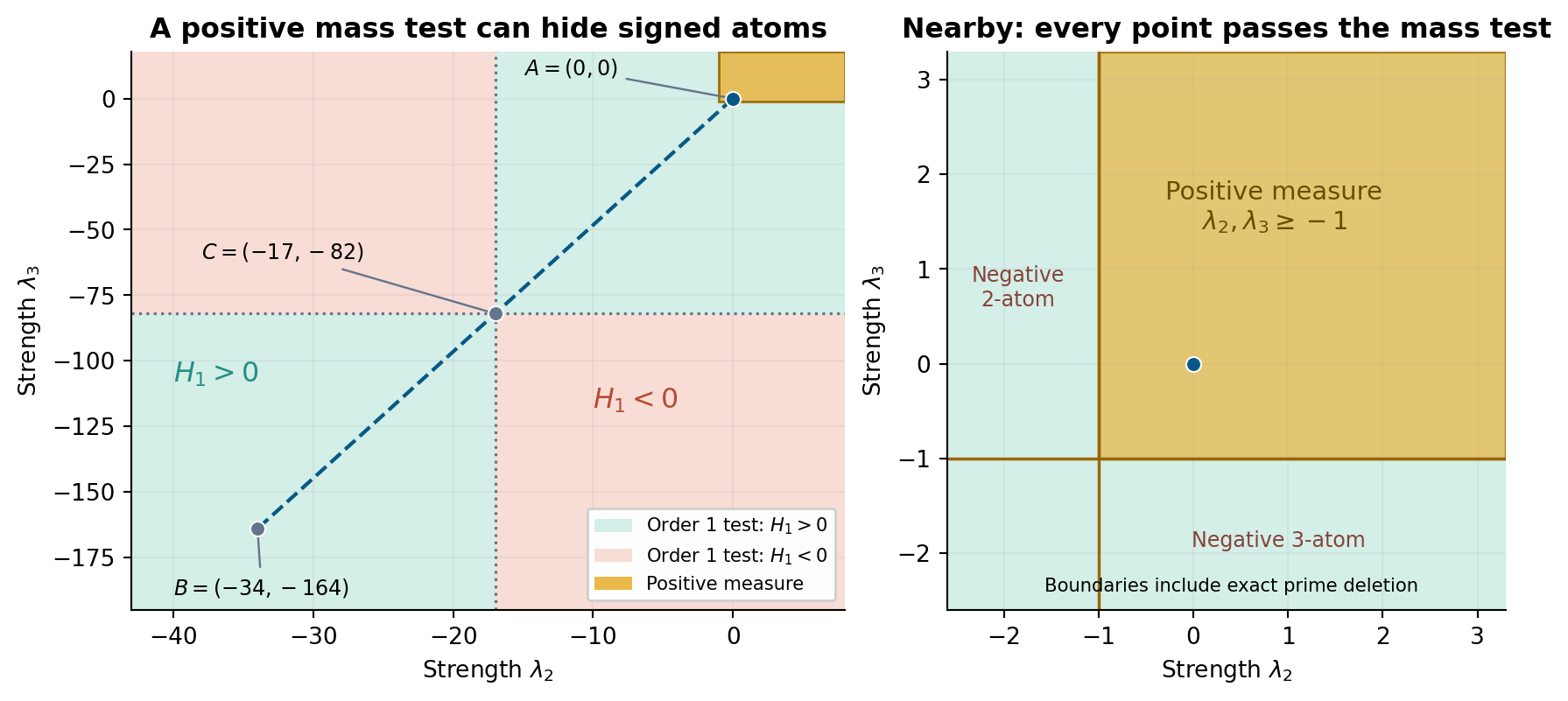
For primes two and three,
Both \((0,0)\) and \((-34,-164)\) have positive total mass. Their midpoint \((-17,-82)\) has zero mass. Thus the parameter set passing the order-one positive-definiteness test is nonconvex. This particular midpoint argument does not establish nonconvexity of the semidefinite test, which permits zero. For that test, take the two points \((0,0)\) and \((-34,-246)\). The normalized masses \(M_0/(105\pi^{-4})\) there are \(1\) and \(2\). Their convex combination with weights \(3/5\) and \(2/5\) is \((-68/5,-492/5)\), where the normalized mass is \(-1/25\). Thus the order-one semidefinite feasible set is also nonconvex, by a separate counterexample.
A separate additive family has different geometry
For weights \(1+\sum_{p\in F}\gamma_p\mathbf1_{p\mid n}\), positivity is equivalent to
Every prime subset appears at its squarefree product, proving necessity. Checking each atom proves sufficiency. Its finite Hankel matrices are affine in \(\gamma\), so the semidefinite feasible sets are convex spectrahedra. The multiplicative family has genuine overlap terms and polynomial parameter dependence. These are two distinct deformations, with distinct domains.
Every negative prime atom has a finite detector
For an integer \(a\ge2\), let
This polynomial kills every lower node, equals one at \(x_a\), and has absolute value at most \(C_ar_a^m\) at every higher node.
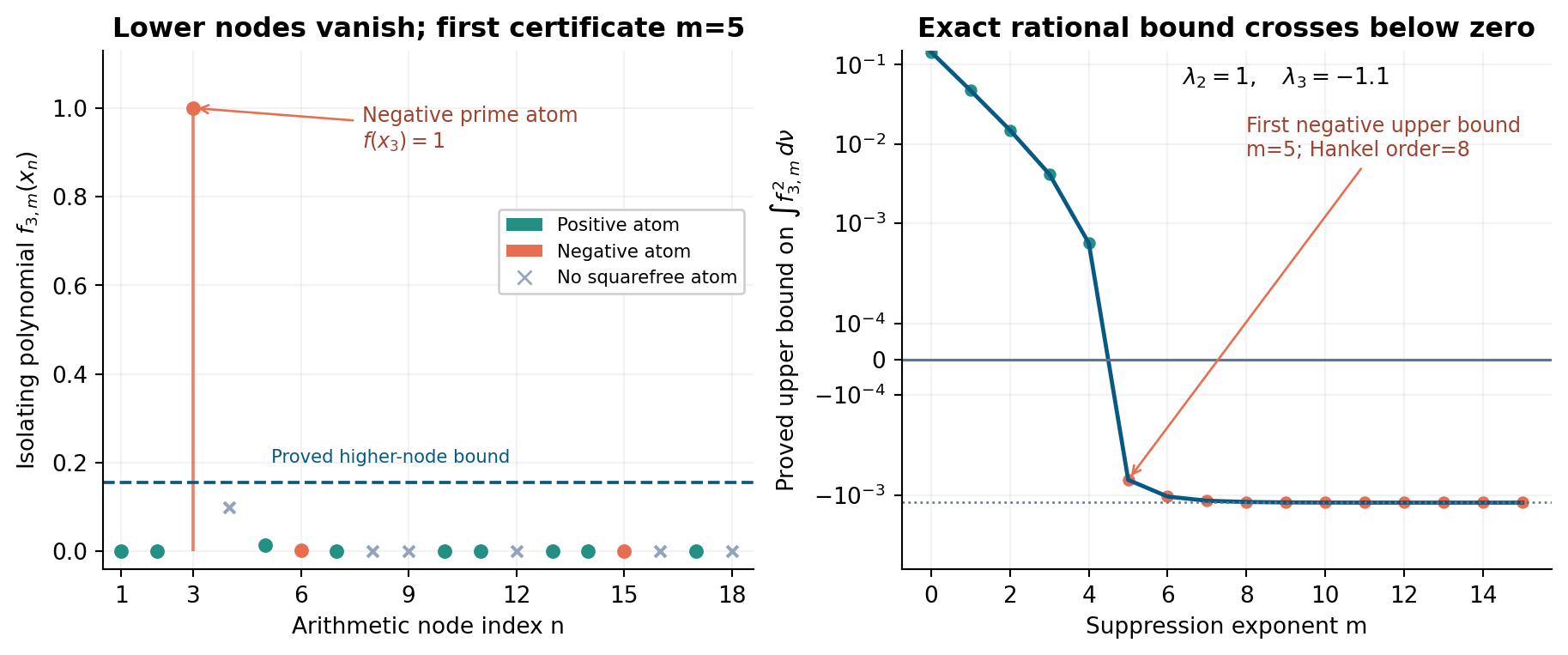
Set \(C_F=\prod_{q\in F}\max(1,|1+\lambda_q|)\). The summable tail gives
Hence the quadratic form is negative whenever \(pC_FC_p^2r_p^{2m}/3<-(1+\lambda_p)\). For rational strengths this is an exact rational certificate. It needs no numerical eigenvalue calculation. A depth tilt \(x^k\) replaces the negative atom contribution by \((1+\lambda_p)x_p^k/p^4\).
Real singularities survive multiple deletions
Fix all strengths except \(\lambda_p\), with the others at least \(-1\). The remaining moment matrix has the form \(A_m+(1+\lambda_p)B_m\), where \(A_m\) is the \(p\)-free part and \(B_m\) the \(p\)-divisible part. Both are positive definite, even at other deletion endpoints: primes outside \(F\) supply the first support, and integers \(p\ell\) the second.
Thus every one-variable determinant fiber has exact degree \(m\) and all roots real below \(-1\). Its nearest margin satisfies
The detector yields, for \(C_\kappa=\prod_{q\ne p}\max(1,1+\lambda_q)\),
The denominator retains the atom \(p\); all lower nodes in the numerator are killed. This extends the prime-two bound to every prime and to simultaneous positive or deletion strengths. It does not assert simple roots or global multivariate real stability.
If at least two positive-domain strengths are nonzero, the complete monic sequence cannot equal a one-prime sequence on the same variable and nodes. Compact moment determinacy equates normalized measures; the fixed mass at zero fixes their scale; atom weights at the individual primes then read off every strength. An arbitrary affine change of variable is outside this separator.