
Arithmetic at complex depth
Arithmetic energy at complex depth
For real \(a>1/2\), \(\beta>0\), and integer \(Q\ge1\), define
The complex power uses the real logarithm of \(1-n^{-\beta}>0\). The atom \(n=1\) is excluded because its logarithm is undefined. At positive integer depths its omitted contribution would be zero. At depth zero the corresponding mass-one atom is absent. In particular, \(A(0)=Z_Q(2a)-1\), where
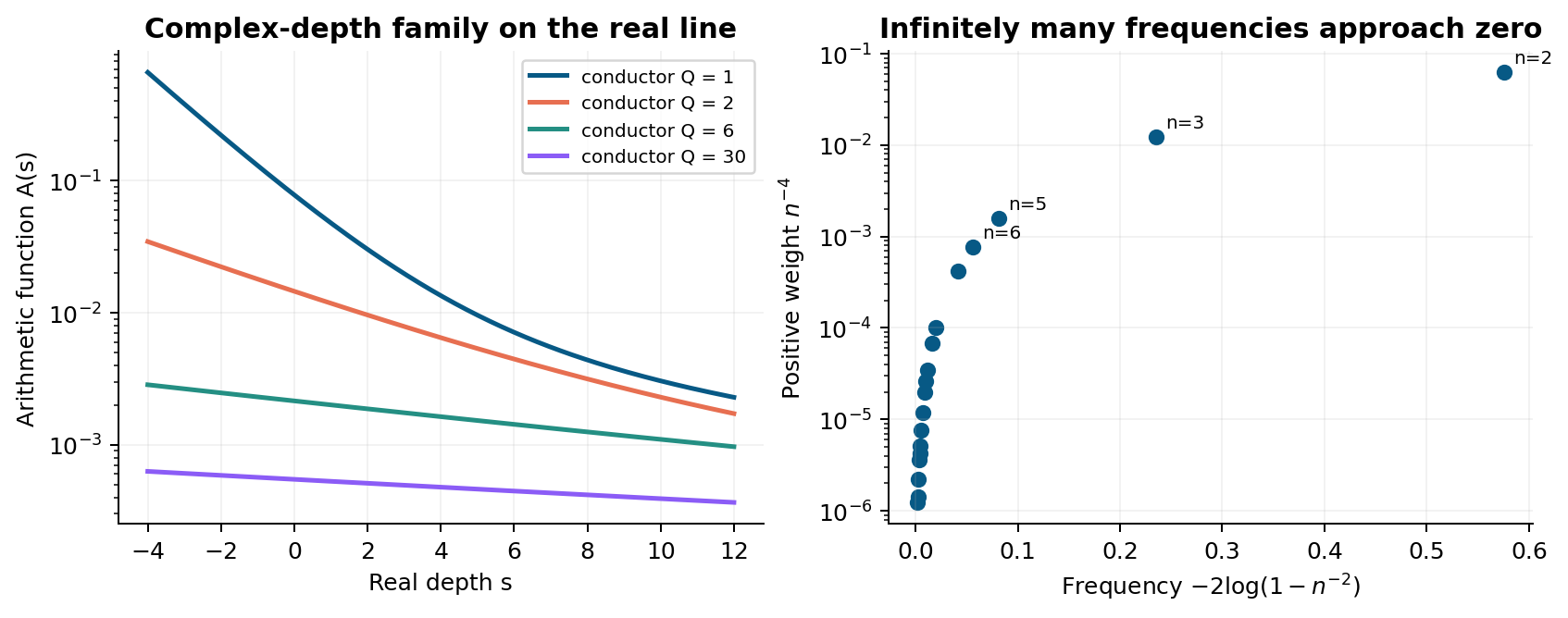
Let \(\mathcal S_Q=\{n\ge2:\mu(n)^2=1,\ (n,Q)=1\}\) and \(\lambda_n=-2\log(1-n^{-\beta})\). Then
The positive weights are summable, and the distinct support frequencies decrease to zero. If \(p_*\) is the least prime not dividing \(Q\), then
This proves local uniform convergence and entire continuation. The first atom dominates \(A(-t)\) as \(t\to\infty\), so the entire function has exact order one and exponential type \(\tau\).
Closed shifts, infinite differential complexity
The Euler product for \(Z_Q\) shows that only \(\operatorname{rad}(Q)=\prod_{p\mid Q}p\) matters. Expansion of the depth factor gives
The fractional transfer and Newton formulas are
They converge absolutely and locally uniformly: binomial coefficients have at most polynomial growth on compact parameter sets, while the shifted sums decay geometrically. The subtraction of one is essential at noninteger depth.
No polynomial-coefficient linear ODE
Suppose \(\sum_{j=0}^{r}P_j(s)A^{(j)}(s)=0\), where the \(P_j\) are polynomials and are not all zero. At \(s=-t\), divide by the exponential of the first support atom. The remaining tail is exponentially smaller, so the polynomial \(\sum_jP_j(-t)(-\lambda_{p_*})^j\) tends to zero exponentially and must vanish identically. Remove that atom and repeat. Every support frequency therefore satisfies \(\sum_jP_j(s)(-\lambda_n)^j=0\) for all \(s\). For fixed \(s\), this polynomial in \(\lambda\) has infinitely many distinct roots. All its coefficients vanish. Thus all \(P_j\) are zero, a contradiction.
The function is not D-finite in depth. This excludes identification in the depth variable with fixed finite-parameter hypergeometric or Meijer G functions and ordinary finite D-finite combinations. It does not exclude nonalgebraic substitutions or representations by known non-D-finite functions.
Strict positive complex kernel
For distinct complex points \(s_i\), \(K_{ij}=A(s_i+\overline{s_j})\) is strictly positive definite. A zero quadratic form would force a finite exponential sum to vanish at every \(\lambda_n\). Their accumulation at zero invokes the identity theorem; derivatives at zero then give a nonsingular Vandermonde system. On the real axis, \((-1)^jA^{(j)}(s)>0\) for every \(j\ge0\).
An arithmetic sector law
The negative real direction is governed by the first admissible prime. The positive direction is governed by the density of infinitely many squarefree integers. These are different pieces of the same entire function.
Let
As \(|s|\to\infty\) in any closed sector \(|\arg s|\le\pi/2-\epsilon\) with \(0<\epsilon<\pi/2\),
In particular,
The principal power is used in the right half-plane. The beta expression is an asymptotic continuous-density model, not an identity with the arithmetic sum.
Proof mechanism
Squarefree inclusion–exclusion gives
Integrate against \(g_s(x)=x^{-2a}(1-x^{-\beta})^{2s}\) on \([1,\infty)\). The density term becomes the beta integral after \(y=x^{-\beta}\). Partial integration bounds the error by \(C_Q\int_1^\infty\sqrt{x}|g_s'(x)|{\,d} x\). The two derivative terms are beta integrals with decay exponent \((2a-1/2)/\beta\); \(|s|/\Re s\) stays bounded in the stated sector. This gives the error term and then the leading asymptotic.
One complex example
At \(a=\beta=2\), \(Q=1\),
Direct finite sums and a zeta–Newton evaluation agree within the recorded omitted-tail envelope. This is an ordinary high-precision example, not an interval certificate.
Mixed Dirichlet-character weights provide matrix-valued positive kernels. Individual off-diagonal entries may be signed or complex, so complete monotonicity is asserted only for the positive principal family.