
Contracted nonlinear feedback
Two scales inside the function
For real \(0<q,r<1\), define the normalized odd solution
The contractions are part of the defining feedback. The function is symmetric in \(q,r\), but unequal scales retain left/right address information.
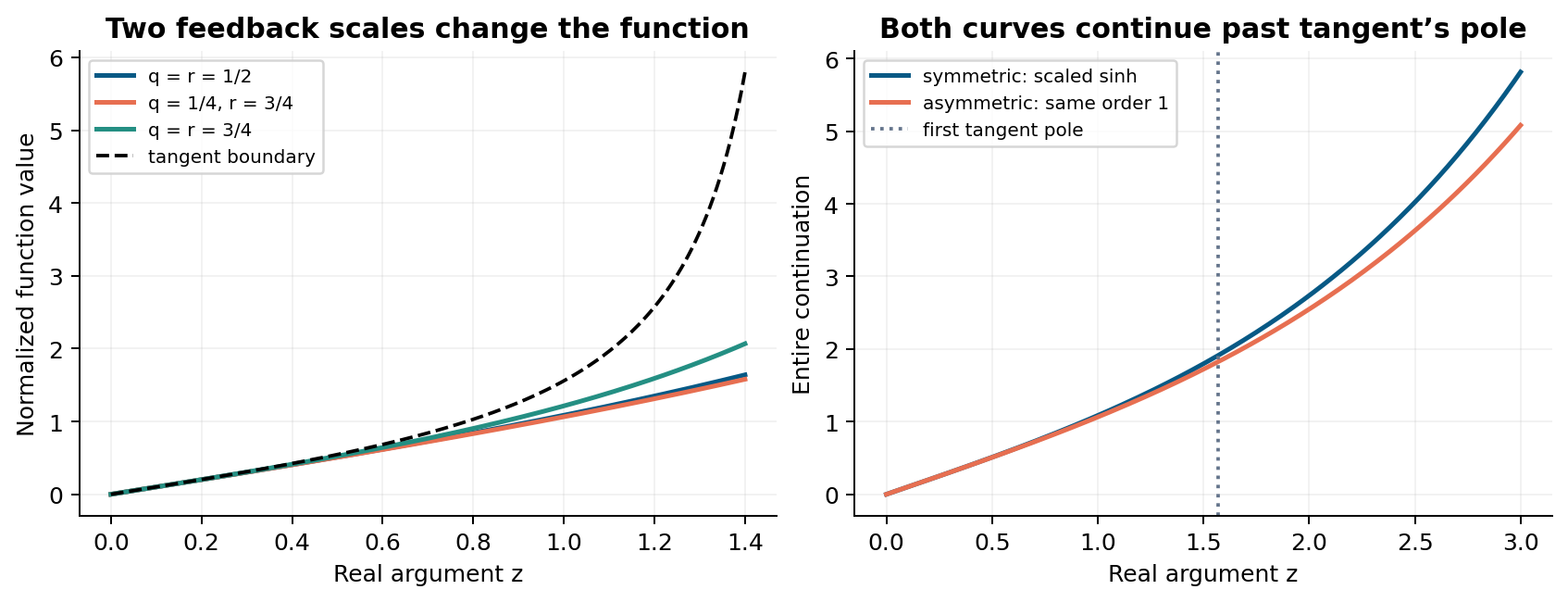
For \(T_{q,r}(z)=\sum_{n\ge0}c_nz^{2n+1}\), \(c_0=1\), coefficient matching gives
In particular,
The coefficients are positive and bounded by tangent coefficients, giving a convergent germ. If the solution is known on \(|z|<R\), its integral equation extends it to \(|z|<R/\max(q,r)\). Repetition proves that it is entire.
The parameters can be recovered, up to swapping, from \(c_1,c_2\). Put \(p=3c_1\) and \(u=15c_2/p^2\). Then \(q,r\) are the roots of \(x^2-\sqrt{u+2p}\,x+p=0\).
A scale-balance atlas
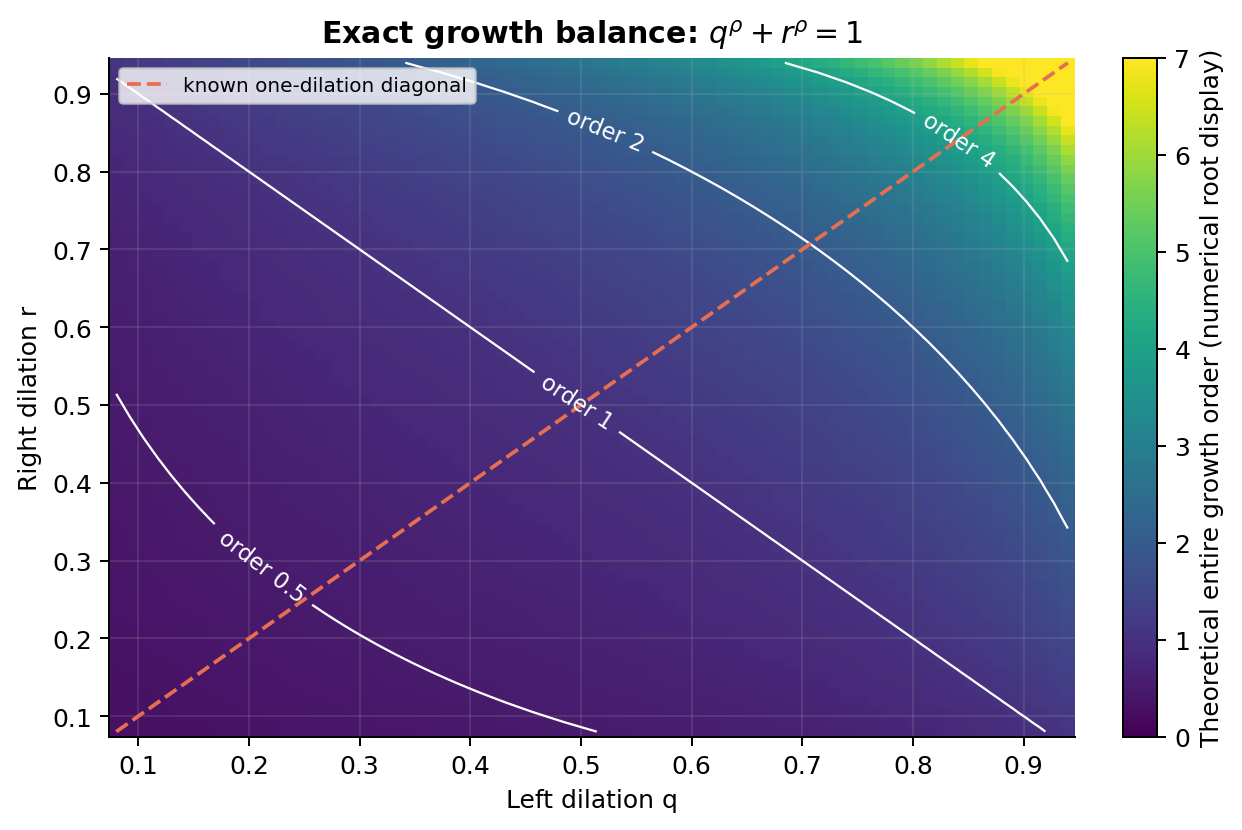
Here \(M_f(R)=\max_{|z|=R}|f(z)|\) and \(\rho(f)=\limsup_{R\to\infty}\log\log M_f(R)/\log R\) is the order of an entire function. Moreover \(\log M_{T}(R)=O(R^\rho)\): the upper type is finite.
| Scales | Order | Interpretation |
|---|---|---|
| \(q=r=1/4\) | \(1/2\) | Slow entire growth |
| \(q+r=1\) | \(1\) | Many distinct functions at one order |
| \(q=r=1/\sqrt2\) | \(2\) | Quadratic logarithmic growth scale |
| \(q=r=3/4\) | \(\log2/\log(4/3)\) | Approximately \(2.4094208397\) |
Why this equation appears
Nonnegative coefficients give \(M(R)=T_{q,r}(R)\). The integral equation implies
Taking logarithms turns product feedback into a sum over contracted scales. Comparison with \(CR^\rho\) proves the upper bound; comparison with \(cR^{\rho_\alpha}\), where \((\alpha q)^{\rho_\alpha}+ (\alpha r)^{\rho_\alpha}=1\), proves the lower bound. Letting \(\alpha\uparrow1\) gives the same order. The complete interval-induction proof is given in Appendix A.
More than a rescaled one-scale seed
Nonrescaling theorem
If \(q\ne r\), then \(T_{q,r}\) cannot equal \(A f_s(Bz)\) for nonzero constants \(A,B\) and any real \(0<s<1\), where \(f_s'=1+f_s(sz)^2\) is the known family.
Suppose such an equality held. Normalization gives \(AB=1\). Write \(p=qr\), \(u=q^2+r^2\), and let \(\rho\) be the common order. The first two nontrivial coefficients and the growth law force
Consequently
For \(\rho\ne2\), strict convexity or concavity of \(x^{\rho/2}\) forces \(q=r\). For the exceptional case \(\rho=2\), we have \(u=1\), \(s^2=1/2\), \(B^2=2p\). The two \(z^7\) coefficients become
Their equality forces \(p=1/2\) and again \((q-r)^2=u-2p=0\). This completes the exceptional-order case.
A worked order-one member
It has order one, and \(T_{1/3,2/3}(1)\approx1.0759239897408249\). The diagonal point \(q=r=1/2\) gives \(f_{1/2}(z)=\sqrt2\sinh(z/\sqrt2)\). Every off-diagonal member is separated from all rescaled diagonal members by the theorem above.
A combinatorial address formula
Sum over full ordered binary trees with \(n\) internal vertices. A vertex with \(i\) internal vertices in its left subtree and \(j\) in its right contributes
Multiply these factors over internal vertices, then sum over trees. Root splitting reproduces the coefficient recurrence exactly. Unequal contractions therefore record left and right path lengths separately.
This is a precise separation result from one authenticated antecedent. It does not prove that no earlier author studied the asymmetric equation.
Feedback banks and weak-channel sensitivity
Choose finitely many channels \(j=1,\ldots,J\), with \(h_j>0\), \(\sum_jh_j=1\), and \(0<q_j,r_j<1\). Define
These taps act inside the nonlinear definition. With \(\mu_1=\sum_jh_jq_jr_j\) and \(\mu_2=\sum_jh_jq_jr_j(q_j^2+r_j^2)\),
If \(q_j^{\rho_j}+r_j^{\rho_j}=1\), then
The positive weights alter local coefficients. The most expansive active channel determines the asymptotic order. A zero-weight channel is removed before taking the maximum.
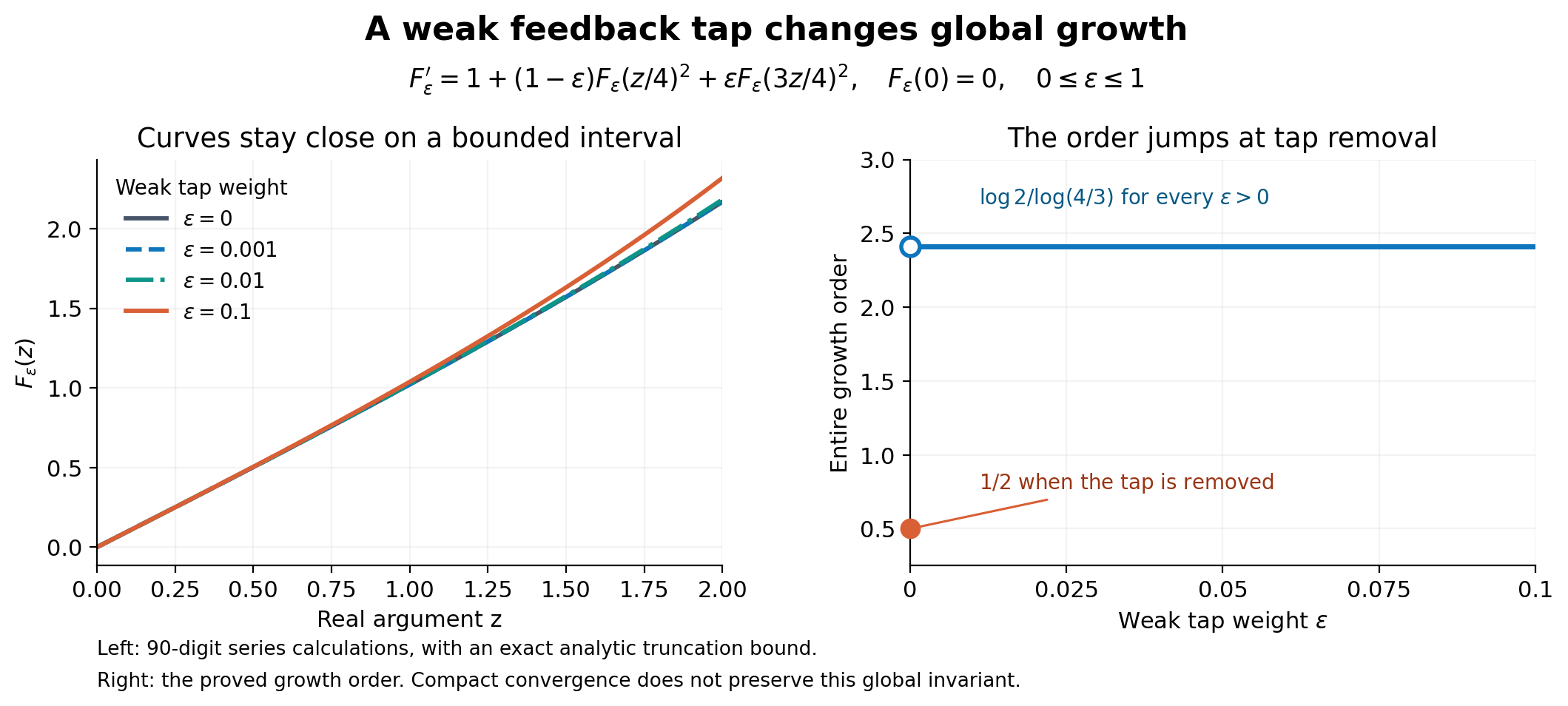
For \(0<\varepsilon\le1\) the order is \(\log2/\log(4/3)\); at \(\varepsilon=0\) it is \(1/2\). Coefficients depend continuously on \(\varepsilon\) and are dominated by those of the entire \(f_{3/4}\). Dominated convergence of the Taylor series therefore proves uniform convergence on compact sets as \(\varepsilon\downarrow0\).
This gives a useful design distinction: finite-window similarity does not control entire growth order. For a bank with weights \(1/4,3/4\) at these scales,
Part II: Arithmetic depth and signed measures
Complex parameters, positive kernels and the boundaries of positivity.