
Spectral functions of zero orbits
One spectral address for each rotation orbit
For integer \(N\ge2\), define the classical Mittag–Leffler seed [DLMF], §10.46
Let \(w_j\) be the nonzero zeros of \(d_N\), counted with multiplicity. Each corresponds to one rotation orbit of \(N\) zeros of \(D_N\). Using \(\operatorname{Arg}w\in(-\pi,\pi]\), define
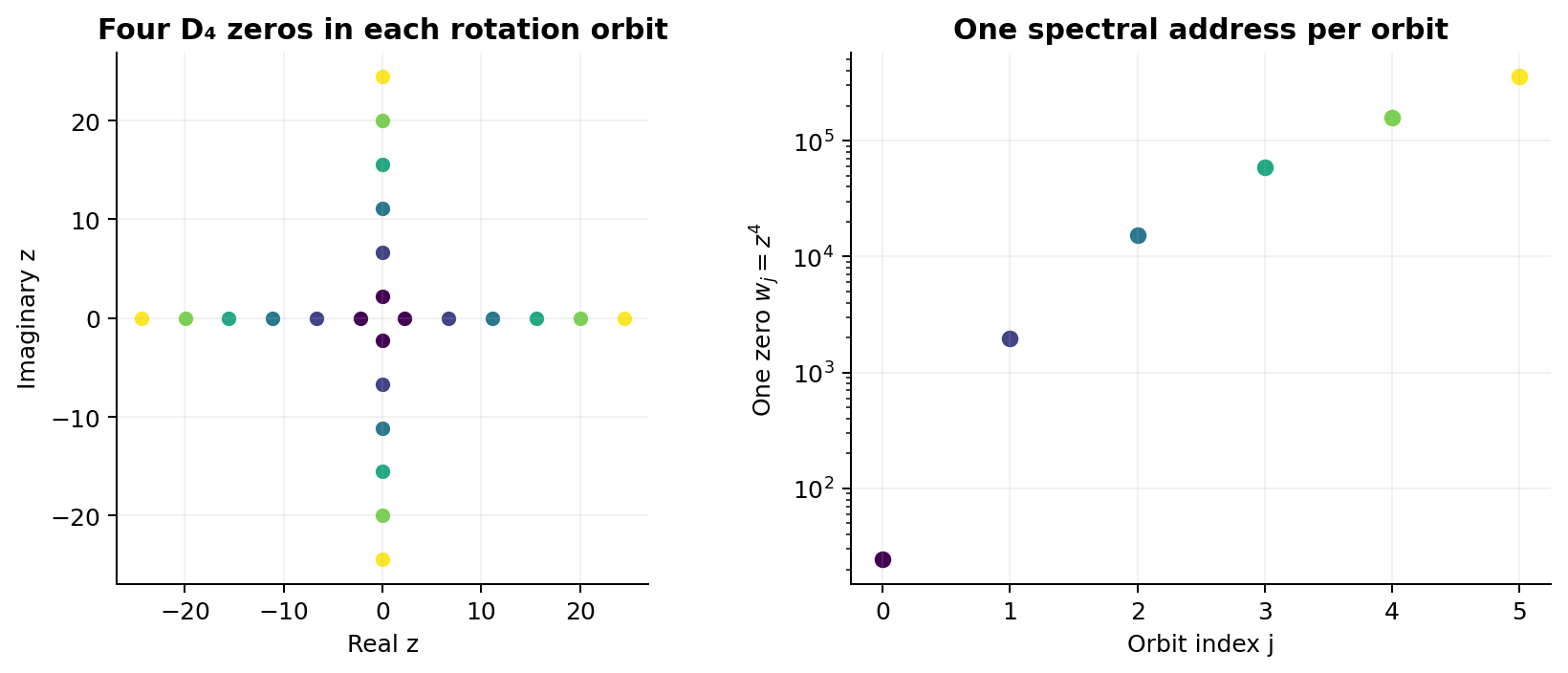
The bound \(|d_N(w)|\le e^{|w|^{1/N}}\) and the finite-order zero-counting theorem give absolute local uniform convergence in the stated half-plane. Since the order is below one and \(d_N(0)=1\), the Hadamard factorization has genus zero:
At positive integers, a log derivative gives
If \(a_n=(-1)^n/(Nn)!\) and \(b_k=\mathcal Z_N(k)\), then
Thus every positive integer value is rational without numerical zero finding.
Classical anchors and the open spectral frontier
The first values are
| \(N\) | \(\mathcal Z_N(1)\) | \(\mathcal Z_N(2)\) | \(\mathcal Z_N(3)\) |
|---|---|---|---|
| 2 | \(1/2\) | \(1/6\) | \(1/15\) |
| 3 | \(1/6\) | \(1/40\) | \(53/13440\) |
| 4 | \(1/24\) | \(17/10080\) | \(691/9979200\) |
| 5 | \(1/120\) | \(5/72576\) | \(997/1743565824\) |
Two exact Hurwitz-zeta reductions
For \(N=2\), \(d_2(w)=\cos\sqrt w\), whose zeros are \(w_j=\pi^2(j+1/2)^2\), \(j\ge0\). Therefore
For \(N=4\),
and the rotation quotient has one zero \(w_j=(\sqrt2\pi)^4(j+1/2)^4\) per orbit. Hence
These anchors are classical reductions. The general spectral-zeta mechanism also has substantial antecedents, including hypergeometric zero zeta functions.
Global meromorphic continuation
The half-plane definition has a meromorphic extension to the whole complex plane. The following sections prove its sole pole, special values, and regularized product using a branch-safe Mellin representation. These are worked spectral results from established analytic mechanisms. Residue-weighted sums involving derivatives at zeros remain a separate question, especially when multiplicities occur.