
Prime sieves and signed measures
An infinite prime shelf changes the packets
For a prime \(p\) and \(\lambda\ge-1\), let
Define monic orthogonal polynomials \(P_m^{(k;p,\lambda)}\) for the measure \(x^k{\,d}\nu_{p,\lambda}\), \(k\ge0\) integer. The zero atom has mass one at \(k=0\) and is annihilated when \(k\ge1\).
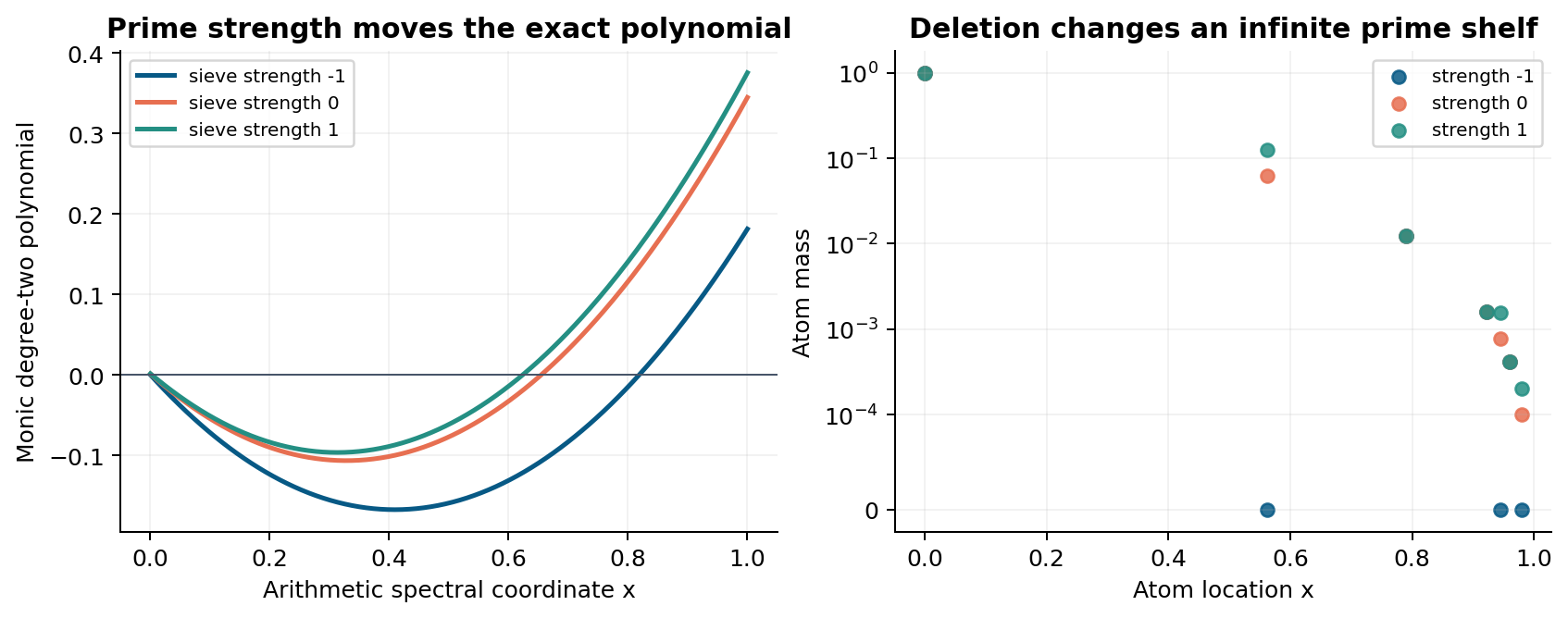
The exact moments are finite zeta stencils:
All polynomial coefficients belong to \(\mathbb Q(\pi^{-2},\lambda)\). With \(\Delta=M_0M_2-M_1^2\),
The infinitely many positive nodes make every Hankel matrix strictly positive definite throughout \(\lambda\ge-1\). Hence all degrees exist, with positive norms, real simple zeros in \((0,1)\), and interlacing.
Finite positivity can conceal a signed defect
Let \(\nu_{\mathrm{non}p}\) and \(\nu_p\) be the restrictions of the undeformed measure \(\nu_{p,0}\) to indices not divisible by \(p\) and divisible by \(p\), respectively. Then \(\nu_{p,\lambda}=\nu_{\mathrm{non}p}+(1+\lambda)\nu_p\). Let \(A_m,B_m\) be the order-\(m\) Hankel matrices of these two unscaled positive measures. Both are positive definite. Thus
where \(\eta_i>0\) are the eigenvalues of \(A_m^{-1/2}B_mA_m^{-1/2}\). Every determinant root is real and below \(-1\); possible coefficient poles occur there, although numerator cancellation is possible.
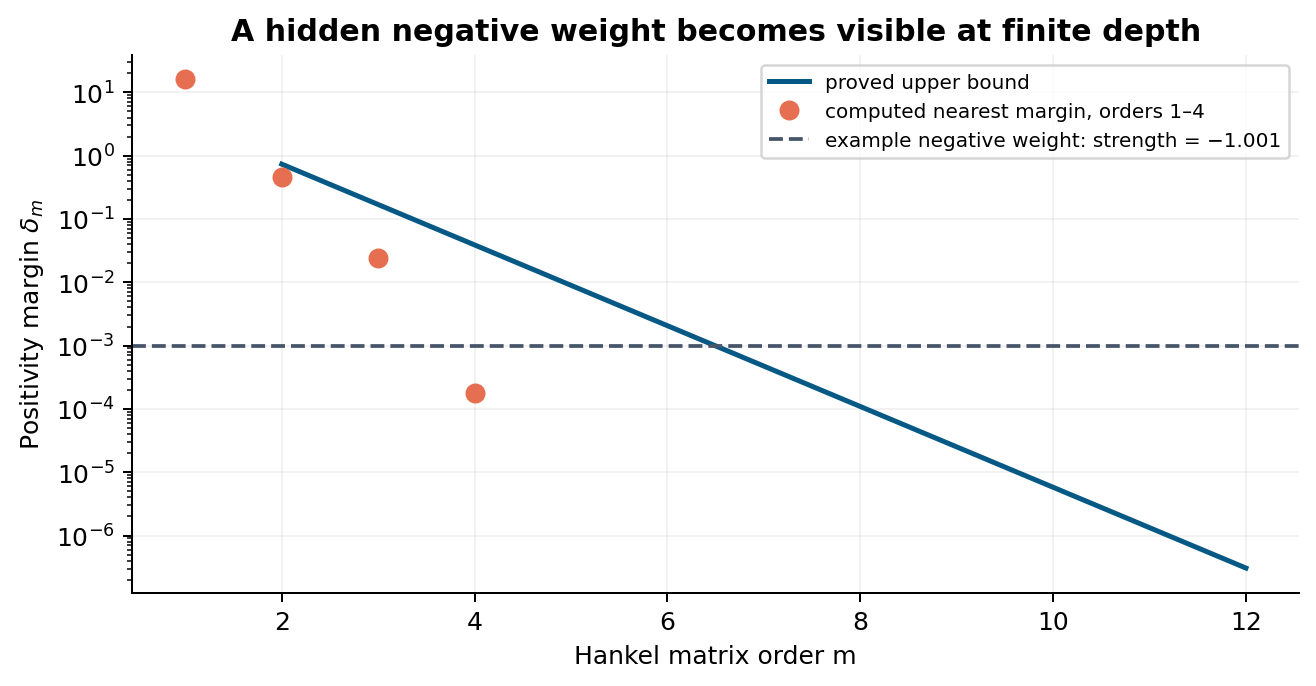
The nearest root is \(-1-\delta_m\), with
To prove the limit, approximate a continuous bump supported at the isolated node \(x_p\) by polynomials on \([0,1]\). The numerator tends to zero while the denominator retains the \(p^{-4}\) atom. Hence every \(\lambda<-1\) eventually produces a negative finite-degree quadratic form.
For \(p=2\), test with \(f(x)=x(1-x)^{m-2}\), \(m\ge2\):
This follows from \(x_2=9/16\) and \(x_n\ge64/81\) at nonzero odd nodes. Exactly \(\delta_1=p^4\); the limit is an infinite-resolution phenomenon.
Classical operations with arithmetic coordinates
The depth tilt \(x^k\) is a Christoffel transformation. Suppressing \(p,\lambda\),
The numerator vanishes at zero. All roots are positive, so the displayed denominator coefficient is nonzero. For shifted Hankel determinants \(\tau_m^{(k)}=\det[M_{k+i+j}]_{i,j<m}\), with \(\tau_0^{(k)}=1\),
This is the Desnanot–Jacobi identity applied to exact arithmetic moments. The construction mechanism is classical.
An endpoint mass is numerically delicate
For the undeformed depth-zero measure, set \(\nu_\theta=\nu+\theta\delta_0\), \(\theta\ge-1\). Write \(h_j=\int P_j(x)^2{\,d}\nu(x)\) and \(K_m(x,y)=\sum_{j=0}^{m}P_j(x)P_j(y)/h_j\). The Uvarov formula [Uvarov1969] is
with \(K_{-1}=0\) for degree zero. The mass at zero is recovered by
The lower bound comes from the zero atom, whose mass is one. The test polynomial \((1-x)^m\) gives the upper bound since every other node is at least \(9/16\). At finite degree \(K_m(0,0)<1\), because no nonzero polynomial can vanish at all the other infinitely many nodes. Complete mass removal is valid, while \(1-K_m(0,0)\) becomes very small. This explains the conditioning problem.
The resolvent is non-D-finite
For \(\lambda\ge-1\), the Stieltjes function \(S_{p,\lambda}(z)=\int(z-x)^{-1}{\,d}\nu_{p,\lambda}(x)\) has infinitely many isolated poles at the positive-weight nodes \(x_n\to1\). A solution of a finite rational-coefficient linear ODE has only finitely many possible finite singular points. The germ at \(z=2\) therefore is not D-finite. This is a general infinite-atomic-resolvent mechanism, specialized here to arithmetic data.
The full packet sequence also cannot be an affine copy of a continuous Jacobi sequence: compact moment determinacy would equate a purely atomic measure with a continuous one. An inherited Laguerre scaling limit remains compatible with this separation of the complete families.
Part III: Orbit spectra and exact coordinates
Spectral continuation and the coefficient language of polyphase transforms.