
Integer coordinates for the nonlinear family
Normalize the Taylor coefficients by
The recurrence becomes
Therefore \(A_n\in\mathbb Z[q,r]\) has nonnegative coefficients and is symmetric in its two variables. The first coordinates are
At \((q,r)=(1,1)\) these are the tangent numbers \(1,2,16,272,7936,\ldots\), the known OEIS A000182 anchor. At \((1,2)\) the exact sequence begins \(1,4,160,35200,38041600,\ldots\).
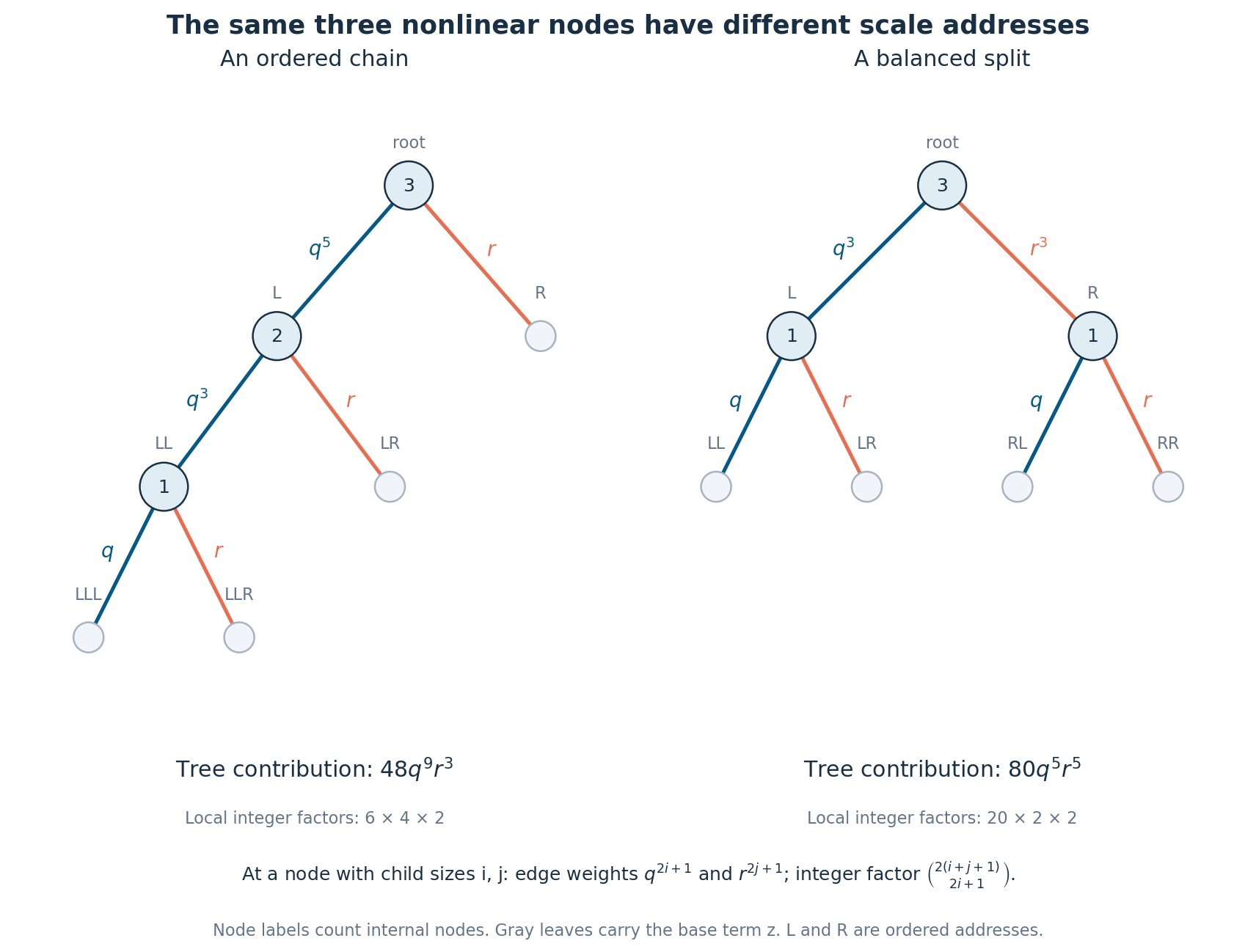
At rational scales, an integer denominator clearing is available. If \(D\) clears every contraction denominator and \(H\) clears every bank weight,
The maximum root-path exponent sum over a full binary tree is \(n(n+1)\). The clearing provides exact sequence exports without implying a new OEIS entry.
A formal sequence is not always an analytic germ
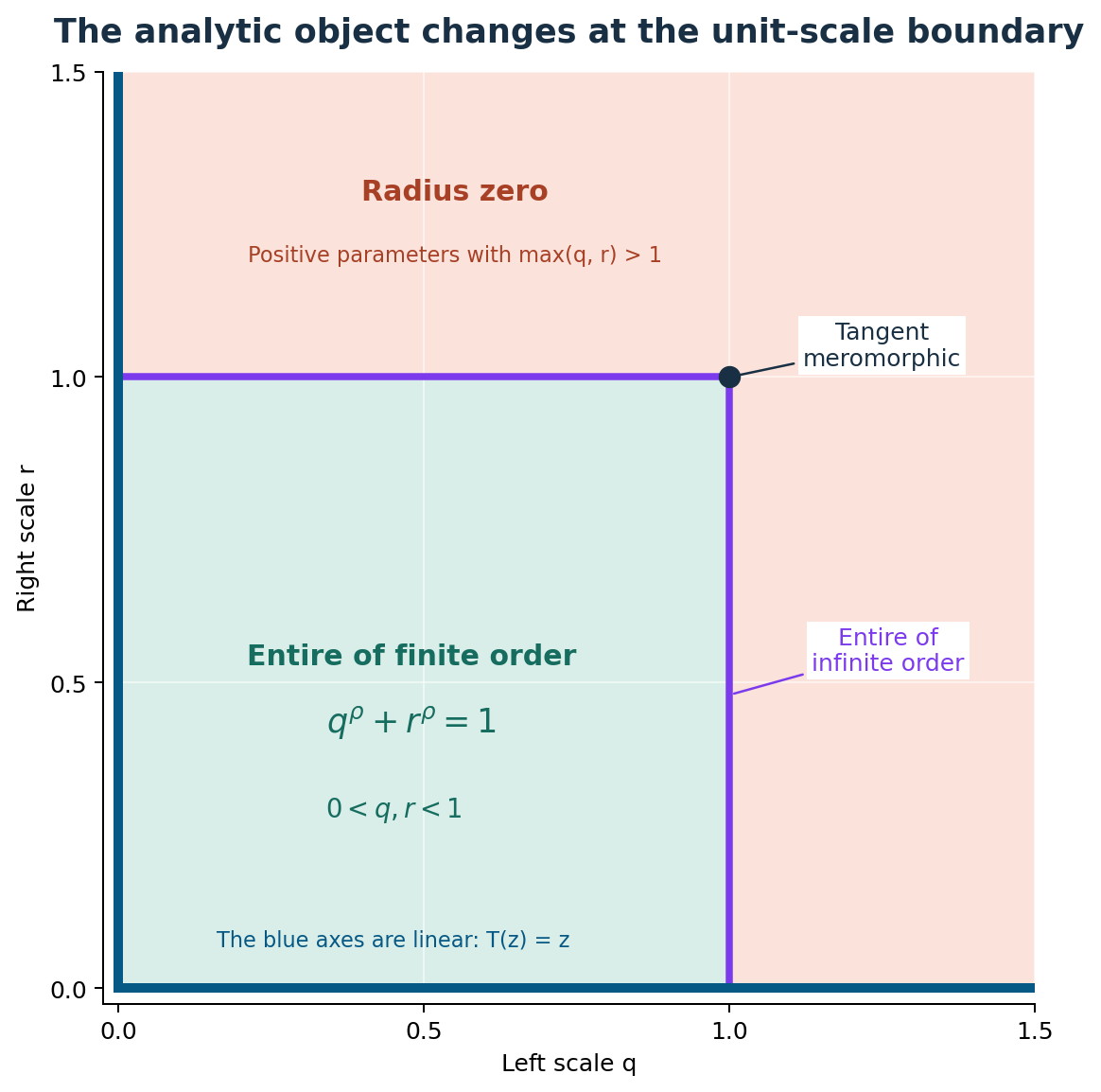
If \(q>0\), \(r>1\), the recurrence includes its \(i=0\) term and gives
The root test proves zero radius. By symmetry this covers either scale above one, provided the other is positive. The exported positive integer asymmetric rows belong to this formal regime.
If \(0<q<1\), \(r=1\), the equation is linear in the uncontracted value: \(T'=1+T(qz)T(z)\). A known coefficient on \(|z|<R/q\) gives a linear ODE there, so disk bootstrapping proves entire extension. On the positive ray, \((\log T)'=T(qR)+1/T(R)\ge qR\), giving an exponential lower bound for \(T\). Substitution back gives, for \(R\ge2/q\),
Thus the entire order is infinite. The corner \((1,1)\) is tangent with poles. These exact boundaries protect the analytic interpretation of the catalog.
Polyphase sections preserve the full sequence
For an ordinary generating function \(G(z)=\sum_{m\ge0}a_mz^m\) and integer \(b\ge1\), write
The root projector is
The same projector works on an EGF, but the section retains its original factorials: \(\sum_na_{bn+j}z^{bn+j}/(bn+j)!\). Removing those denominators changes the representation and requires an explicit transport. Root filtering does not do it automatically.
For causal FIR taps \(h_\ell\), \(b_m=\sum_\ell h_\ell a_{m-\ell}\) with zero extension to negative indices, split \(A(z)\) and \(B(z)\) into \(b\) phases. Then \(B_i(t)=\sum_jH_{ij}(t)A_j(t)\), where
The exponent is the nonnegative carry to the next phase block. This is an exact coefficient law, with no approximation or loss of terms.
The carry matrix is part of the filter
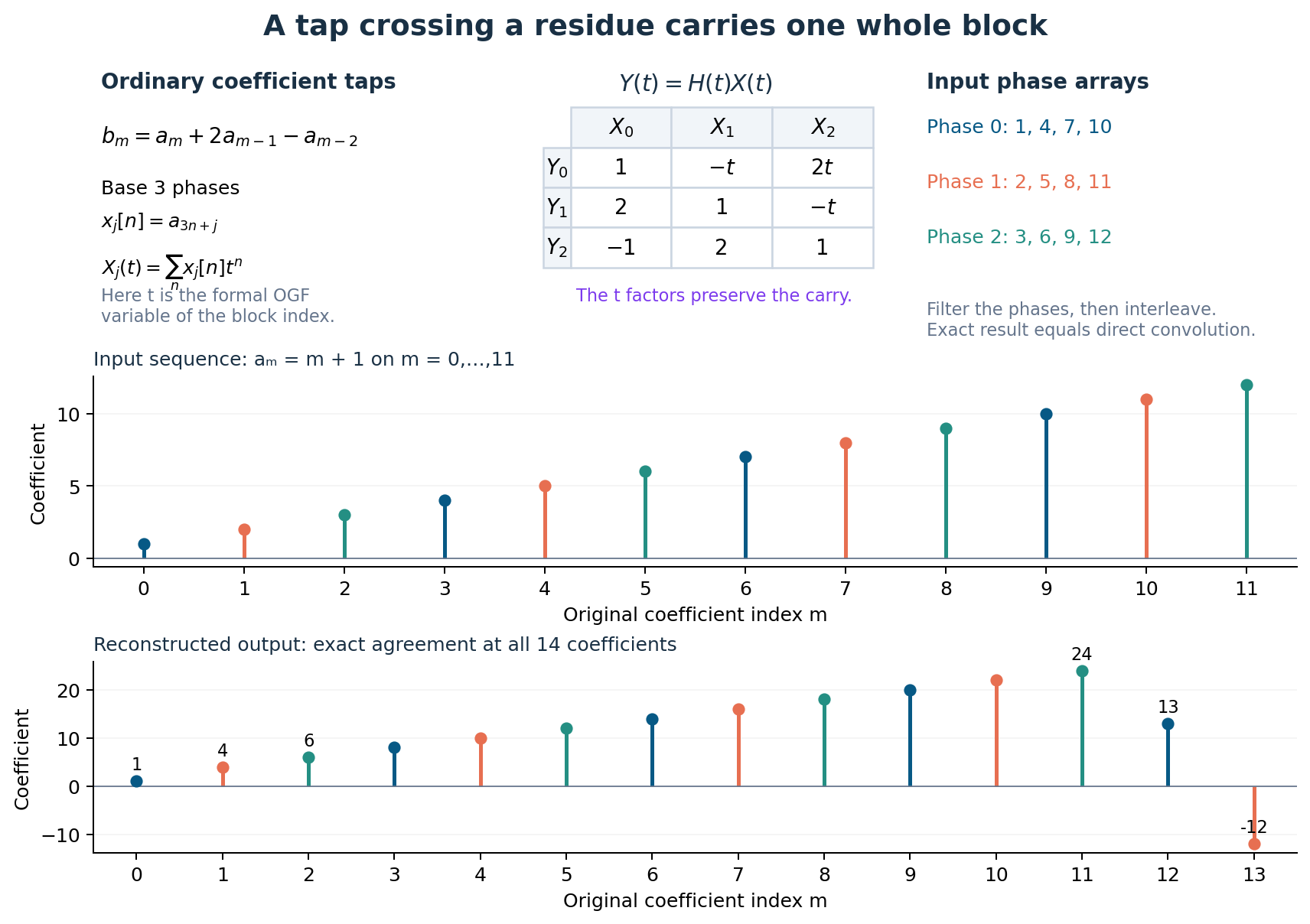
With these taps and \(b=3\),
The entries arise from the same congruence condition. For instance an input in phase two shifted by one lands in phase zero of the next block, contributing \(2t\) to \(H_{0,2}\).
Three operations that must be kept distinct
For an EGF \(E_a(z)=\sum_ma_mz^m/m!\), differentiation transports future coefficients: \(E_a^{(k)}=\sum_ma_{m+k}z^m/m!\). Causal ordinary taps instead act by repeated zero-constant integration:
Multiplication of two EGFs gives Hurwitz convolution, \(b_m=\sum_{k=0}^m\binom mk a_kh_{m-k}\). It is not ordinary sequence FIR convolution. Intrinsic nonlinear feedback taps alter the defining family and are a fourth operation with their own coefficient recurrence.
A catalog with explicit provenance
The standard-library family_lab.py exposes exact coefficient polynomials, normalized sequences, positive-bank coefficients, rational denominator clearing, root sections, Hurwitz products, ordinary FIR taps, and polyphase filter matrices. The catalog contains 18 rows through index 12.
Every row records parameters, coefficient normalization, arithmetic regime, and whether its entries are integers or rationals. Eight positive integer asymmetric specializations are labeled zero-radius formal sequences. Entire interior examples and an infinite-order edge are labeled separately.
| Example | First normalized coordinates | Interpretation |
|---|---|---|
| \((1,1)\) | \(1,2,16,272,7936\) | Known tangent anchor |
| \((1,2)\) | \(1,4,160,35200,38041600\) | Integer, formal radius zero |
| \((1/2,1/2)\) | \(1,1/2,1/4,1/8,1/16\) | Scaled sinh, entire order one |
| \((1/3,2/3)\) | \(1,4/9,160/729,18560/177147,\ldots\) | Asymmetric entire order one |
Implementation boundaries are enforced
Phase residues and bases must be integers, and a phase bank cannot be empty. The independent review found that fractional residues and zero phases were previously accepted. Both domain-validation defects were fixed and covered by regression assertions before publication.
The 8,038 exact API checks compare separate constructions: Picard integration, sine/cosine tangent division, root filters in a cyclotomic quotient, direct and phase-matrix taps, and coefficient-level antiderivatives. They verify finite implementation ranges. The algebraic laws above have separate proofs in Appendix E.
The catalog is ready for comparison with OEIS, with known anchors identified. It makes no claim that an unmatched prefix establishes a new sequence, and no sequence is represented here as a submitted or independently assigned OEIS entry.