
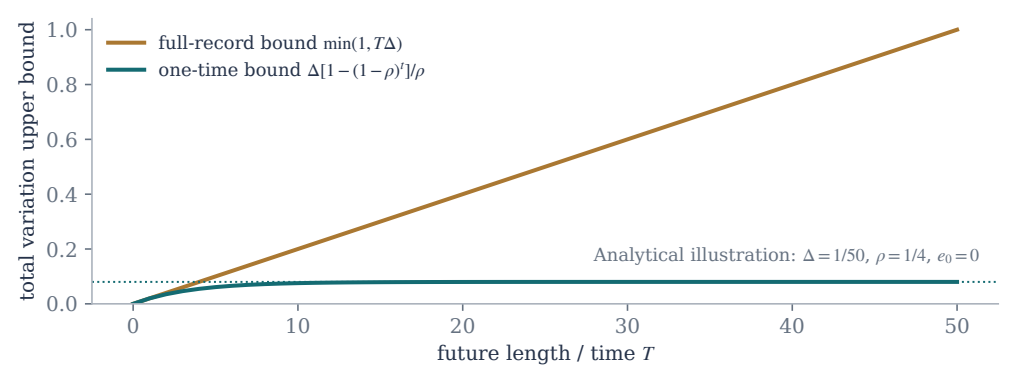
Start two processes from the same history or initial law and use the same action policy. If their conditional next-observation laws differ by at most \(\Delta\) at every common history, telescoping gives the record bound \(\min(1,T\Delta)\) in total variation.
Read the diagram in words
A complete record can accumulate distinguishability as its horizon grows. Under the separate Markov and minorization assumptions, a one-time marginal can remain close. A rolling window combines the marginal discrepancy with the additional steps in the window. The plotted bounds have declared constants and are not empirical errors.
For Markov kernels with a common probability measure \(\mu\) and \(P(s,\cdot)\geq\rho\mu(\cdot)\), \(0<\rho\leq1\), and \(\sup_s\|P(s,\cdot)-Q(s,\cdot)\|_{{\operatorname{TV}}}\leq\Delta\), their one-time law distances satisfy
A length-\(k\) rolling window starting at time \(t\) has distance at most \(\min(1,e_t+(k-1)\Delta)\).
The mathematical point
Contraction can keep a single marginal close indefinitely while complete-record distinguishability tends to one. Two distinct independent Bernoulli laws already exhibit that separation.
Scope
The plotted curves are analytical illustrations with declared constants. The marginal result needs actual Markov and minorization hypotheses. Arbitrary policies that remember the entire history require their own comparison argument.
Formal route
CurvedMomentRecordTV.lean; MarkovMarginals.lean; MarkovWindows.lean; BernoulliRecordSeparation.lean.