
Let \(C\subseteq{\mathbb R}^d\) be a convex cone and \(\lambda\) a linear mass map strictly positive on \(C\setminus\{0\}\). Set \(K=\{z\in C:\lambda z=1\}\). Linear observation operators must satisfy
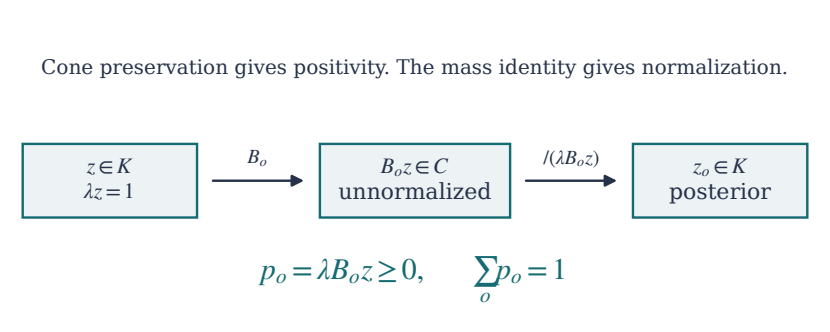
Read the diagram in words
Each observation operator must preserve the cone, and their sum must preserve total mass. A normalized initial state supplies the starting probability law. Normalization is defined only for branches of positive mass; a zero-mass branch cannot be divided into a posterior.
A finite record \(o_1\cdots o_T\) has probability
Summing over every branch repeatedly applies the mass identity and gives total probability one. A positive-probability posterior is \(B_oz/(\lambda B_oz)\).
A finite-generator witness. Let \(V\) have full row rank and normalized generator columns. Nonnegative lifts \(A_o\) with \(B_oV=VA_o\) and \(\mathbf1^{\mathsf T}\sum_oA_o=\mathbf1^{\mathsf T}\) certify the generated cone. The initial state must be a normalized nonnegative mixture of those columns.
The mathematical point
All-horizon validity follows by induction from a finite exact witness. Statistical proximity to a generating process is a further obligation.
Scope
A zero-probability branch does not define a normalized posterior by division. A finite positive lift is sufficient, but some valid low-dimensional processes require curved domains.
Formal route
CanonicalCone.lean; PositiveLift.lean; PositiveLiftTopology.lean.