
An observation, its archive, a predictive summary and a probability state carry different mathematical obligations. The theory connects them through maps whose domains and identities are explicit.
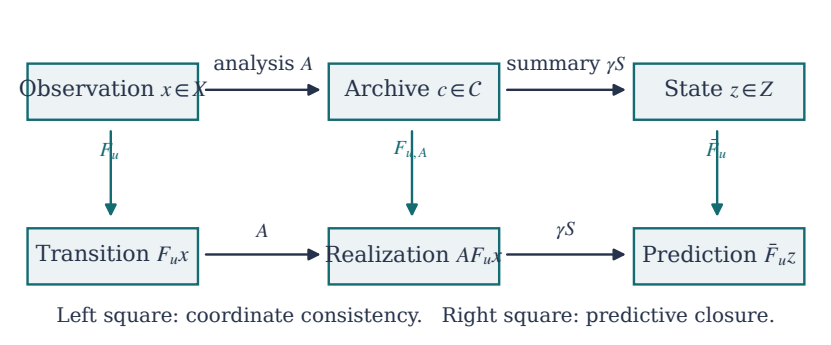
Read the diagram in words
Read from left to right: analysis stores an observation in an archive, then a summary produces a predictive state. The left square asks whether the stored transition agrees with the observation-space transition. The right square asks the additional question of whether the summary determines its own next state. Each square has its own contract.
| Contract | Defining identity | Question answered |
|---|---|---|
| Reconstruction | \(SA=I_X\) | Can the accepted observation be recovered? |
| Transport | \(F_bT_{ba}=T_{ba}F_a\) | Do coordinate descriptions agree? |
| Closure | \(\gamma F_u=\bar F_u\gamma\) | Does the summary determine its own future? |
| Probability | \(B_oC\subseteq C\), \(\lambda\sum_oB_o=\lambda\) | Are every branch and every finite record valid? |
Reading route. Plates 1–4 build the representation and its predictive quotient. Plates 5–9 explain interactions, lost paths, memory and observable identification. Plates 10–16 develop behavior spaces, positivity, curved geometry and statistical guarantees. Plate 17 locates the formal proofs.
Visual conventions. Teal marks exact structure. Gold marks transported, refined or uncertain quantities. Red marks an obstruction or an omitted contribution. Every figure is drawn from a formula or an exact finite example. Curves of bounds are labeled as bounds.
Scope
The atlas selects core mechanisms from the 87 registered propositions. It introduces no new numbered theorem, fitted model, benchmark result or empirical coverage claim. Its diagrams supplement the proofs.