Large Signal Model · Plate 3 of 17

The obstruction lives in a fiber

Equal present summaries must have equal next summaries.

Question to keep in view. Can the same current summary lead to two different futures?

Resources & source

Original PDF page · Atlas source

Skip contents and start reading

A reduced map \(\bar F:\gamma(X)\to\gamma(X)\) exists exactly when

\[ \gamma x=\gamma x'\quad\Longrightarrow\quad\gamma Fx=\gamma Fx'. \]

For linear \(L\) and linear \(\gamma\), this is \(L(\ker\gamma)\subseteq\ker\gamma\).
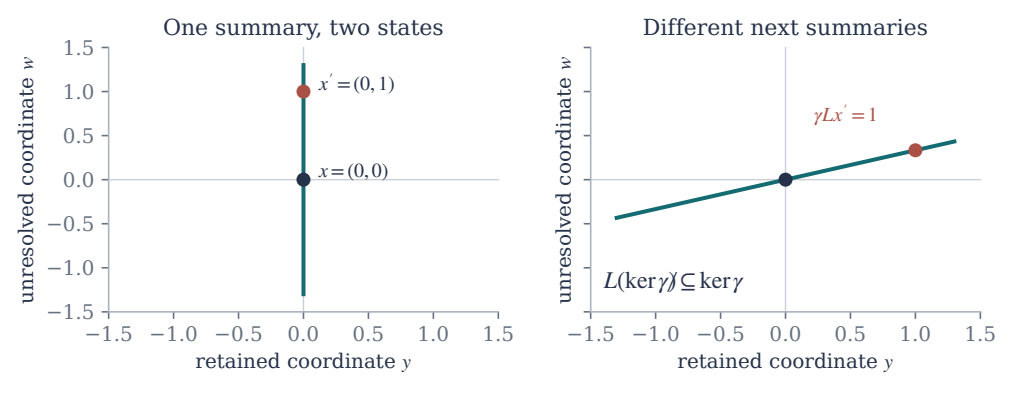
Two states on one observation fiber move to different next observations.
Read the diagram in words

The left panel places the two comparison states on the same vertical fiber: both have first coordinate zero. Applying the declared matrix sends them to points with different first coordinates in the right panel. A single update rule supplied only with the first coordinate cannot choose both next answers.

The running rational example. Throughout the deterministic plates, use

\[ L=\begin{pmatrix}1/2&1\\1/4&1/3\end{pmatrix},\qquad \gamma=(1,0),\qquad x_0=(1,0)^{\mathsf T}. \]

The two states \((0,0)\) and \((0,1)\) have summary zero. Their next summaries are \(0\) and \(1\). Thus no scalar autonomous update reproduces every state's first-coordinate dynamics.

The mathematical point

Predictive sufficiency is a property of entire summary fibers. A lossless archive of each full state does not make its chosen scalar summary sufficient.

Scope

The diagram is a counterexample for the declared operator. In a stochastic model, the corresponding condition concerns equality of next-summary distributions.

Formal route

PredictiveClosure.lean; LinearClosure.lean.

Try the declared example

Two states, one current observation

Use the atlas's fixed matrix with comparison states A = (0, 0) and B = (0, h). The observation is the first coordinate. Change the hidden coordinate, then advance the observations.

The scalar summary is not closed for this operator. At h = 1, the same current output 0 has next outputs 0 and 1. Setting h = 0 makes this particular pair coincide; it does not change that obstruction.

Default comparison: both current outputs are 0, but applying the full operator gives next outputs 0 and 1. One past observation is needed before a causal delay state is available.

State A

Full state now
(0, 0)
Output now
0
Next output from the full state
0
Causal delay state (previous, current)
Available after one observation
Next output from the delay recurrence
Available after one observation

State B

Full state now
(0, 1)
Output now
0
Next output from the full state
1
Causal delay state (previous, current)
Available after one observation
Next output from the delay recurrence
Available after one observation
Exact observed outputs
Observed stepState A outputState B output
000

For this matrix, the causal pair (previous output, current output) predicts the next output by adding five sixths of the current output to one twelfth of the previous output. It is available only after the first observation step. The comparison uses exact rational arithmetic; it is a finite illustration of the stated system.

Why the observable space closes · What the observations identify

Follow the proofs

Inspect the mapped Lean modules
Source and reading aids

The atlas text, mathematics, plate order, and original diagrams are retained. Questions, diagram descriptions, navigation, and the bounded comparison explorer are web reading aids. No original TeX build or Lean execution is added.

Source identities and conversion checks

Notation in Large Signal Model

Look up a symbol without leaving this chapter. Select text before opening help to search for it.

Search this work’s notation.

    Symbols can have different meanings in different passages. Read each result in its own context.

    Open the full notation index