Large Signal Model · Plate 5 of 17

Packets decompose operations too

Resolution changes preserve identities when every block is retained.

Question to keep in view. What changes when interactions cross packet boundaries?

Resources & source

Original PDF page · Atlas source

Skip contents and start reading

For complete input and output projector families,

\[ x=\sum_iP_ix,\qquad L=\sum_{j,i}Q_jLP_i. \]

Refining either family subdivides these transfer blocks without changing their total. Orthogonal packet families also give the corresponding squared-norm decomposition.
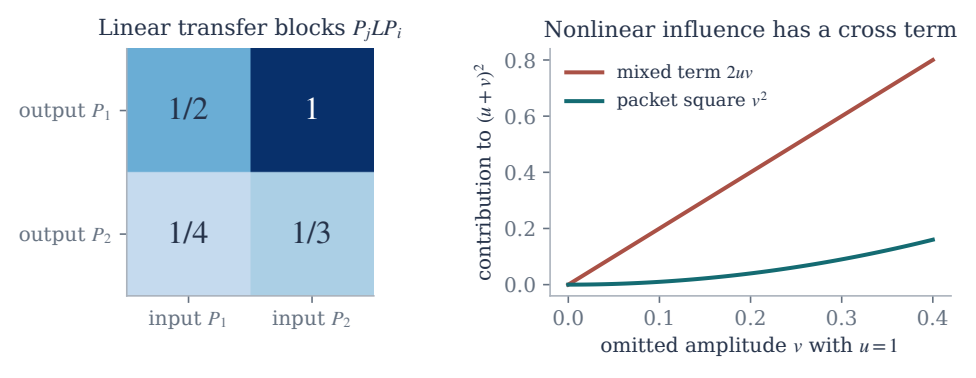
Transfer blocks and a comparison of linear mixed terms with quadratic omitted energy.
Read the diagram in words

The transfer array records how every input packet contributes to every output packet. The accompanying curves distinguish the mixed contribution in a square from the square of the omitted amplitude. Retaining every block is an exact decomposition; dropping blocks needs a separate error estimate.

For a polynomial operation, multilinearity produces every ordered packet interaction:

\[ Q_jB_m(x,\ldots,x)=\sum_{i_1,\ldots,i_m} Q_jB_m(P_{i_1}x,\ldots,P_{i_m}x). \]

In the scalar square, the mixed contribution is \(2uv\). With \(u=1\), it is linear in omitted amplitude \(v\), whereas the omitted packet square is quadratic.

The mathematical point

A nonlinear operation acts on interactions between packets. Reconstruction energy alone does not bound an omitted packet's influence on a future quantity.

Scope

Complete refinement and truncation are different operations. Truncation requires an explicit omitted-interaction estimate on its declared domain. Projectors from different atlases need not commute.

Formal route

PacketTree.lean; TreeEnergy.lean; Transfer.lean; Polynomial.lean.

Follow the proofs

Inspect the mapped Lean modules
Source and reading aids

The atlas text, mathematics, plate order, and original diagrams are retained. Questions, diagram descriptions, navigation, and the bounded comparison explorer are web reading aids. No original TeX build or Lean execution is added.

Source identities and conversion checks

Notation in Large Signal Model

Look up a symbol without leaving this chapter. Select text before opening help to search for it.

Search this work’s notation.

    Symbols can have different meanings in different passages. Read each result in its own context.

    Open the full notation index