
For linear analysis and synthesis maps \(A:X\to C\) and \(S:C\to X\), the left-inverse law \(SA=I_X\) gives injectivity of \(A\). The coefficient projector is \(\Pi=AS\), with
Read the diagram in words
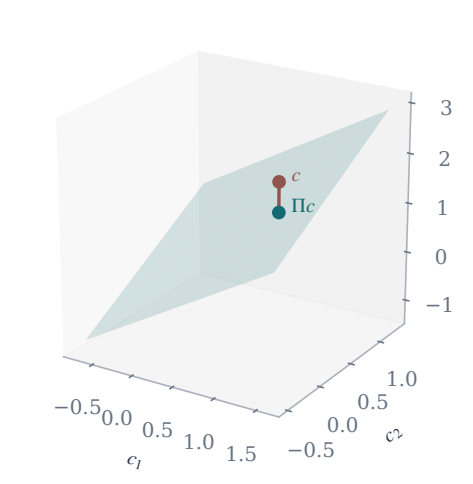
The shaded plane consists of coefficient vectors whose third entry is the sum of their first two entries. The off-plane vector is synthesized and analyzed again, landing on that plane. This projection is oblique; the picture does not assert that it is an orthogonal nearest-point projection.
A redundant archive. Take \(X={\mathbb R}^2\), \(C={\mathbb R}^3\) and
Then \(\Pi(c_1,c_2,c_3)=(c_1,c_2,c_1+c_2)\). The shaded plane is the set of realizable coefficients. The red segment shows synthesis followed by reanalysis of an inconsistent vector.
The mathematical point
A left inverse determines an idempotent consistency map. Here it is oblique: \(\Pi\) is not self-adjoint. Orthogonality requires an additional hypothesis.
Scope
For bounded linear maps on normed spaces, \(\|S\|\) controls amplification of coefficient errors. Exact invertibility by itself gives no conditioning guarantee.
Formal route
Realization.lean; norm estimates in Normed.lean.