Large Signal Model · Plate 9 of 17

What four observations identify

Data span, closure and coverage are separate checks.

Question to keep in view. What does a finite set of observations actually identify?

Resources & source

Original PDF page · Atlas source

Skip contents and start reading

The running example begins \(1,\tfrac12,\tfrac12,\tfrac{11}{24},\tfrac{61}{144}\). Its first four outputs give
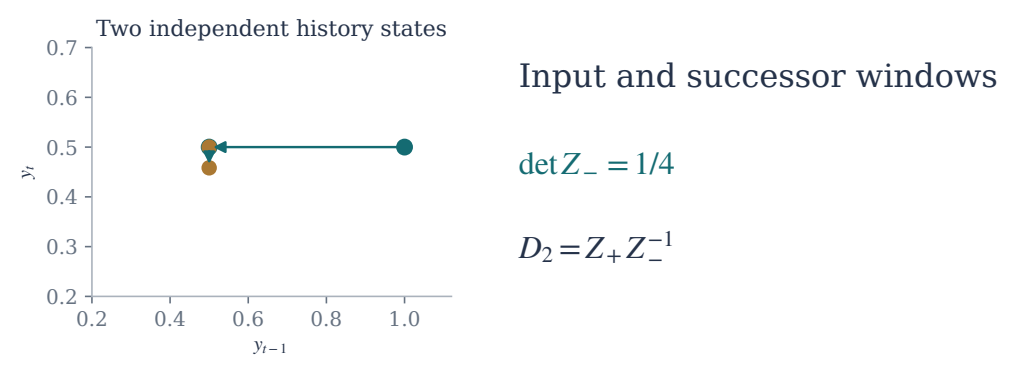
\[ Z_-=\begin{pmatrix}1&1/2\\1/2&1/2\end{pmatrix},\quad Z_+=\begin{pmatrix}1/2&1/2\\1/2&11/24\end{pmatrix},\quad Z_+Z_-^{-1}=\begin{pmatrix}0&1\\1/12&5/6\end{pmatrix}. \]
Paired consecutive outputs spanning the declared two-dimensional delay space.
Read the diagram in words

The two columns of the input delay matrix are independent in the running example. Their paired next columns identify a transition on that input span. Coverage of a larger unknown state space is not established by a finite observed rank.

The determinant \(\det Z_-=1/4\) establishes coverage of the declared two-dimensional delay space. The resulting recurrence is

\[ y_{t+1}=\frac56y_t+\frac1{12}y_{t-1},\qquad t\geq1. \]

For general paired states, a linear fit exists exactly when \(\ker Z_-\subseteq\ker Z_+\). It is unique on \(W={\operatorname{im}} Z_-\), and maps \(W\) to itself exactly when \({\operatorname{im}} Z_+\subseteq W\).

The mathematical point

These data identify the transition on their input span. The known generating system separately certifies that this span is the required full predictive state space.

Scope

Finite sampled rank does not exclude a larger unexcited state space. Finite continuation agreement does not establish unrestricted discovery. Perturbations additionally require a conditioning bound.

Formal route

DelayClosure.lean; DataSpan.lean; see the exact module map at the end.

Follow the proofs

Inspect the mapped Lean modules
Source and reading aids

The atlas text, mathematics, plate order, and original diagrams are retained. Questions, diagram descriptions, navigation, and the bounded comparison explorer are web reading aids. No original TeX build or Lean execution is added.

Source identities and conversion checks

Notation in Large Signal Model

Look up a symbol without leaving this chapter. Select text before opening help to search for it.

Search this work’s notation.

    Symbols can have different meanings in different passages. Read each result in its own context.

    Open the full notation index