
For a known finite family \(L_u\) on a \(d\)-dimensional space, start from the rows of a required observation \(C_0\) and form
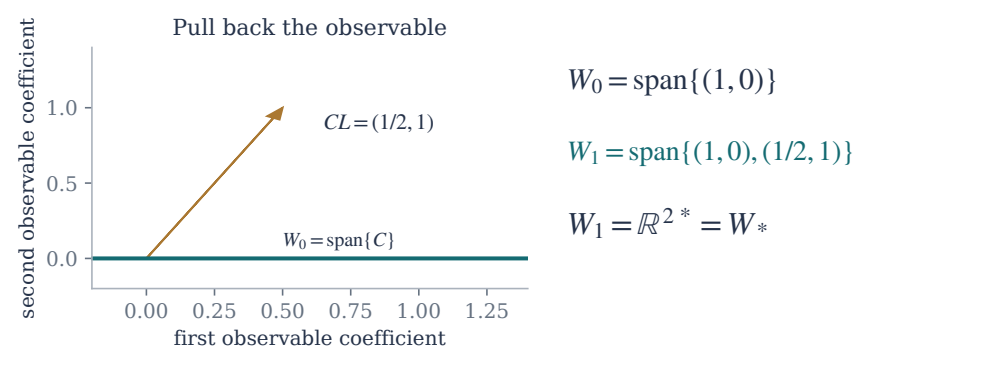
Read the diagram in words
The diagram adds the directions obtained by applying the known dynamics to the requested observation. In this example, the observation and its one-step image span the two-dimensional dual space. The forward observation must actually become available before it can serve as a causal delay state.
Every strict inclusion raises dimension. After at most \(d-\dim W_0\) strict enlargements, the limit \(W_*\) is the least common invariant row space containing \(W_0\).
For the running example, the rows of
span \(W_*={\mathbb R}^{2\,*}\). The state \(Ox_s=(y_s,y_{s+1})^{\mathsf T}\) therefore closes.
The mathematical point
The added coordinate is forced by the action of \(L\) on the requested observable. In a larger system, unobserved directions unrelated to its future can remain outside \(W_*\).
Scope
Computing \(Ox_s\) uses a forward observation. It becomes an available delay state \((y_{t-1},y_t)\) only after a one-step warm-up. Known-operator completion does not establish sensor access to arbitrary new observables.
Formal route
InvariantCompletion.lean; PredictiveCompletion.lean; DelayClosure.lean.