
Assume \(Y_t=\theta_*^{\mathsf T}\phi_t+\xi_t\) with predictable \(\phi_t\), conditional sub-Gaussian noise of scale \(\sigma>0\) and \(\|\theta_*\|_2\leq S\). For ridge \(\eta>0\), define \(V_t=\eta I+\sum_{s\leq t}\phi_s\phi_s^{\mathsf T}\) and \(\widehat\theta_t=V_t^{-1}\sum_{s\leq t}\phi_sY_s\). For \(0<\delta<1\), with probability at least \(1-\delta\), simultaneously for every finite \(t\),
Read the diagram in words
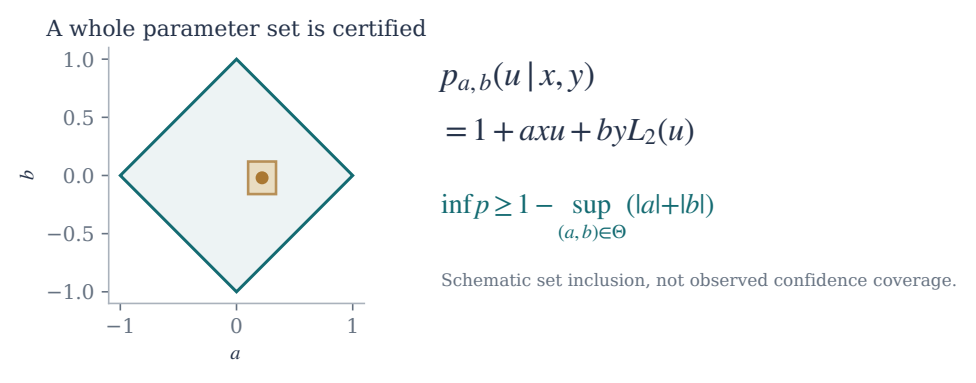
One obligation is statistical: the confidence event must cover the true parameter. The other is algebraic: every parameter returned in the rectangle must satisfy the internal validity certificate. This rectangle is a schematic inclusion picture, rather than a confidence set estimated from observations.
In the structured moment family, a nonempty returned rectangle \(\Theta\) is internally valid when its sufficient floor
is nonnegative. Statistical coverage places the true parameter in \(\Theta\) on a simultaneous event. The exact domain argument applies to every parameter in \(\Theta\).
The mathematical point
A data-selected time is allowed by the simultaneous confidence statement. It does not convert the model, noise or predictability assumptions into observed facts.
Scope
Predictable residual rejection can give a lower discrepancy certificate. Nonrejection alone supplies no upper accuracy guarantee. The drawn rectangle is schematic, not an estimated confidence set.
Formal route
RegressionConfidence.lean; PredictableResidualP66.lean;StructuredLearningCapstone.lean.